What is ASPD (Antisocial Personality Disorder)?

Antisocial Personality Disorder (ASPD) is a clinical diagnosis used to describe a persistent pattern of disregard for the rights, safety, and boundaries of others. It’s not about being “difficult” or having a bad temper. It’s about how someone relates to people, rules, and responsibility over time. Common features include: Repeated lying, manipulation, or deceit Lack of remorse after harming others… Read More What is ASPD (Antisocial Personality Disorder)?

Why Some People Never Understand Abuse

Many people will never truly understand abuse — especially strangulation — unless it happens to them, or to someone they deeply love. Until it affects: Their child Their grandchild Their close friend Their partner Or themselves It remains theoretical. From the outside, people rely on: Comforting beliefs (“surely it wouldn’t go that far”) Denial (“I don’t want… Read More Why Some People Never Understand Abuse

Safe Script for People in Denial or Avoidance

1. Neutral Acknowledgment “I understand this is hard for you to hear.” “I know this is uncomfortable, and that’s okay.” (This acknowledges their feelings without invalidating yours.) 2. State Your Boundary “I cannot continue this conversation if my safety and experience are dismissed.” “I need to focus on protecting myself and my healing right now.”… Read More Safe Script for People in Denial or Avoidance

When People Refuse to Acknowledge Abuse

What’s Really Happening Denial or avoidance is often a defense mechanism. Witnessing abuse is traumatic, and some people cannot process it without distress. Blocking communication or refusing to engage is usually about their discomfort, not your credibility. Even if they have seen abuse firsthand, fear, shame, or unwillingness to intervene can make them pretend it didn’t happen. Why Their Reaction Doesn’t… Read More When People Refuse to Acknowledge Abuse

What to Say to Minimisers of Strangulation or Abuse

1. Keep it Simple You don’t need to explain or justify your feelings. “I experienced this, and it was serious for me.” “My safety and feelings are real.” “I need support, not doubt.” 2. Set Boundaries If someone starts downplaying the abuse: “I don’t need your opinion right now.” “It’s not helpful to minimise my… Read More What to Say to Minimisers of Strangulation or Abuse

Quick Neuroscience Note on Trauma and Safety

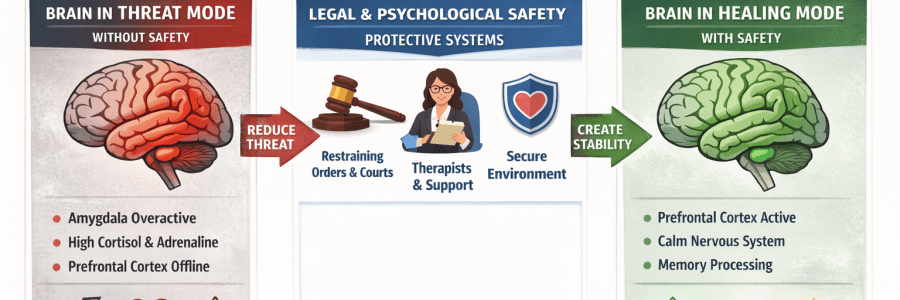
Feeling unsafe, even if not in immediate danger, triggers the amygdala, the brain’s threat detection system. Past trauma can prime the amygdala to react strongly, sometimes to triggers that feel small or subtle. Actual danger activates the body’s full survival system: adrenaline, cortisol, and the freeze/fight/flight responses. Strangulation or other life-threatening abuse pushes this response to the extreme, leaving lasting… Read More Quick Neuroscience Note on Trauma and Safety

Why Minimising Strangulation is Dangerous

Strangulation is not just “a scary moment”. It is a direct, intentional threat to life, even if the person survives. 1. Life-Threatening Behavior Non-fatal strangulation is a strong predictor of future lethal violence. Research shows survivors of strangulation are at much higher risk of homicide or severe injury later. The lack of visible injury does not mean it’s not serious. Internal damage… Read More Why Minimising Strangulation is Dangerous

Effective Therapeutic Approaches

1. Trauma-Focused Therapy Helps the brain process traumatic memories without reliving them fully. Reduces emotional charge, anxiety, and flashbacks. Especially effective for life-threatening trauma like strangulation. Helps survivors reframe thoughts and beliefs formed during abuse. Builds coping skills for fear, anxiety, and hypervigilance. Strangulation trauma often leaves physical nervous system imprints. Therapies like somatic experiencing, sensorimotor psychotherapy, or trauma-informed yoga help release… Read More Effective Therapeutic Approaches

Statistics & Prevalence

Here’s a clear, evidence-based overview of what research shows about non-fatal strangulation — including how common it is, how it affects survivors physically and psychologically, and what we know about how it impacts the person doing the strangulation (to the extent research addresses that). This is grounded in scientific literature and public health data. 📊 Statistics & Prevalence Non-fatal strangulation (NFS) is recognised… Read More Statistics & Prevalence

Talking About Strangulation in Therapy: Why It’s So Hard — and How EMDR Can Help

Talking about strangulation in therapy is not just “talking about a memory.”For many survivors, describing the sensations, fear, and loss of control can reactivate the trauma itself. This is not resistance.It is how the nervous system remembers danger. Why Describing It Feels Overwhelming Strangulation is a primal threat to survival. When it happened, the brain and body… Read More Talking About Strangulation in Therapy: Why It’s So Hard — and How EMDR Can Help