Monitoring Systems & Databases for Domestic Abusers in Europe

What Exists — What Works — What’s Missing 1. Is There an EU-Wide Domestic Abuser Database? Short answer: NO. There is no single EU-wide public or police-accessible registry of domestic abuse perpetrators. However, the EU mandates data collection, risk assessment, and protection order tracking through: European Institute for Gender Equality (EIGE) EU Victims’ Rights Directive EU Directive 2024/1385… Read More Monitoring Systems & Databases for Domestic Abusers in Europe

Domestic Homicide Prevention Strategy

A Trauma-Informed, Public Health & Justice Framework Executive Summary Domestic homicide is predictable, preventable, and systemic. Research consistently demonstrates that domestic homicide is not a sudden act of violence, but the final stage of an escalating pattern of coercive control, psychological abuse, fear-based domination, and trauma entrapment. This strategy proposes a multi-layered prevention model combining: Early detection Neuroscience-based risk profiling… Read More Domestic Homicide Prevention Strategy

Human Rights Legal Analysis

Domestic Abuse as a Violation of Fundamental Human Rights Executive Summary Domestic abuse constitutes a grave and systematic violation of fundamental human rights. Beyond isolated criminal acts, domestic abuse represents a sustained deprivation of safety, dignity, autonomy, bodily integrity, psychological security, and equality before the law. Despite international human rights obligations, many legal systems fail to adequately prevent,… Read More Human Rights Legal Analysis

Legal Reform Recommendations

A Trauma-Informed Framework for Justice in Domestic Abuse Cases Executive Summary Domestic abuse is not a series of isolated incidents — it is a sustained pattern of coercive control and psychological domination that produces long-term neurological, emotional, and socioeconomic harm. Current legal systems largely fail to recognise the cumulative nature of this trauma, leading to: Undercharging Inadequate sentencing Survivor retraumatisation Increased… Read More Legal Reform Recommendations

“Let the Punishment Fit the Crime” — When Justice Fails Survivors of Domestic Abuse

“Let the punishment fit the crime.”— Gilbert & Sullivan, The Mikado A famous line. A clever lyric. A timeless moral principle. And yet, in cases of domestic abuse, this principle too often collapses. When the Law Falls Short In many justice systems, domestic abuse is still: Minimised Undercharged Under-sentenced Or psychologically misunderstood Survivors frequently face: Burdens of proof… Read More “Let the Punishment Fit the Crime” — When Justice Fails Survivors of Domestic Abuse

Trauma-Informed Risk Assessment Framework

This framework helps evaluate risk levels in relationships or environments where abuse and compulsive/ritualistic behaviours intersect. 1️⃣ Assess the Type and Severity of Abuse Abuse Type Key Indicators Risk Implication Physical Hitting, choking, pushing, slapping Immediate risk of injury or escalation Emotional / Mental Gaslighting, verbal threats, humiliation High risk of psychological trauma, anxiety, PTSD Financial Controlling… Read More Trauma-Informed Risk Assessment Framework

Protecting Your Rights: A Psychological and Moral Imperative

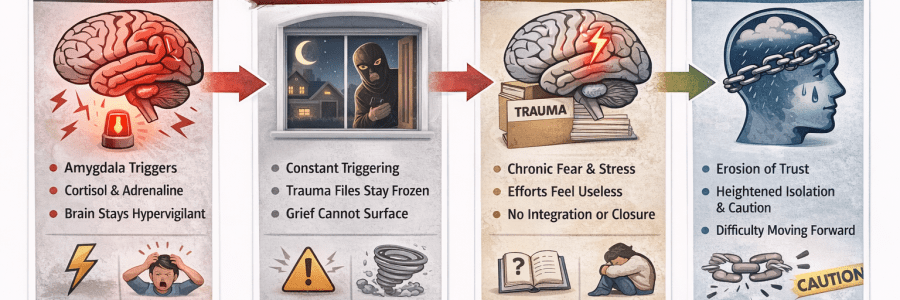
When your autonomy is restricted or your safety threatened, the brain’s stress systems (amygdala, hypothalamic-pituitary-adrenal axis) become chronically activated. This leads to heightened anxiety, hypervigilance, and emotional dysregulation. Chronic deprivation of freedom, through manipulation or coercion, can create learned helplessness, where the brain begins to expect that action is futile. This can impair decision-making, motivation, and cognitive flexibility, making… Read More Protecting Your Rights: A Psychological and Moral Imperative

“This Isn’t New — It’s the Same Game in a Different Arena”Why Long-Term Mind Games Continue After Separation

When you’ve lived with decades of psychological manipulation, the most destabilising part isn’t the behaviour itself. It’s the moment you realise:This is just a continuation of the same pattern. Different setting.Different language.Same impact on your nervous system. That recognition is not bitterness.It’s pattern recognition. What Kind of Person Does This? From a trauma-informed and neuroscience perspective,… Read More “This Isn’t New — It’s the Same Game in a Different Arena”Why Long-Term Mind Games Continue After Separation

How to Deal With This Without Going Crazy(A Trauma-Informed, Neuroscience-Based Guide)

First, an important reframe: If you feel anxious, angry, hyper-alert, exhausted, or mentally foggy in this situation, you are not “going crazy.”Your nervous system is responding normally to an abnormal level of prolonged uncertainty and control. The goal is not to “stay calm.”The goal is to stay regulated enough to function and protect yourself. 1. Stop Treating This… Read More How to Deal With This Without Going Crazy(A Trauma-Informed, Neuroscience-Based Guide)

If your abuser shows up — step-by-step plan (Spain-adapted)

Immediate safety (first 60 seconds) Speak through the door or intercom if you must. Do not let them in. Your home is inviolable; you do not have to open. Emergency: 112 (all emergencies) Policía Nacional: 091 Guardia Civil: 062 If you’re in immediate danger, say “I’m in immediate danger, please send the police to [your address] now.” Call 016 for domestic-violence support (confidential)… Read More If your abuser shows up — step-by-step plan (Spain-adapted)