🧠 1. The neuroscience of denial: fear and self-protection
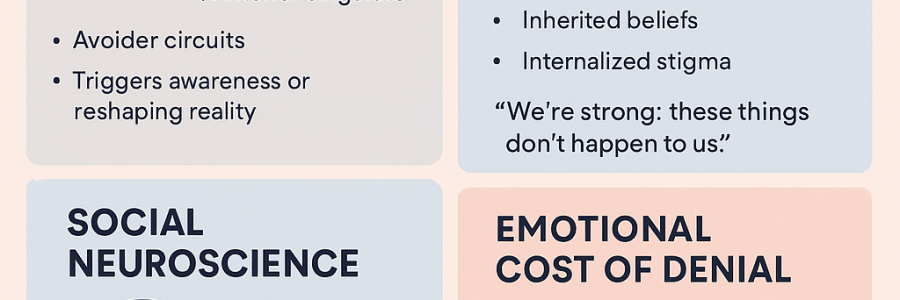
Denial is not just psychological — it’s neurobiological.When the brain encounters something threatening to identity, reputation, or emotional safety, the amygdala (fear center) and anterior cingulate cortex (conflict detector) activate.This triggers avoidance circuits — the brain unconsciously blocks awareness or reshapes reality to reduce emotional pain. In other words: “If I don’t admit it, I don’t have to feel it.” The brain… Read More 🧠 1. The neuroscience of denial: fear and self-protection

🧠 1. Family psychology

Families may: Use medication as an easy explanation for behaviour they don’t understand (“he’s acting strange → must’ve stopped his pills”). Avoid deeper emotional or relational issues by focusing only on the medical angle. It feels “safe,” but it can invalidate the person’s real experiences or distress. Sometimes, it’s fear-driven — they remember past crises linked to stopping medication… Read More 🧠 1. Family psychology

🧠 1. What happens in the brain (neuroscience perspective)

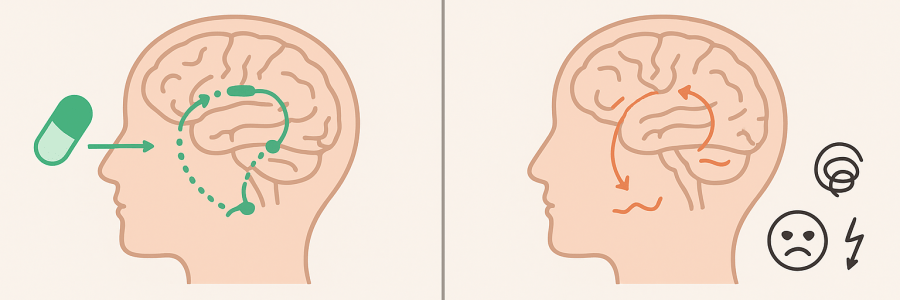
Antipsychotic medication (used for conditions like schizophrenia, schizoaffective disorder, or severe bipolar disorder) works by regulating dopamine and sometimes serotonin activity in key brain circuits — especially those involving: The prefrontal cortex (thinking, planning, judgment) The limbic system (emotion and fear regulation) The striatum (motivation and reward) When you’ve been on these medications for years, your brain adapts to their presence: Receptors adjust (for example,… Read More 🧠 1. What happens in the brain (neuroscience perspective)

“The Look That Never Lied: The Psychology of Hatred and Survival”

You can see the pattern in every picture — birthdays, holidays, celebrations.The smiles around you are bright, the music is playing, yet beside you is that same expression: a cold, hostile glare that never softens.Even on his own birthday, surrounded by friends, the cake lit and the room full of warmth, his eyes stayed fixed… Read More “The Look That Never Lied: The Psychology of Hatred and Survival”

“The Psychology of Projection: When the Real Controller Says ‘They’re Trying to Control You’”

You heard it over and over:“They’re trying to control you.”Your family. Your friends. Anyone who cared about you —he cast them all as the enemy. But in truth, it was never them.It was him. Psychologically, this is a classic tactic of projection — one of the most common defense mechanisms in controlling or narcissistic personalities.Projection happens when a person… Read More “The Psychology of Projection: When the Real Controller Says ‘They’re Trying to Control You’”

“After Control: The Neuroscience of Finally Living as You Choose”

For years, you went everywhere alone.Weddings, dinners, birthdays, the Camino de Santiago —always the one who showed up, smiled, and stood alone.But he never came — not to celebrate, not to walk beside you.You attended masonic dinners, family events, special moments — mostly  without him. For three decades, the pattern never changed.The only things you… Read More “After Control: The Neuroscience of Finally Living as You Choose”

“When They Never Come: The Psychology of Avoiding What You Love”

Moraira.Perth, Australia.Bournemouth.Puerto Banús.The places your daughter and grandchildren lived.The places filled with laughter, warmth, and belonging. And he never came.Not once. Not to visit. Not to share a meal, a beach, a moment.Always an excuse — too hot, too far, too boring, too Benidorm. It speaks volumes. Because in psychology, avoidance is rarely about disinterest — it’s… Read More “When They Never Come: The Psychology of Avoiding What You Love”

“When the Abuser Moves to Your Dream: The Psychology Behind Suddenly Wanting Moraira”

There’s a certain kind of cruelty that isn’t loud — it’s symbolic.Ten years ago, Moraira was your dream: sunshine, family, peace.He never wanted to come. He criticized Spain — too hot, too tacky, too Benidorm.He dismissed your joy because it wasn’t his. But now, suddenly, it’s his place.He visits, settles, even claims it as though the dream was always… Read More “When the Abuser Moves to Your Dream: The Psychology Behind Suddenly Wanting Moraira”

“The Girl on the Train: When Truth Sounds Too Unbelievable”

Have you ever felt like The Girl on the Train — gaslit by reality, watching your own story unfold from the outside, wondering if anyone will ever believe you? In Paula Hawkins’ novel — and the film that followed — Rachel’s truth was buried beneath disbelief. Her pain was rewritten by others, her memory questioned, her credibility… Read More “The Girl on the Train: When Truth Sounds Too Unbelievable”

Article 183 bis of the Spanish Penal Code

Article 183 bis of the Spanish Penal Code deals with the sexual exploitation of minors through digital or electronic means, commonly referred to as grooming. What it covers It criminalizes anyone who, using the internet, phone, or other communication technologies, contacts a minor under 16 years old with the intention of arranging a meeting to commit sexual offenses (as described in… Read More Article 183 bis of the Spanish Penal Code