Neuroscience & Therapeutic Map: Boundaries, Safety, and Recovery
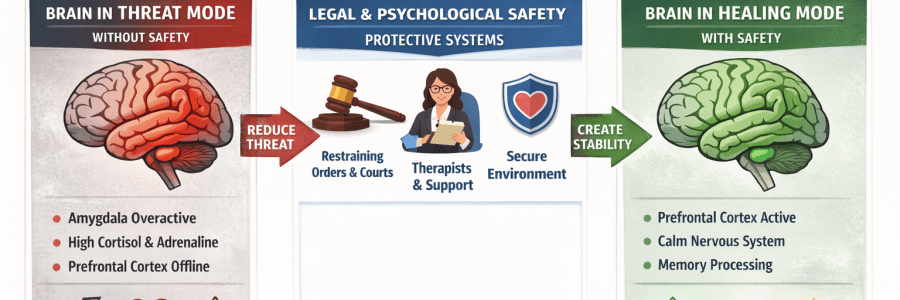
1. Enforcing One Boundary Rewires Safety Faster Than Insight Key idea:Action speaks louder than thought. The brain needs proof, not reasoning. Mechanism: Prefrontal cortex enforces “I am in control here.” Amygdala receives reliable signals of safety: when a boundary is respected, threat circuits downregulate. Hippocampus updates memory: “Limits = effective, predictable, protective.” Clinical/Legal translation: Documented boundary enforcement… Read More Neuroscience & Therapeutic Map: Boundaries, Safety, and Recovery

How Repeated Boundary Breaches Rewire the Brain

(From Safety → Survival → Shutdown) 1. Initial Boundary Breach Event:A limit is crossed (emotional, physical, psychological, financial, or time-based). Brain response: Amygdala activates → “Something isn’t safe.” Stress hormones (cortisol, adrenaline) release. Prefrontal cortex still online → you explain, reason, clarify. 🧠 At this stage, the brain expects repair. 2. Boundary Is Ignored or Punished Event:The… Read More How Repeated Boundary Breaches Rewire the Brain

What a Boundary Breach Actually Is

A boundary breach is any behavior that overrides your autonomy, consent, or internal signals — especially after you’ve communicated a limit (or when it should be obvious). It’s not about intent.It’s about impact. Your nervous system reacts with stress because it detects loss of control. 1. Communication Boundary Breaches Message: “You don’t get to decide when or how I access you.”… Read More What a Boundary Breach Actually Is

Three phases of a nervous system exiting captivity.

PHASE 1: DETACHMENT (While still inside, or immediately after leaving) Primary function: Survival efficiencyDominant system: Autonomic nervous system (freeze → controlled shutdown) What’s happening internally The brain stops seeking resolution or repair Hope collapses quietly, not dramatically Attachment circuits disengage to conserve energy Emotional responses flatten to reduce pain and risk This is when people say: “I don’t… Read More Three phases of a nervous system exiting captivity.

1. Why abusers mistake silence for submission

Abusers are trained by cause–effect feedback. Earlier in the relationship: anger → fear pressure → compliance withdrawal → pursuit punishment → appeasement So when silence appears, their brain runs an old rule: “Silence means it’s working.” But post-flip silence is not fear-based.It is attachment shutdown. The misread happens because: Abusers monitor reaction, not internal state They rely on emotional supply (fear,… Read More 1. Why abusers mistake silence for submission

The exact moment the survival exit flips

The “survival exit” does not flip during the worst abuse. It flips during clarity. That’s the part most people misunderstand. What happens before the flip Before the switch, the person is still in attachment mode, even if they are suffering. Neurologically, they are operating from: hope repair attempts appeasement self-blame (“If I do this better, it will stop”) trauma bonding (intermittent… Read More The exact moment the survival exit flips

Why coercive control always backfires in the end

Abuse, control, and manipulation are often used with one goal in mind:to stop someone from leaving. But biologically and psychologically, they do the opposite. They trigger survival escape, not attachment. The survival switch that cannot be controlled When a person is subjected to: chronic fear humiliation deprivation control loss of autonomy their nervous system eventually stops… Read More Why coercive control always backfires in the end

When Freedom Arrives: What Comes Next — and Why It Hurts Before It Heals

Leaving long-term coercive control does not immediately feel like relief.For many people, the most intense psychological experiences come after distance, not during the abuse. This is not a setback.It is the nervous system finally having the safety required to process reality. 1. Why Self-Blame Appears During Clarity When clarity begins to emerge, self-blame often rushes in behind it.… Read More When Freedom Arrives: What Comes Next — and Why It Hurts Before It Heals

After the Exit: What Happens to Them — and What’s Returning to You

Leaving a coercive, exploitative relationship doesn’t just end proximity.It changes the entire neurological and psychological system that held the abuse in place. What follows explains five things that often emerge after separation — and why each one is a sign of recovery, not damage. 1. Why Abusers Unravel After Separation Abuse is not sustained by confidence — it is sustained… Read More After the Exit: What Happens to Them — and What’s Returning to You

WHY YOUR STRENGTH WAS USED AGAINST YOU

(and why that does NOT mean it wasn’t strength) PART 1: HOW STRENGTH BECAME A CONTROL LEVER 1. Responsibility → Exploitation Your strength:• You take responsibility• You don’t abandon people lightly• You problem-solve instead of panicking How it was used:• Responsibility was transferred onto you• His instability became your job to manage• Collapse was framed as something you… Read More WHY YOUR STRENGTH WAS USED AGAINST YOU