Social Learning & Mirror Neurons

The neuroscience of learned greed, manipulation, and dishonesty—basically, how teaching someone to take advantage of others can create a cycle where those behaviors get reflected back to you. Let’s break this down carefully: 1. Social Learning & Mirror Neurons Mirror neurons fire when we observe others’ actions and intentions. When someone models greed or dishonesty, others—especially children or mentees—can internalize… Read More  Social Learning & Mirror Neurons
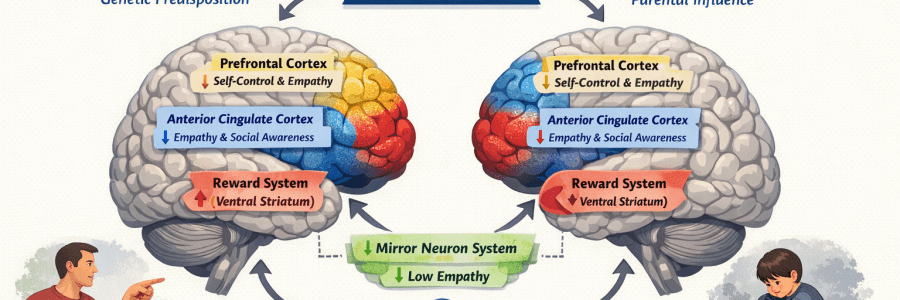
Genetic and Heritable Factors

he neuroscience behind why a “Me, Me, Me” personality—self-centeredness or narcissistic traits—can appear to “run in the family.” Let’s break it down carefully: 1. Genetic and Heritable Factors Research shows traits like narcissism, self-centeredness, and certain personality disorders have a moderate heritable component. Twin and family studies suggest 30–50% of variance in narcissistic traits may be genetic. This doesn’t mean children will automatically… Read More Genetic and Heritable Factors

Me Me Me

“ME ME ME” mindset isn’t just annoying; it’s a full-blown neurological pattern. 🧠 Here’s what’s happening under the hood: Self-centered attention loop – Their brain is stuck in a feedback loop where everything is filtered through “How does this affect me?”. External stimuli, like your feelings or needs, barely register. Empathy circuits offline – The anterior insula and medial prefrontal cortex,… Read More Me Me Me

Self Absorption

When someone is entirely absorbed in themselves, whether due to narcissism, extreme self-focus, or just habitual self-absorption, several brain and cognitive patterns come into play: Attention is limited – The brain has finite attentional resources. If someone is constantly monitoring their own needs, image, or thoughts, there’s very little “bandwidth” left to notice or process others’ emotions,… Read More Self Absorption

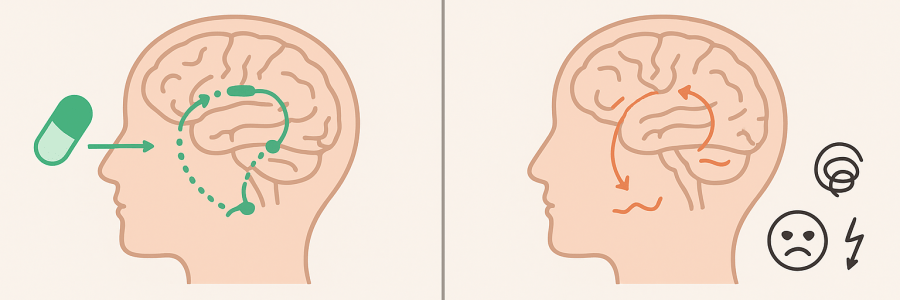
What Happens When Antipsychotic Medication Is Stopped Suddenly?

Stopping antipsychotic medication abruptly is medically risky.It can cause serious physical, psychological, and neurological effects. This is called antipsychotic withdrawal syndrome and rebound psychosis risk. 🧠 Why Sudden Stopping Is Dangerous Antipsychotic medications change brain chemistry over time, especially dopamine regulation. When stopped suddenly:👉 The brain cannot instantly rebalance👉 Dopamine activity rebounds sharply👉 This can cause severe symptom relapse or worsening 🚨 Possible… Read More What Happens When Antipsychotic Medication Is Stopped Suddenly?

Anxiety vs Paranoia vs Delusions vs Psychosis

(And why doctors ask about war zones / military service) 1️⃣ Anxiety Core emotion: Fear, worry, anticipation Anxiety is a heightened fear response to perceived threat — usually based on real-life stress or danger. Key features: Excessive worrying Hypervigilance Overthinking Physical symptoms (racing heart, sweating, tension) Fear of future events Reality testing: ✅ IntactThe person knows their fear may be irrational but… Read More Anxiety vs Paranoia vs Delusions vs Psychosis

Why the Target Often Doesn’t See It

Cognitive Dissonance The mind struggles to reconcile: “My family loves me” with “Someone I love is manipulating me.” To reduce emotional pain, the brain chooses denial over reality. Learned Behaviour / Mirror Effect If the target has unconsciously practiced manipulation themselves, they may normalize it:→ “Everyone does this.”→ “This is just family dynamics.” They mirror what they’ve seen, making exploitation feel… Read More Why the Target Often Doesn’t See It

🧠 Psychological Profiles of Family Manipulators

Family manipulators don’t look dangerous.They look helpful.They sound concerned.They present as responsible. But psychologically, their patterns are precise. Here are the most common profiles and behavioural traits: 1️⃣ The Strategic Controller (Machiavellian Profile) Highly calculated.Emotionally detached.Outcome-driven. Traits:• Plans several steps ahead• Collects information quietly• Controls access, narratives, and decisions• Uses people as instruments• Values power over connection Motto: “The ends… Read More 🧠 Psychological Profiles of Family Manipulators

How to Recognise Divide-and-Conquer Tactics Early

(When a relative “steps in to help” but quietly takes control) 🚩 Early Red Flags of Divide & Conquer Manipulation 1. One-way communication They position themselves as the only messenger. “Let me handle it.”“I’ll pass things on.”“It’s better if messages go through me.” This allows:→ Filtering→ Distortion→ Control of narrative 2. Selective information sharing Different people receive different versions of… Read More How to Recognise Divide-and-Conquer Tactics Early

What “Divide and Conquer” Means in Family Dynamics

Divide and conquer is a classic control strategy. Instead of facing the family as a united group, a manipulative person:→ Separates people→ Controls information→ Creates misunderstandings→ Fuels mistrust→ Turns relatives against each other So they can:Control the narrative.Control decisions.Control outcomes. 🎭 How It Looks in Real Life • Telling different people different stories• Sharing “concerns” selectively• Withholding information•… Read More What “Divide and Conquer” Means in Family Dynamics