Cruel people don’t always reveal themselves straight away.

Sometimes they’re charming. Funny. Engaging.And then—slowly—you start to feel it. Not in what they say at first, but in how you feel after. 🚩 You feel smaller, not supported🚩 Your feelings get dismissed or mocked🚩 “Jokes” leave a sting instead of laughter🚩 Boundaries are pushed, then ignored🚩 Accountability is replaced with blame Cruelty isn’t always… Read More Cruel people don’t always reveal themselves straight away.
⚖️ Cruelty vs Abuse — What’s the Difference?

Here’s a clean, clear comparison you can use to spot the difference between cruel behaviour and abuse patterns—they overlap, but they’re not always identical. ⚖️ Cruelty vs Abuse — What’s the Difference? Area Cruelty Abuse Definition Intentional behaviour that causes emotional or physical pain A pattern of behaviour used to control, dominate, or harm another person Frequency Can be occasional… Read More ⚖️ Cruelty vs Abuse — What’s the Difference?

Real cruelty is something else entirely.

Not everything that looks like cruelty is the same—and understanding the difference matters more than people think. There’s a world of difference between consensual power dynamics and real cruelty or abuse, and the line between them isn’t blurred when you know what to look for. In healthy, consensual dynamics, everything is built on:– Clear, ongoing consent– Mutual respect– Emotional safety–… Read More Real cruelty is something else entirely.

🧠 When cruelty can be arousing

In certain contexts, the brain can link power, dominance, or intensity with sexual arousal: 1. Power and dominance Feeling in control can activate the brain’s reward system (dopamine) For some, dominance becomes associated with arousal over time 2. Adrenaline and arousal crossover Fear, tension, and excitement all activate the sympathetic nervous system The brain can sometimes “mislabel” that heightened… Read More 🧠 When cruelty can be arousing

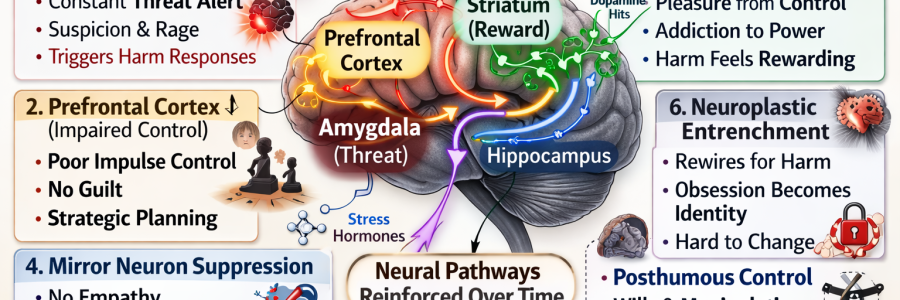
🧠 The Neuroscience of Cruelty

Cruelty isn’t just a moral idea—it has roots in how the brain processes threat, empathy, power, and control. When you look at it through both neuroscience and psychology, a clearer (and less mysterious) picture emerges. 🧠 The Neuroscience of Cruelty At a brain level, cruelty often reflects an imbalance between systems that generate emotion and those that regulate it. 1.… Read More 🧠 The Neuroscience of Cruelty

Cruelty When No One’s Watching

In a lesser-known series of experiments within Social Psychology, researchers explored a simple but uncomfortable question: What do people do when they believe no one is watching? What they found challenges the comforting belief that cruelty is rare or limited to “bad people.” When anonymity increases, accountability drops. And when accountability drops, a small but significant number… Read More Cruelty When No One’s Watching

Why some cases are fast—and others take a long time

🚨 1. Urgency / immediate risk level (biggest factor) Fast cases happen when: A child is currently at risk There is active contact with a suspect Police believe harm may be ongoing 👉 These can move within hours to days Slower cases happen when: Risk is not immediate Evidence is historical (already happened) No identified victim at… Read More Why some cases are fast—and others take a long time

How long does it take (typical timeline in Spain)?

🚨 1. Initial report → opening investigation Time: Same day to a few days Report received (police, INCIBE 017, school, or victim disclosure) Risk is assessed immediately Devices may be seized quickly if there is urgency 👉 In urgent child protection cases, action can be within hours 💻 2. Forensic extraction of devices Time: 2 weeks to 3+ months (sometimes… Read More How long does it take (typical timeline in Spain)?

How encrypted apps are investigated in Spain (legally)

🧠 1. Key principle: encryption is not “broken casually” Spanish police and cybercrime units do not simply “open” encrypted messages. Instead, investigations rely on: legal authorisation (judge-approved warrants) device forensics metadata and surrounding evidence lawful data requests to companies 👮‍♂️ 2. Device seizure (most important step) If a phone or computer is lawfully seized: Authorities can: Extract messages… Read More How encrypted apps are investigated in Spain (legally)

After a forensic report in Spain: step-by-step process

🧾 1. Forensic report is produced Specialist cybercrime officers (Policía Nacional or Guardia Civil) analyse devices in a lab They create a forensic report (informe pericial) recovered files chat logs metadata (dates, devices, accounts) links to other users or platforms 👉 This report becomes formal legal evidence 👮 2. Case assessment by investigators Once the report is ready: Officers… Read More After a forensic report in Spain: step-by-step process