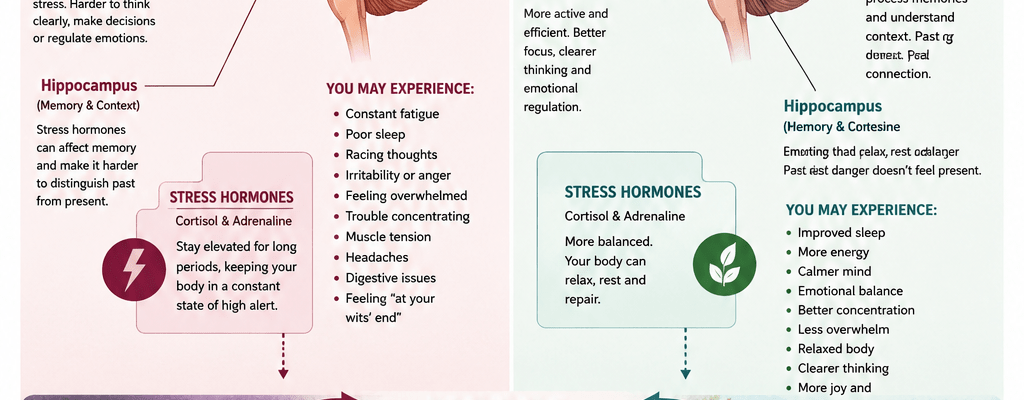
When you’ve been living with prolonged stress, trauma, or abuse, constant exhaustion isn’t because you’re weak—it’s because your brain and body have been working overtime for months or even years.
Here’s what is happening in the brain and nervous system:
1. Your Brain Is Constantly Scanning for Danger
constantly transmit signals through brain networks involved in threat detection.
The amygdala, the brain’s alarm system, becomes overactive. Instead of switching off when danger has passed, it continues asking:
- Is something about to happen?
- What mood are they in?
- Am I safe?
- What have I missed?
This state is called hypervigilance.
It’s like having a smoke alarm that goes off every few minutes, even when there’s no fire.
2. Your Stress Hormones Stay Elevated
Your body releases stress hormones such as cortisol and adrenaline.
These hormones are designed to help you survive emergencies by:
- Increasing heart rate
- Raising blood pressure
- Sharpening attention
- Preparing your muscles to fight or run
They’re incredibly useful in the short term.
But when they remain elevated for months or years, they become exhausting.
Your body never gets the message that it’s safe to relax.
3. Your Brain Uses Huge Amounts of Energy
Although your brain makes up only about 2% of your body weight, it uses roughly 20% of your body’s energy.
When it’s constantly monitoring your environment for danger, analysing conversations, anticipating conflict, and planning escape strategies, it burns enormous amounts of energy.
That’s one reason survivors often feel mentally exhausted, even if they’ve done very little physically.
4. Your Prefrontal Cortex Gets Overloaded
The prefrontal cortex, which helps with planning, decision-making, concentration, and emotional regulation, becomes less efficient under chronic stress.
You may notice that you:
- Forget things
- Lose concentration
- Feel indecisive
- Can’t think clearly
- Become overwhelmed by simple decisions
This isn’t because you’re incapable.
It’s because your brain has prioritised survival over higher thinking.
5. Your Nervous System Rarely Switches Into Rest Mode
Your autonomic nervous system has two key modes:
- Sympathetic – fight, flight, or survival.
- Parasympathetic – rest, digest, recover, and repair.
During prolonged abuse or chronic stress, many people spend far too much time in sympathetic activation.
That means your body is always “on.”
Your muscles stay tense.
Your breathing becomes shallow.
Sleep is often poor.
Digestion can be affected.
Even when you’re sitting quietly, your body may still behave as though danger is nearby.
Then Healing Begins…
As you begin to feel safe, your brain slowly changes.
The amygdala becomes less reactive.
Stress hormone levels become better regulated.
The prefrontal cortex regains its ability to think clearly.
Your parasympathetic nervous system spends more time in control.
Your sleep improves.
Your body repairs itself more effectively.
Your mind becomes clearer.
And perhaps most noticeably…
The constant exhaustion begins to lift.
You don’t suddenly become full of energy overnight, but you realise you’re no longer running on empty.
You wake up with more motivation.
Simple tasks no longer feel impossible.
You stop feeling permanently “at your wits’ end.”
That’s not just feeling better.
It’s a sign that your brain and nervous system are beginning to recover.
As a trauma therapist, this is one of the most rewarding changes I see in people. They often tell me, “I thought I was lazy or broken. I didn’t realise my brain had been trying to protect me all those years.” Understanding the neuroscience can replace self-blame with self-compassion and hope.


