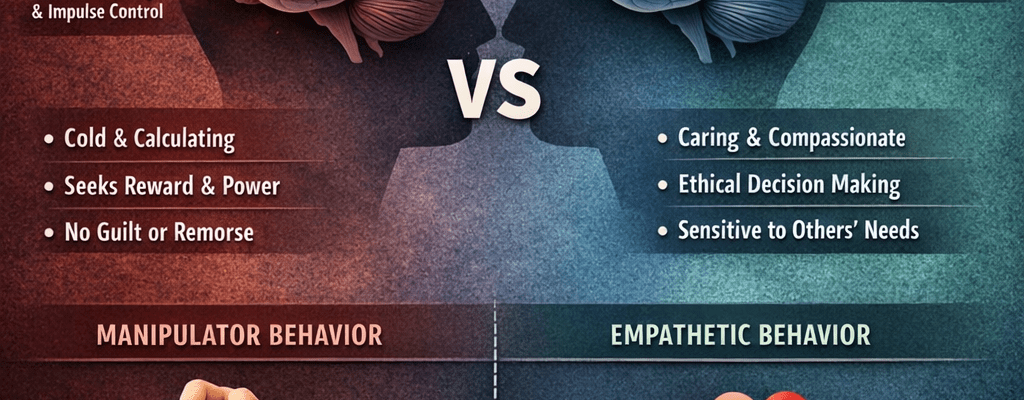
From a neuroscience perspective, the difference is often not that one person has a “bad brain” and another has a “good brain.”
It is more about how certain brain systems work together — especially the systems for:
- empathy
- emotional regulation
- fear/anger response
- conscience
- impulse control
1. The brain of someone who may become abusive
Research shows some abusive or violent people can have:
Overactive threat system
The amygdala (the brain’s alarm center) can react too strongly.
This means they may:
- feel easily threatened
- misread neutral situations as rejection
- become angry very quickly
- see disagreement as danger
Instead of hearing:
“I need space.”
Their brain may hear:
“You are being abandoned or disrespected.”
(PubMed)
Weaker emotional brakes
The prefrontal cortex helps control impulses.
In abusive individuals, this area can show poorer regulation of anger.
That can lead to:
- explosive reactions
- blaming others
- inability to calm themselves
- acting before thinking
Think of it as:
strong accelerator + weak brakes
(PMC)
Reduced empathy circuits
Some people who harm others show less activation in areas involved in:
- feeling another person’s pain
- guilt
- compassion
- emotional resonance
That means they may intellectually understand:
“You are hurt”
but not deeply feel:
“I caused that pain.”
(PMC)
2. The brain of someone who would not abuse
A non-abusive person often shows stronger function in:
Healthy empathy network
They can sense:
- your pain
- your fear
- your emotional state
Their brain naturally says:
“I don’t want to hurt someone I love.”
Strong self-regulation
Their frontal brain helps them:
- pause before reacting
- tolerate frustration
- manage jealousy
- calm anger
They may feel anger, but they can still choose:
control instead of harm
Secure attachment response
Their nervous system does not interpret closeness as danger.
So conflict feels like:
“we need to solve this”
not
“I need to dominate this.”
3. One of the biggest differences
The deepest difference is often:
Abusive brain:
Pain → fear → control → aggression
Healthy brain:
Pain → reflection → empathy → repair
4. Important point
Neuroscience also shows:
A person can have trauma, anger, or a difficult childhood
and still never become abusive.
Brain tendencies are not destiny.
Choice still matters.
Some people feel rage and choose:
“I must not become the person who hurts others.”
Others choose control.
5. What survivors often notice first
Before physical abuse, the nervous system difference often appears as:
Abusive people often show:
- lack of remorse
- coldness after hurting you
- turning blame onto you
- calm after causing your distress
Because your pain can regulate their internal chaos.
That is one of the most damaging patterns.
6. The simplest neuroscience difference
You could say it like this:
Non-abusive person
“Your pain stops me.”
Abusive person
“Your pain does not stop me.”

