A Busy Night on the website
Most viewed Posts & pages Views
Trauma refers to an emotional or psychological response to an event or series of events that are distressing or disturbing, often exceeding an individual’s ability to cope. Traumatic experiences can be diverse and may include situations such as accidents, natural disasters, physical or sexual assault, combat, or the sudden loss of a loved one. Trauma can have a profound impact on an individual’s mental, emotional, and physical well-being, leading to a range of symptoms and challenges.
Most viewed Posts & pages Views
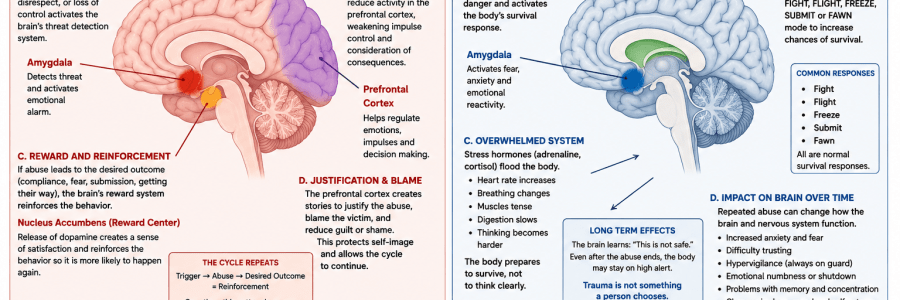
The Neuroscience and Psychology Behind Manipulation and Accountability Lies. Tears. Claims of illness.Cancer. Mental health struggles.Every excuse under the sun. These are often used to explain, justify, or deflect from behaviour that is physically, emotionally, and financially abusive. Let’s get one thing absolutely clear: Abuse is abuse. It is not an illness.It is not an… Read More Abuse Is Not an Excuse
A Neuroscience Perspective on Blame, Denial, and Repeated Abuse We live in a time where many women are still not believed—sometimes not even until it is too late. And even then, the questions begin: Why didn’t she leave earlier?What did she do to push him that far? This happens even when there is a clear… Read More Why Women Are Still Not Believed
A Neuroscience Perspective on Awareness, Denial, and Accountability Many people only recognise the seriousness of abuse when it affects someone close to them. But by then, the damage is already done. Awareness, honesty, and accountability must come sooner—not later. Because ignoring abuse does not make it disappear—it allows it to continue. The Brain Prefers Comfort… Read More Why We Ignore Abuse—Until It’s Too Late
Even when there are restraining orders, criminal charges, or clear evidence of domestic abuse, some people still defend or minimise the abuser’s behaviour. This can feel shocking, especially to someone who knows the truth. 1. Psychological denial People sometimes go into denial because the reality is too uncomfortable to accept. If the abuser is: …then accepting… Read More Why do people protect an abuser?
How to identify risk patterns safely and early in someone’s behaviour, which is actually more reliable than gossip or partial stories. 🚩 Strong early warning signs of financial / emotional / physical abuse risk 🔹 1. Extreme control tendencies early on 👉 Control is usually the foundation pattern 🔹 2. History where “everyone else is the problem”… Read More Identify risk patterns safely and early
🔹 1. Fast “hooking” behaviour (love bombing) 👉 Purpose: create fast attachment so boundaries weaken 🔹 2. Instant emotional mirroring 👉 Healthy connection takes time — instant “perfect fit” is often manufactured 🔹 3. Boundary testing disguised as charm 👉 If small boundaries are ignored early, bigger ones will be too 🔹 4. Controlled identity… Read More Early signs of a predatory / highly manipulative dating pattern
Some people entering new relationships may not show abusive behaviour openly at first. Instead, they may hide it behind a carefully managed story and image. Be aware of these possible patterns: 🚩 1. Carefully controlled “victim story” They may present themselves as: 👉 This can be used to shape how others see them before the truth is… Read More WARNING: Hidden Abuse in New Relationships (Covert Control Tactics)
Being with someone secretive or inconsistent for decades can leave deep patterns in your brain and behavior, and neuroscience and psychology actually explain a lot about why it’s so disruptive and how to heal. Let’s break it down carefully: 1. Why secretive behavior messes with your head 2. What drives someone to be secretive 3. The neuroscience of… Read More Uncertainty activates the brain’s alarm system
Recovering from trauma or difficult life experiences is rarely linear. Emotional ups and downs, confusion, and uncertainty are normal, but what often helps most is the people you surround yourself with. Spending time with supportive friends and family isn’t just comforting—it can actively regulate your emotions, reinforce healthy coping strategies, and complement professional therapy. Why Connection Matters… Read More The Healing Power of Connection: How Time with Friends and Family Supports Emotional Recovery