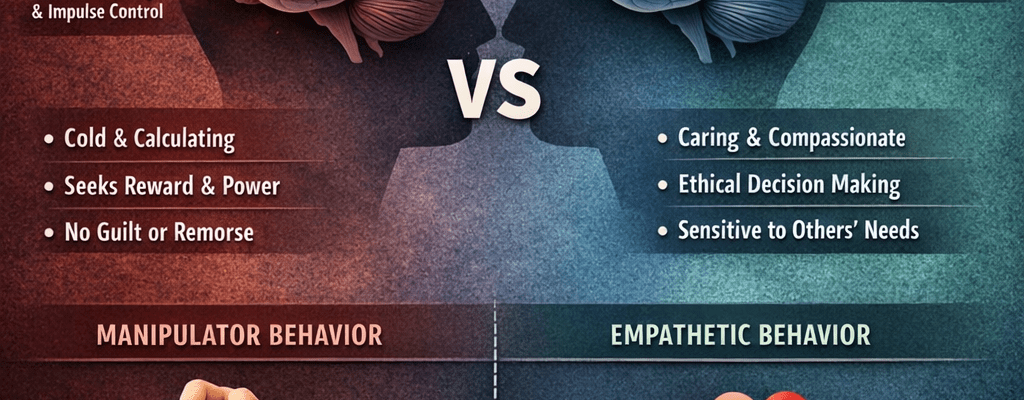
1. Control is used as emotional regulation
Many abusive behaviours function as a way to manage internal discomfort.
Brain systems involved:
- amygdala (threat + emotional reactivity)
- prefrontal control systems (planning, inhibition)
Pattern:
- distress → attempt to regain control over another person
- dominance reduces internal anxiety short-term
So control becomes:
a regulation strategy, not just behaviour
2. Reward system reinforces dominance
When controlling behaviour “works” (the other person complies, stays, or becomes fearful), the brain can reinforce it.
- dopamine system
Pattern:
- coercion → compliance → relief/reward feeling
- this reinforces the behaviour loop
This is why coercive behaviour can escalate over time.
3. Emotional empathy is often selective or shut down under threat
Not always absent, but often distorted.
Patterns can include:
- high empathy for self
- low empathy for partner’s emotional reality during conflict
- justification of harm (“they made me do it”)
This is linked to stress-driven narrowing of perspective in the brain.
4. Cognitive distortion supports justification
Psychology shows recurring thinking patterns such as:
- “I’m in control because I have to be”
- “They are exaggerating”
- “I’m the real victim”
- “This is discipline, not harm”
These are not random—they reduce internal guilt and cognitive dissonance.
5. Physical abuse = impulse + control override
In physical abuse patterns, there is often:
- poor emotional impulse regulation under anger
- escalation when feeling disrespected or losing control
- use of fear to restore dominance
Neurologically:
- reduced top-down regulation from the prefrontal cortex during emotional arousal
6. Financial abuse = power + dependency reinforcement
Financial control is often strategic rather than impulsive.
Common patterns:
- restricting access to money
- monitoring spending
- creating dependency
- using money as reward/punishment
This is a learned control system that strengthens attachment asymmetry.
7. Emotional abuse = intermittent reinforcement + destabilisation
This includes:
- love-bombing → withdrawal cycles
- criticism + affection mixing
- gaslighting and reality distortion
This creates strong attachment loops in the victim and reinforces control in the abuser.
🧠 The deeper psychological driver: power regulation
Across emotional, financial, and physical abuse, the core mechanism is often:
regulating internal insecurity through external control
So instead of:
- self-regulation
they use: - controlling others
⚖️ Important clarity
- Not all people with anger issues are abusive
- Not all conflict = abuse
- Abuse is repetitive, patterned, and controlling, not isolated incidents
❤️ Why understanding this matters
Seeing these patterns in brain + behaviour terms helps clarify:
- it’s not “just conflict”
- it’s not random behaviour
- it’s a predictable control system
And importantly:
it also shows why victims often feel confused, bonded, or psychologically trapped

