1. Emotional overload (the nervous system is stuck “on”)
From a neuroscience view, chronic stress keeps the amygdala overactive (threat detection system), while the prefrontal cortex (reasoning, regulation) becomes less effective.
People come to therapy because:
- anxiety won’t switch off
- panic or hypervigilance persists
- emotional reactions feel “too big”
Therapy helps retrain the brain to feel safety again.
2. Trauma and memory processing
Trauma isn’t just a memory—it’s a stuck survival response.
The brain stores traumatic experiences differently:
- fragmented memory
- strong body sensations
- triggers that feel like “now,” not “then”
Therapy helps integrate this so the brain updates:
“That happened in the past, I am safe now.”
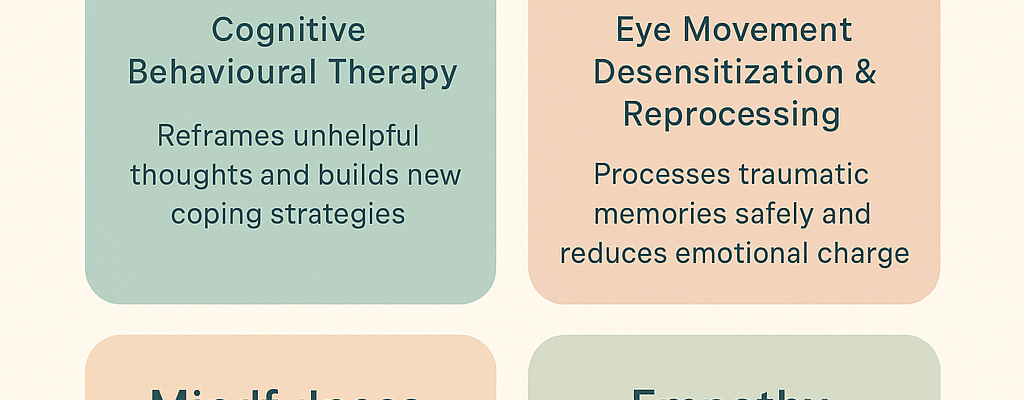
This is central in approaches like EMDR and trauma-focused CBT.
3. Attachment and relationship patterns
Psychology shows early relationships shape our “attachment style.”
People often go to therapy because:
- they repeat unhealthy relationships
- they fear abandonment or intimacy
- they struggle with trust or boundaries
Therapy helps rewire relational expectations through safe connection.
4. Identity confusion or life transitions
People seek therapy when:
- a relationship ends
- abuse or control is left behind
- identity feels lost (“Who am I now?”)
The brain prefers predictability. Big life changes destabilise internal models of self.
Therapy helps rebuild identity coherence.
5. Depression and motivation systems
Depression is not just sadness—it involves brain networks linked to reward and energy regulation.
Common features:
- low motivation
- loss of pleasure
- cognitive slowing
Therapy helps re-engage meaning, reward pathways, and behavioural activation.
6. Cognitive distortions (thinking patterns)
Psychology (especially CBT) identifies automatic thinking errors like:
- “I’m not safe”
- “It’s my fault”
- “Nothing will change”
These are not “truths,” but learned neural shortcuts.
Therapy helps challenge and rewire them.
7. Emotional regulation skills
Many people were never taught how to:
- calm their nervous system
- name emotions
- set boundaries
- tolerate discomfort
Therapy builds these skills explicitly.
🧬 The neuroscience summary
Therapy works because it changes:
- neural connectivity (brain wiring)
- stress response systems
- memory integration
- prediction models (how the brain expects the world to behave)
In simple terms:
The brain learns new patterns of safety, thinking, and relating.
❤️ The psychological truth
People don’t go to therapy because they are “broken.”
They go because:
- something overwhelmed their coping system
- their past is still shaping their present
- or they are trying to grow beyond survival mode

