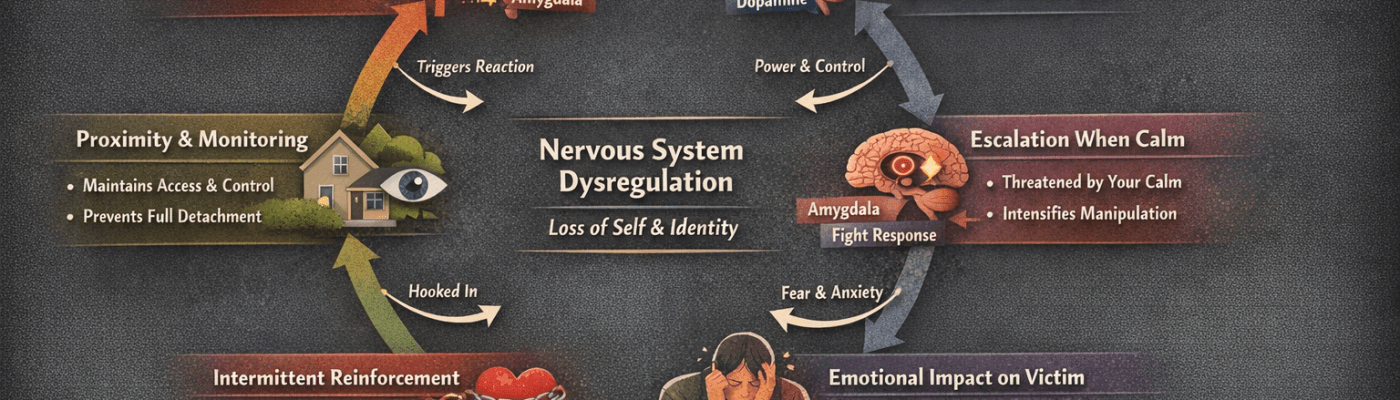
The Most Dangerous Abusers Are Often the Calmest People in the Room
Understanding coercive control through neuroscience and psychology
One of the most damaging myths about domestic abuse is the belief that the abuser will always be obvious: angry, loud, aggressive, and visibly out of control.
In reality, some of the most dangerous abusers are the calmest people in the room.
They are composed. Articulate. Charming. Credible.
And that is exactly what makes them so dangerous.
Meanwhile, the victim—after months or years of manipulation, intimidation, gaslighting, and psychological erosion—may appear distressed, emotional, confused, or even reactive.
To an outsider, especially in a single moment of crisis, it can look like the calm person is the “safe” one.
Psychology tells us that this is often a devastating misread.
The Psychology of Coercive Control
Coercive Control is not usually about physical violence alone.
It is a pattern of domination designed to strip another person of autonomy, confidence, and reality.
This can include:
- isolation from friends and family
- financial control
- intimidation without visible violence
- surveillance and monitoring
- threats (spoken or implied)
- emotional withholding
- gaslighting
- humiliation
- unpredictable rewards and punishments
The goal is not simply conflict.
The goal is power.
And power is often exercised most effectively in silence.
Why the Victim Often Looks “Worse”
From a neuroscience perspective, chronic abuse changes the brain.
Long-term exposure to fear and unpredictability activates the Amygdala—the brain’s alarm system—keeping victims in a near-constant state of threat detection.
This creates:
- hypervigilance
- panic responses
- memory disruption
- emotional flooding
- difficulty explaining events clearly
At the same time, the Prefrontal Cortex—responsible for logical thinking, sequencing, and emotional regulation—becomes less effective under chronic stress.
This is why survivors often say:
- “I couldn’t think straight.”
- “I sounded crazy.”
- “I couldn’t explain what was happening.”
They were not “overreacting.”
Their nervous system was overwhelmed.
Trauma Makes Perfect Sense
Many victims experience Post-Traumatic Stress Disorder symptoms long before they leave.
Their body may show:
- shaking
- dissociation
- crying
- fragmented speech
- confusion
- anger bursts
- shutdown
To an untrained observer, this can look unstable.
But clinically, it is often a normal response to prolonged danger.
Why the Abuser Stays Calm
Many coercive controllers are highly regulated in public because control is their strategy.
Remaining calm helps them:
- appear credible
- undermine the victim
- trigger doubt in witnesses
- manipulate professionals
- maintain dominance
This is sometimes called impression management—carefully controlling how others perceive them.
They may say:
- “She’s hysterical.”
- “I don’t know why he’s acting like this.”
- “I’m only trying to help.”
And because they say it calmly, people believe them.
That calmness is not always safety.
Sometimes it is performance.
When Systems Get It Wrong
This is where danger increases.
If police, courts, family members, or professionals assume:
calm = safe
and
distress = unstable
they may accidentally reinforce the abuse.
Victims can be:
- left in the home with the abuser
- disbelieved
- labeled “difficult”
- retraumatized by the very systems meant to protect them
This is why trauma-informed training matters.
Professionals must learn to ask:
“What happened to this person?”
not
“What’s wrong with this person?”
The Hidden Terror of Quiet Abuse
Coercive control is not always loud.
Sometimes it is:
- a look
- a silence
- a financial threat
- a subtle humiliation
- a reminder that “no one will believe you”
It is calm.
Calculated.
And often invisible—until the damage is profound.
What Survivors Need to Hear
If you were the emotional one…
if you were called “crazy”…
if nobody believed you because you were distressed…
that does not mean you were the problem.
Your reaction may have been evidence of what you survived.
Healing often begins when someone finally says:
“What happened to you makes sense.”
And that can be the moment recovery begins.
Because sometimes the calmest person in the room is not the safest.
Sometimes they are simply the most practiced at hiding the harm they cause.

