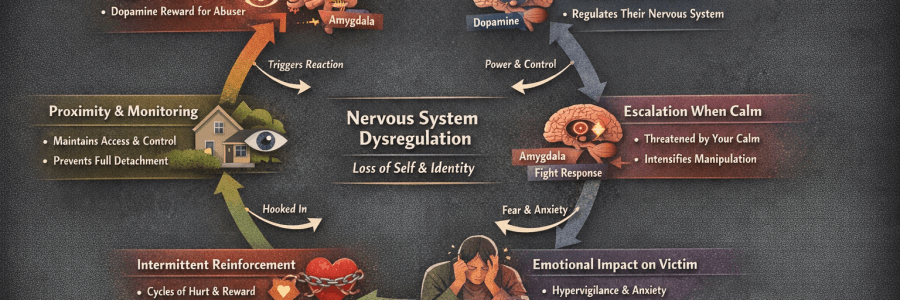
ASPD vs Narcissistic traits vs Avoidant attachment (in relationships)
Feature ASPD (Antisocial Personality Disorder) Narcissistic traits Avoidant attachment Core issue Low empathy + rule-breaking tendencies Self-worth regulation through admiration Fear of emotional dependence Capacity for love Can form attachment, but often conditional or self-focused Can feel attachment, but often tied to ego/validation Can feel love, but struggles to express/maintain closeness Empathy Often significantly reduced… Read More ASPD vs Narcissistic traits vs Avoidant attachment (in relationships)
Can someone with Antisocial Personality Disorder fall in love?

Yes—but not in the way most people mean when they talk about love. And that distinction matters. Let’s be honest about what’s really happening Someone with ASPD can form attachments. They can feel desire, interest, even a version of “love.” But it is often driven by self-interest, not emotional depth. What they call love is… Read More Can someone with Antisocial Personality Disorder fall in love?

Safe Disengagement When ASPD-Type Dynamics Are Present

When antisocial traits are involved, disengagement is not relational — it is operational.You are not leaving a mutual bond; you are exiting a system where you were an asset. 🧭 Core Shift (This Is Non-Negotiable) You are not dealing with misunderstanding — you are dealing with entitlement. There is no insight coming.There is no repair coming.There is no shared… Read More Safe Disengagement When ASPD-Type Dynamics Are Present

ASPD vs Narcissistic Abuse — What’s the Difference?

Core Difference (In Plain Terms) ASPD = Disregard for othersNarcissistic abuse = Use of others to regulate self-esteem They can overlap — but the motivation, emotional structure, and risk profile are different. 1. Internal World ASPD People with ASPD don’t need admiration to function.They need control, advantage, or access. Narcissistic Abuse Narcissistic abuse is driven by ego regulation, not indifference. 2. Emotional… Read More ASPD vs Narcissistic Abuse — What’s the Difference?

What is ASPD (Antisocial Personality Disorder)?

Antisocial Personality Disorder (ASPD) is a clinical diagnosis used to describe a persistent pattern of disregard for the rights, safety, and boundaries of others. It’s not about being “difficult” or having a bad temper. It’s about how someone relates to people, rules, and responsibility over time. Common features include: Importantly:Not everyone with antisocial traits has ASPD, and not… Read More What is ASPD (Antisocial Personality Disorder)?

Understanding a Loved One with ASPD Traits

(Compassionate, practical guidance.) Loving someone with sociopathic traits can be confusing — not because they lack feelings, but because their emotional language differs from yours. Here’s how to navigate it. 1. Don’t assume lack of emotion = lack of care They may not mirror your emotions, but they often show love through: Their devotion is… Read More Understanding a Loved One with ASPD Traits

💔 Can You Love Someone with Antisocial Personality Disorder (ASPD) — Especially If They’re Violent?

The honest and evidence-based answer is: You can love someone with ASPD, but that love may not be emotionally or physically safe — especially if violence is involved.And safety, not love, must come first. 🧠 What is ASPD? Antisocial Personality Disorder is a serious and often misunderstood condition characterized by: Not everyone with ASPD is… Read More 💔 Can You Love Someone with Antisocial Personality Disorder (ASPD) — Especially If They’re Violent?

🧠 ASPD and Coming Clean: Should You Tell a New Partner the Truth?

When hiding it hurts, and healing begins with radical honesty. We live in a world where image often matters more than truth.Where people with serious psychological patterns are told to keep quiet, fake normalcy, and “just try harder.”But here’s a deeper question: If you’ve been diagnosed with ASPD—or if you know deep down you hurt… Read More 🧠 ASPD and Coming Clean: Should You Tell a New Partner the Truth?

🧠 When Someone You Love Has ASPD: Choosing to Stay or Walk Away

And why choosing your safety isn’t cruel—it’s necessary. We don’t often talk about what it really means to live with someone diagnosed with Antisocial Personality Disorder (ASPD)—or what it costs your soul to stay. When people hear “ASPD,” they often think of criminals or serial offenders. But ASPD shows up far more subtly in daily life—partners, parents, siblings,… Read More 🧠 When Someone You Love Has ASPD: Choosing to Stay or Walk Away