When people experience harmful or abusive behaviour in relationships, one of the most confusing aspects is repetition.
The same dynamics appear again and again.
The same excuses.
The same cycles.
And often, the same outcome.
This is why it’s essential to look beyond isolated incidents and focus on patterns over time—because psychology shows us that patterns are rarely accidental.
Patterns Are Predictors of Future Behaviour
Human behaviour is remarkably consistent.
What someone has done repeatedly in the past is the strongest indicator of what they are likely to do again.
If someone has a history of:
- Blaming others
- Avoiding accountability
- Controlling or manipulating behaviour
- Cycling between harm and apology
…it is not coincidence. It is conditioning.
These behaviours become ingrained neural pathways—automatic responses reinforced over time.
Without deep, intentional work, people don’t just “grow out” of them.
Why Abusive Patterns Repeat
1. Learned Behaviour
Many people who exhibit harmful behaviour have learned it—through upbringing, past relationships, or environment.
If control, anger, or manipulation worked for them before, the brain registers it as effective.
The brain prioritises what works, not what is healthy.
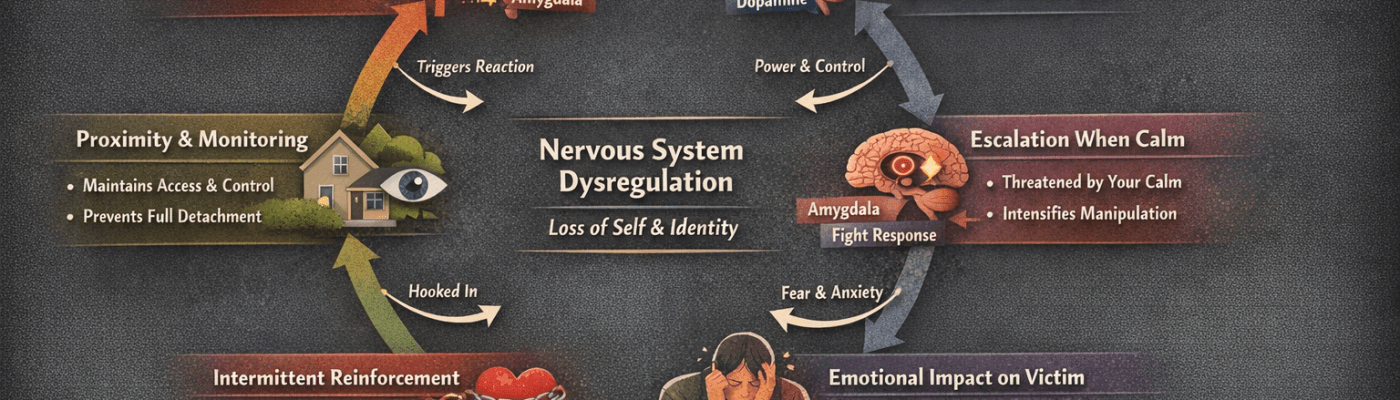
2. Reinforcement Cycles
Abusive dynamics often follow a cycle:
- Tension builds
- Incident occurs
- Apology or justification
- Temporary calm
This cycle is powerful because the “good” moments reinforce staying, while the harmful moments create instability.
This is known in psychology as intermittent reinforcement—one of the strongest ways to condition attachment.
3. Lack of Accountability
Real change requires:
- Self-awareness
- Ownership of behaviour
- Consistent effort over time
If someone consistently blames others—especially ex-partners—they are not engaging in the level of reflection required to change.
Without accountability, patterns remain intact.
4. Identity and Control
For some individuals, controlling behaviour becomes part of their identity and way of relating.
It’s not just what they do—it’s how they function in relationships.
This is why the same dynamics often appear across:
- Multiple partners
- Friendships
- Work environments
Why It’s Important to Look at Their History
You are not evaluating a single moment—you are evaluating a behavioural pattern across time.
Ask yourself:
- Have they behaved this way before?
- Do they speak about others with blame or contempt?
- Do they take responsibility, or rewrite the story?
If the pattern existed before you, it will likely exist after you—unless there is clear, sustained evidence of change.
You Didn’t Cause It—and You Can’t Cure It
One of the most damaging beliefs people hold is:
“If I love them enough, they will change.”
But patterns like these are not changed through:
- Patience
- Understanding
- Sacrifice
They are changed through internal work done by the individual themselves.
No one can do that work for them.
The Nervous System Recognises Patterns Before the Mind Does
Even when the mind is trying to rationalise or hope, the body often reacts first.
You may feel:
- Uneasy or anxious
- Hyper-aware of their moods
- Relieved when you have space from them
This is your nervous system detecting inconsistency and potential threat.
It is not weakness—it is intelligence.
Patterns Tell the Truth
Words can be convincing.
Apologies can sound sincere.
Intentions can feel real in the moment.
But patterns reveal what is actually happening.
Not once. Not occasionally. But repeatedly.
Final Thought
Pay attention to how long the behaviour has been happening.
Pay attention to whether others have experienced the same.
Pay attention to whether anything truly changes.
Because when behaviour is repeated over time, it is no longer a mistake.
It is a pattern.
And patterns, left unaddressed, don’t disappear—they continue.
:::

