Understanding Why It Took So Long: What 18 Months of Therapy Can Reveal

Many people come to therapy asking a simple question: “Why did I stay so long?”“Why did I not see it sooner?”“Why did I doubt myself?” These questions often carry shame, confusion, or frustration. But over time, therapy rarely delivers a dramatic single answer. Instead, it reveals something quieter — and more accurate. Understanding begins to… Read More Understanding Why It Took So Long: What 18 Months of Therapy Can Reveal

Unprocessed Experiences and the Brain: How Survival Becomes Pattern—and How Healing Becomes Possible

In both Psychology and Neuroscience, it is well understood that human beings are shaped by experience—not just emotionally, but biologically. When difficult experiences such as trauma, neglect, chronic stress, or unsafe relationships are not fully processed, they do not simply fade away. Instead, they can become embedded in how the brain learns to interpret and… Read More Unprocessed Experiences and the Brain: How Survival Becomes Pattern—and How Healing Becomes Possible

When Brain and Behaviour Become Dysregulated: Understanding the Signs, the Science, and the Path to Healing

Human behaviour is shaped by a complex interaction between our brain, our life experiences, our environment, and our relationships. In both psychology and neuroscience, we understand that many of our emotional and behavioural patterns are governed by core systems in the brain—systems responsible for emotional processing, reward sensitivity, impulse control, social processing, and stress regulation.… Read More When Brain and Behaviour Become Dysregulated: Understanding the Signs, the Science, and the Path to Healing

Distorted, underdeveloped, overactive, or impaired

When these systems are distorted, underdeveloped, overactive, or impaired, it can affect how a person thinks, feels, behaves, and relates to others. In Neuroscience this can happen because of genetics, development, injury, chronic stress, trauma, or learned patterns. In Psychology it shows up as patterns in personality and behavior. Important: “missing” is usually not literal—these systems… Read More Distorted, underdeveloped, overactive, or impaired

What’s happening in your brain during therapy

1. The threat system starts to settle At the beginning of therapy—especially if someone is anxious or traumatised—the brain often has a more active: As you speak in a safe, structured environment, something important happens: the brain starts to detect “this is not danger” This reduces hypervigilance over time. 2. The thinking brain comes back… Read More What’s happening in your brain during therapy

Why people have therapy (neuroscience + psychology)

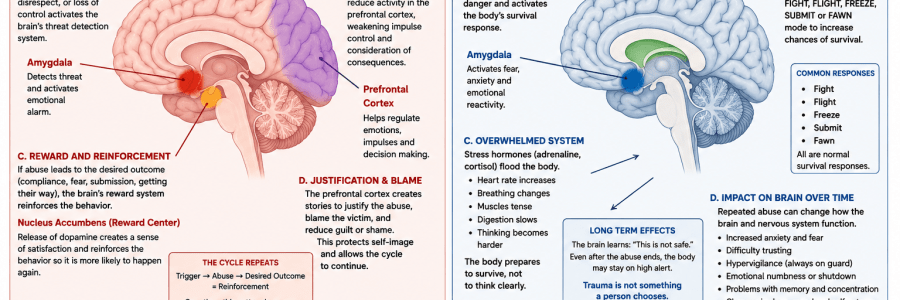
1. Emotional overload (the nervous system is stuck “on”) From a neuroscience view, chronic stress keeps the amygdala overactive (threat detection system), while the prefrontal cortex (reasoning, regulation) becomes less effective. People come to therapy because: Therapy helps retrain the brain to feel safety again. 2. Trauma and memory processing Trauma isn’t just a memory—it’s a stuck survival response. The… Read More Why people have therapy (neuroscience + psychology)

Paperwork

When dealing with Domestic Abuse or Gender-Based Violence, the amount of paperwork can feel relentless: It can feel like a second job layered on top of surviving trauma. That’s exhausting—and it’s also why many survivors feel re-traumatized by the process. Why documentation matters psychologically and legally 1. Trauma affects memory Trauma Memory During abuse, the brain… Read More Paperwork

The Healing Power of Connection: How Time with Friends and Family Supports Emotional Recovery

Recovering from trauma or difficult life experiences is rarely linear. Emotional ups and downs, confusion, and uncertainty are normal, but what often helps most is the people you surround yourself with. Spending time with supportive friends and family isn’t just comforting—it can actively regulate your emotions, reinforce healthy coping strategies, and complement professional therapy. Why Connection Matters… Read More The Healing Power of Connection: How Time with Friends and Family Supports Emotional Recovery

Post-traumatic growth

After leaving an abusive long-term marriage, many people go through something psychologists call post-traumatic growth. Research in Psychology and Neuroscience shows that although trauma is deeply painful, the brain and mind can actually develop new strengths and capacities during recovery. This does not mean the trauma was positive — but it means the brain is capable of transforming adversity into growth. 1. The… Read More Post-traumatic growth