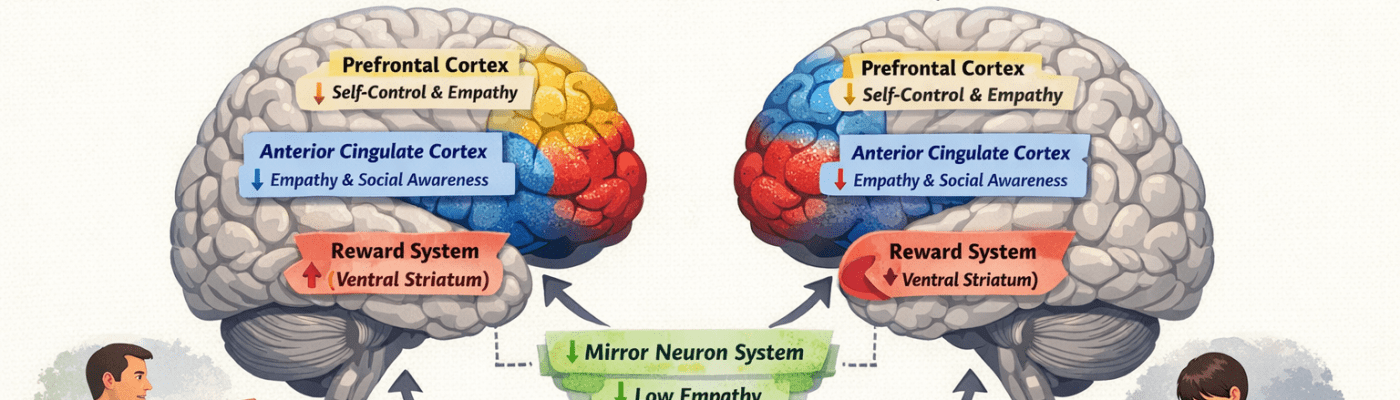
Cruelty does not always remain visible as cruelty.
Sometimes it becomes background noise.
What once felt sharp begins to feel ordinary. What once triggered internal resistance begins to pass without question. The nervous system adapts not by rejecting the experience, but by recalibrating to it.
This is one of the brain’s core survival features: habituation.
Repeated emotional exposure leads to reduced neural response over time. Systems involved in salience detection — including the amygdala — become less reactive when patterns repeat without change. The signal weakens, not because the experience is harmless, but because the brain is conserving energy in a predictable environment.
At the same time, the mind builds a model of “normal.”
Not consciously — but through repetition.
What is consistently present becomes what is expected. And what is expected becomes what is no longer questioned.
This is how cruelty can stop being recognised.
Not through understanding — but through adaptation.
Another layer is cognitive dissonance reduction. When someone depends emotionally on a person or environment that is also harmful, the mind often resolves the conflict by adjusting perception rather than abandoning attachment. The behaviour becomes reframed, minimised, or normalised in order to preserve connection.
Over time, this creates a subtle shift:
Not “this is harmful,”
but “this is just how things are.”
And “how things are” is rarely challenged.
This is where cruelty becomes most embedded — not in its intensity, but in its familiarity. In families, relationships, workplaces, or systems, repeated exposure can slowly reshape the threshold for what is considered acceptable.
Each moment on its own may feel small.
Together, they form a new baseline.
And once the baseline shifts, perception follows.
What was once clearly recognisable as cruelty can become harder to name, harder to feel, and harder to interrupt.
Not because awareness disappears —
but because the nervous system has adapted to preserve stability within it.
Closing reflection
Cruelty becomes most powerful not when it is seen as cruelty, but when it is no longer seen at all.
Because what the brain learns to tolerate,
it also learns to stop noticing.

