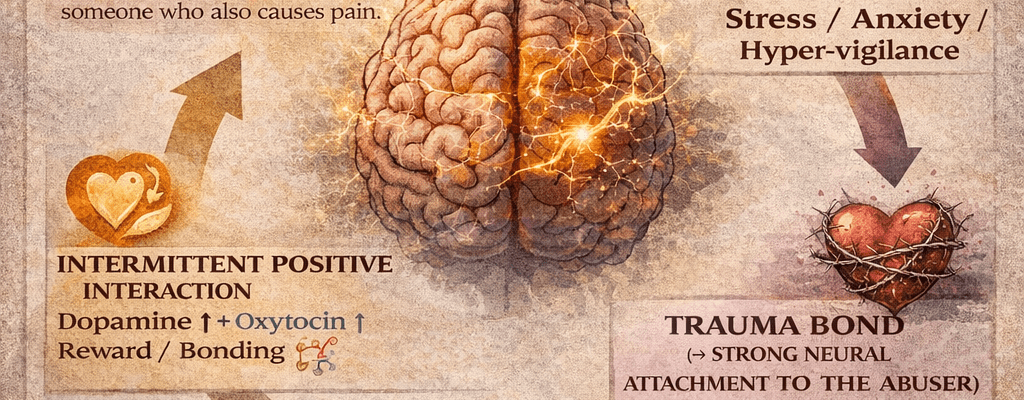
Part 1: The Neuroscience of Cruelty
Cruelty rarely announces itself as cruelty. It often presents itself as power, control, or superiority.
But in the brain, cruelty is not abstract — it is processed through systems that evaluate threat, meaning, and emotional pain.
The amygdala detects emotional danger.
The anterior insula registers internal distress.
The anterior cingulate cortex tracks conflict between expectation and experience.
When cruelty is experienced, these systems activate a state of internal alarm — especially when harm comes from someone who was expected to be safe.
Over time, repeated exposure to cruelty can shift emotional processing. The brain adapts to reduce overload, sometimes dampening emotional response or normalising what was once clearly distressing.
This is not acceptance.
It is adaptation.
Cruelty does not only affect relationships. It shapes perception itself.
And what is repeated begins to feel normal — even when it is not.
Part 2: The Neuroscience of Betrayal
Betrayal is not only emotional — it is predictive collapse.
The brain is built to forecast safety based on past experience. When someone trusted becomes a source of harm, the brain experiences a prediction error: the expected model of safety no longer matches reality.
This engages multiple systems:
- The amygdala (threat detection)
- The hippocampus (memory and context)
- The prefrontal cortex (re-evaluation and meaning-making)
But these systems do not update instantly.
The body reacts first.
The mind follows later.
This is why betrayal often feels like confusion before it becomes clarity. The nervous system signals danger before language can fully explain it.
At the same time, attachment systems can delay recognition. When connection, dependency, or hope are present, the brain may minimise or reinterpret harm to preserve emotional stability.
This creates a split:
- The body registers disruption
- The mind searches for continuity
That gap is where self-doubt often forms.
Betrayal is not only about what happened.
It is about the collapse of what was expected.
And that collapse must be integrated over time.
Part 3: The Neuroscience of Recovery
Recovery is not forgetting. It is reorganisation.
When clarity returns, the brain begins to update its internal models of safety, trust, and relationship. This involves rebalancing activity across emotional and regulatory systems.
The amygdala becomes less reactive over time when safety is re-established.
The prefrontal cortex strengthens its role in evaluation and boundary formation.
The body’s stress systems gradually recalibrate away from chronic activation.
But perhaps most importantly, internal signals become trustworthy again.
People begin to distinguish:
- what feels safe
- what feels familiar
- what is actually harmful
This is not just emotional insight — it is neural recalibration.
Healing is the restoration of alignment between perception and reality.
And in that process:
Clarity restores dignity.
Truth restores power.
Healing restores the self.
Because the body often senses betrayal before the mind can accept it —
and recovery is learning to listen again without distortion.

