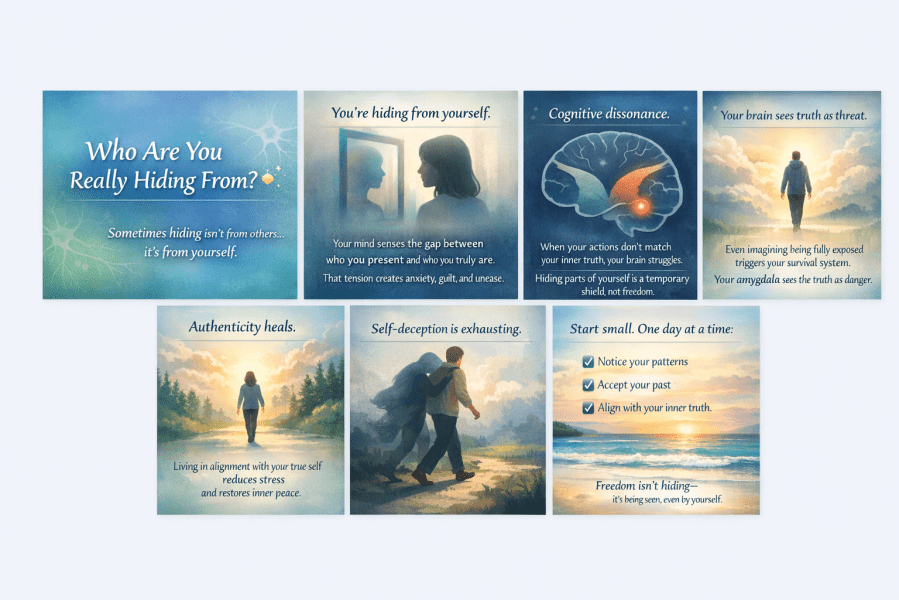
People hide their true selves for a mix of neuroscientific and psychological reasons, and it usually isn’t just about lying to others — it’s often about protecting the self from internal or external threats. Here’s a breakdown:
1️⃣ Fear of Judgment & Social Threats
- Neuroscience: The amygdala (our brain’s threat detector) lights up when we anticipate social rejection or criticism.
- Psychology: Humans are social animals — being ostracized or judged historically meant danger. So hiding parts of ourselves is a protective adaptation.
2️⃣ Cognitive Dissonance
- Psychology: When your actions, values, or desires conflict with how you want to be seen, your mind experiences tension.
- Effect: You may hide aspects of yourself to reduce this inner conflict, but this is only temporary — the tension persists subconsciously.
3️⃣ Avoiding Vulnerability
- Psychology: Opening up requires risk. Vulnerability can trigger fear of hurt or abandonment.
- Neuroscience: Anticipating emotional pain activates the same pathways as physical pain, making it feel threatening even if the risk is only social.
4️⃣ Past Trauma & Conditioning
- Psychology: People who grew up in environments of criticism, neglect, or abuse may learn to suppress their authentic selves.
- Neuroscience: Chronic stress can reshape neural pathways, reinforcing “masking” behaviors as a survival strategy.
5️⃣ Identity Confusion
- Psychology: Some people hide because they are uncertain about who they truly are, or they fear they won’t be accepted for it.
- Neuroscience: The prefrontal cortex (responsible for self-reflection) struggles to reconcile conflicting identities, leading to concealment as a coping mechanism.
6️⃣ Self-Deception & Defense Mechanisms
- Psychology: We often hide from ourselves first — denying feelings, impulses, or traits we find unacceptable.
- Neuroscience: The brain protects itself from distressing truths by creating alternative narratives, reinforcing false personas.
✨ Bottom line:
Hiding your true self is rarely about others — it’s your brain and mind trying to protect you from judgment, rejection, or internal conflict. True growth happens when you start to safely explore and accept who you are, reducing the need for these protective “masks.”