“Let the punishment fit the crime.”
— Gilbert & Sullivan, The Mikado
A famous line. A clever lyric. A timeless moral principle.
And yet, in cases of domestic abuse, this principle too often collapses.
When the Law Falls Short
In many justice systems, domestic abuse is still:
- Minimised
- Undercharged
- Under-sentenced
- Or psychologically misunderstood
Survivors frequently face:
- Burdens of proof that exceed what trauma allows
- Procedural delays that retraumatise
- Sentences that fail to reflect the true psychological and physical harm inflicted
As a result, the punishment rarely fits the crime.
The Psychology of Harm
Domestic abuse is not simply:
an incident
It is a system of control
It is:
- Chronic psychological conditioning
- Fear-based behavioural programming
- Nervous system captivity
- Identity erosion
- Long-term trauma embedding
Yet legal systems often assess:
single events — not cumulative damage
This is a fundamental mismatch between psychological reality and legal measurement.
The Neuroscience of Trauma: Why This Matters
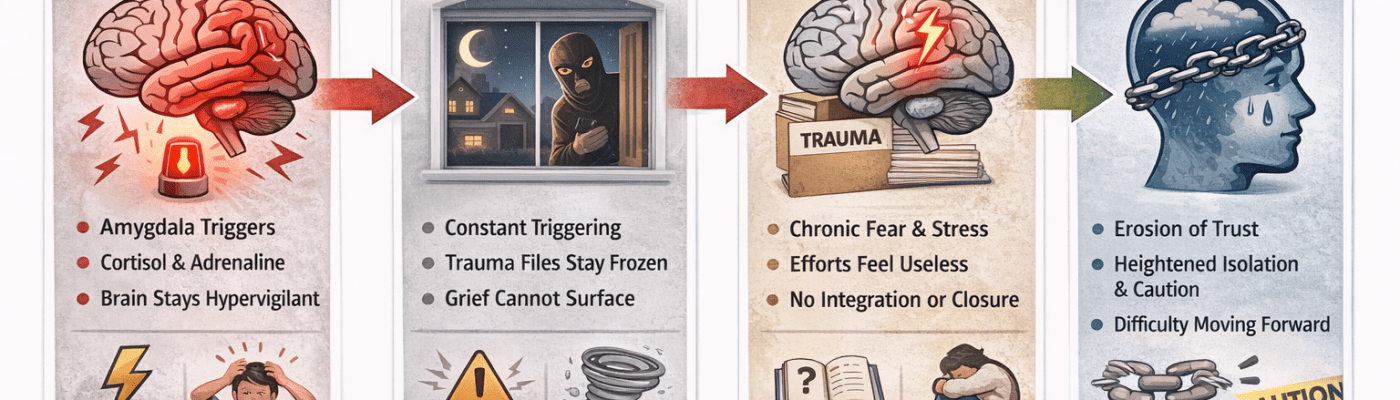
Trauma physically alters the brain.
Domestic abuse reshapes:
- Amygdala → threat hypersensitivity
- Hippocampus → memory fragmentation
- Prefrontal cortex → impaired regulation
- Autonomic nervous system → chronic survival mode
This means survivors are not simply “hurt” —
they are neurologically injured.
Yet legal sentencing rarely reflects:
- Neurological injury
- Complex PTSD
- Long-term health consequences
- Loss of earning capacity
- Identity damage
- Intergenerational trauma risk
The Illusion of Proportional Justice
Short sentences, suspended sentences, cautions, and minimal penalties:
- Fail to deter
- Fail to protect
- Fail to validate
- Fail to restore
They also:
- Reinforce perpetrator entitlement
- Increase post-separation risk
- Signal social minimisation
When consequences are mild, abuse escalates.
Survivors Pay the True Sentence
While perpetrators often walk away lightly penalised, survivors serve:
- A life sentence of hypervigilance
- Years of trauma recovery
- Chronic health conditions
- Economic disadvantage
- Identity reconstruction
This is the true imbalance of justice.
Reframing Justice: What Proportionality Should Mean
True proportional justice would include:
- Trauma-informed court processes
- Neuropsychological injury recognition
- Sentencing aligned with cumulative harm
- Mandatory perpetrator rehabilitation
- Survivor-centred safety planning
- Long-term protective measures
Justice must evolve from:
punishment → protection + prevention
Final Reflection
“Let the punishment fit the crime.”
Until legal systems fully comprehend the psychological and neurological devastation of domestic abuse, this phrase remains:
A lyric — not a reality — for survivors.
True justice does not merely punish wrongdoing.
It recognises harm, restores dignity, and prevents recurrence.
 Linda C J Turner | Trauma Therapist & Emotional Healing Specialist