First 30 Days After Leaving – Recovery Checklist

Week 1: Stabilise & Contain the Chaos This is usually the most emotionally volatile stage. 🧠 Goal: safety + nervous system stabilisation, not clarity yet. Week 2: Emotional Detox This is where withdrawal and doubt often peak. 🧠 Goal: reduce emotional spikes and attachment loops. Week 3: Rebuilding Internal Stability You start coming back to yourself in… Read More First 30 Days After Leaving – Recovery Checklist

When You Leave: Navigating the Seismic Fallout and Learning to Hold Yourself

Leaving a harmful or abusive dynamic is not a single decision—it’s a process.And often, the moment you step away is when everything feels like it shakes the most. This is the part people don’t talk about enough. The seismic fallout. Why It Feels So Intense When you leave, you’re not just walking away from a person.… Read More When You Leave: Navigating the Seismic Fallout and Learning to Hold Yourself

Pay Attention to Patterns: The Psychology Behind Repeated Abusive Behaviour

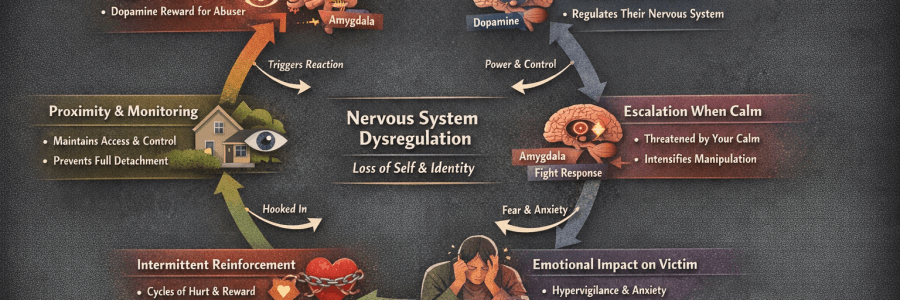
When people experience harmful or abusive behaviour in relationships, one of the most confusing aspects is repetition. The same dynamics appear again and again.The same excuses.The same cycles. And often, the same outcome. This is why it’s essential to look beyond isolated incidents and focus on patterns over time—because psychology shows us that patterns are rarely… Read More Pay Attention to Patterns: The Psychology Behind Repeated Abusive Behaviour

Dangerous and Abusive Behaviours: Recognising the Signs Before They Escalate

Abuse does not always begin with something obvious. It often starts subtly—small shifts in behaviour, tone, or control that are easy to dismiss or explain away. Over time, these behaviours can build into patterns that impact your safety, your mental health, and your sense of self. Understanding the signs of dangerous or abusive behaviour is… Read More Dangerous and Abusive Behaviours: Recognising the Signs Before They Escalate

What counts as grooming in Spain?

Grooming (often called “child solicitation” or “online sexual solicitation of minors”) is when an adult contacts a minor with sexual intent and tries to build trust for sexual purposes. 🔴 It is considered grooming when someone: 1. Contacts a minor under 16 (or under 18 in some exploitation contexts) 2. Establishes communication with sexual intent For example: 3. Builds trust… Read More What counts as grooming in Spain?

Neuroscience and Psychology of Connection: Why We Feel the Urge to Reach Out

There are moments when life delivers difficult news in clusters — one concern followed quickly by another. In those periods, something subtle but powerful often happens in the mind and body: a heightened sense of emotional awareness and a sudden urge to reconnect with the people we care about. From the perspective of neuroscience and… Read More Neuroscience and Psychology of Connection: Why We Feel the Urge to Reach Out

Don’t Ignore the Urge to Reach Out — It Often Means Something Important

There are moments in life when information arrives in waves — one difficult message after another — and it can create a kind of emotional overload that is hard to immediately process. In those moments, something important often happens in the nervous system. The brain begins to shift into a heightened state of sensitivity. The… Read More Don’t Ignore the Urge to Reach Out — It Often Means Something Important

The Difference Between Cruelty and Abuse (and How the Brain Learns Both)

Cruelty and abuse are often used interchangeably, but they are not the same thing. Understanding the difference matters — not only psychologically and socially, but also in terms of how the brain processes repeated harm versus isolated harm. Cruelty: the act Cruelty refers to behaviour that causes emotional or physical pain, often without empathy or… Read More The Difference Between Cruelty and Abuse (and How the Brain Learns Both)