“This Isn’t New — It’s the Same Game in a Different Arena”Why Long-Term Mind Games Continue After Separation

When you’ve lived with decades of psychological manipulation, the most destabilising part isn’t the behaviour itself. It’s the moment you realise:This is just a continuation of the same pattern. Different setting.Different language.Same impact on your nervous system. That recognition is not bitterness.It’s pattern recognition. What Kind of Person Does This? From a trauma-informed and neuroscience perspective,… Read More “This Isn’t New — It’s the Same Game in a Different Arena”Why Long-Term Mind Games Continue After Separation

How to Deal With This Without Going Crazy(A Trauma-Informed, Neuroscience-Based Guide)

First, an important reframe: If you feel anxious, angry, hyper-alert, exhausted, or mentally foggy in this situation, you are not “going crazy.”Your nervous system is responding normally to an abnormal level of prolonged uncertainty and control. The goal is not to “stay calm.”The goal is to stay regulated enough to function and protect yourself. 1. Stop Treating This… Read More How to Deal With This Without Going Crazy(A Trauma-Informed, Neuroscience-Based Guide)

When Divorce Becomes a Control Strategy: A Neuroscience Perspective

What happens when you file for divorce in 2024 and the other person says “no”?What happens when your solicitor receives no response for months?When you try to sell the house, put forward offers, and hear nothing?When “For Sale” signs are quietly removed in the night?And then—one year later—you are accused, sued, or taken to court… Read More When Divorce Becomes a Control Strategy: A Neuroscience Perspective

🧠 Why a Psychologist’s Shock Is Neurologically Significant

When a trained psychologist is visibly shocked, it tells you something important about the severity and objectivity of what you endured. This is not about validation through emotion. It’s about clinical reality breaking through professional neutrality. 🧠 Why a Psychologist’s Shock Is Neurologically Significant Psychologists are trained to: So when their face gives it away, something unusual is happening at a… Read More 🧠 Why a Psychologist’s Shock Is Neurologically Significant

Exposing the Abuser (No Sugar-Coating)

Let’s start with the truth most survivors are pressured not to say: Abusers rely on silence, minimisation, and “being the bigger person.”Protection of abusers is one of the most socially normalised forms of harm. 1. Abuse Is Not “Loss of Control” — It Is Selective Control Abusers: Then claim: “I just snapped”“I’m blunt”“I was stressed”“That’s just how I… Read More Exposing the Abuser (No Sugar-Coating)

Filters

Upbringing and character shape communication at a nervous-system level, not just a “personality” level. People don’t simply choose how they communicate — they default to what their brain learned was safe, effective, or rewardedearly in life. I’ll break this down clearly and then show how different upbringings produce different communication styles. 🧠 1. Early Environment Wires the Communication System A… Read More Filters

Aggressive Communication

What Those Statements Actually Are Examples: These are NOT: These ARE: Why This Is Not Just “Unfiltered Honesty” 1. They Target Identity, Not Behavior Unfiltered honesty can still focus on actions: “This task wasn’t completed.” Your examples focus on who the person is: 📍 The brain experiences this as a social threat, activating the same neural pathways as physical danger. 2.… Read More Aggressive Communication

Why family members often enable abuse

This is a crucial piece of the picture — and one that causes survivors enormous secondary harm. Psychology and neuroscience explain family enabling very clearly. 1. Threat to the family identity Families function as identity systems, not just groups of individuals. When abuse is acknowledged, it threatens: The brain treats this as an existential threat, activating the amygdala. Under… Read More Why family members often enable abuse

Do abusers ever look outside the box and imagine it happening to their own loved ones?

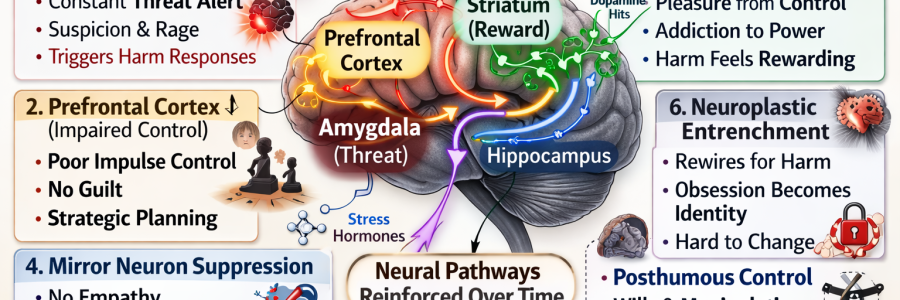
Most do not — and when they do, it is usually abstract, not empathic. 1. Empathy is compartmentalised, not absent Contrary to popular belief, many abusers are not “emotionless.” They can show selective empathy — especially toward people they identify with or feel ownership over (their mother, daughter, family name). Neuroscience shows this as compartmentalisation in the brain: So… Read More Do abusers ever look outside the box and imagine it happening to their own loved ones?

Reclaiming the Paperwork — and the Truth

As I prepare for divorce, I have had to replace every single legal document I need.Passports, certificates, records — all of the originals were taken long ago. They were kept in a briefcase I was never allowed to open or touch.Money and documents stored away before we were even married. On the surface, this looks like administration.Psychologically, it… Read More Reclaiming the Paperwork — and the Truth