“He could never have done those things. He’s such a nice man.”
These are some of the most painful words survivors of coercive control and emotional abuse hear.
Friends, family and neighbours often judge a person by the version they see: charming, funny, generous and helpful. Meanwhile, behind closed doors, another reality exists—one known only to the partner or family members living with them.
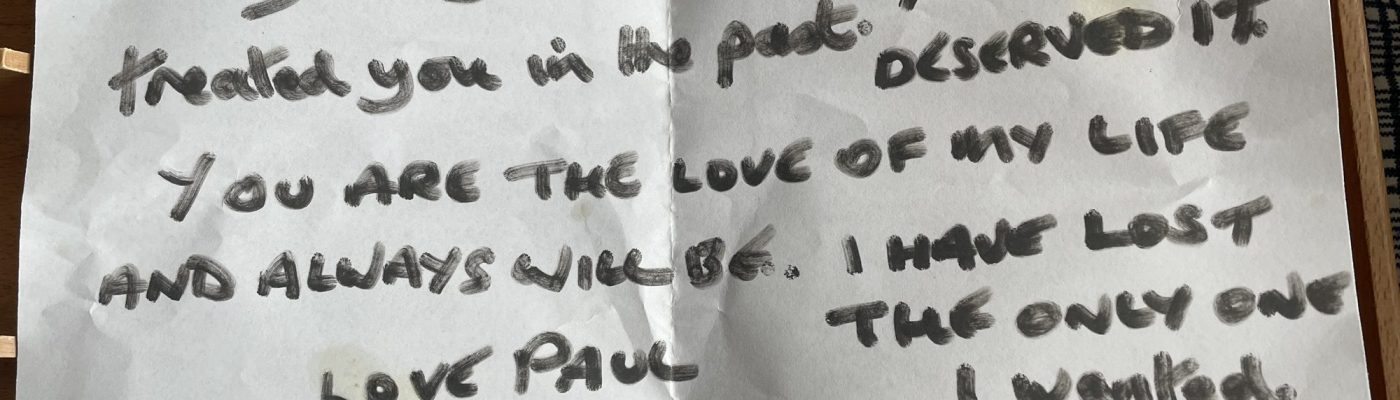
Then, years later, while packing boxes or sorting paperwork, hidden away in a drawer is a letter:
“I am truly sorry for the way I treated you.”
The confession exists.
It was simply never meant for anyone else to see.
The Psychology of Public Kindness
Human beings naturally rely on the halo effect, a cognitive bias where one positive quality leads us to assume someone possesses many other positive qualities.
If someone is:
- Funny
- Helpful
- Successful
- Well spoken
- Generous with friends
people unconsciously conclude they must also be kind, honest and incapable of cruelty.
The private victim’s experience becomes incompatible with the public image.
Why Write a Hidden Confession?
From a psychological perspective, a private apology can serve several functions.
1. Reducing Cognitive Dissonance
The brain struggles to hold two conflicting beliefs:
“I am a good person.”
and
“I repeatedly hurt someone I claim to love.”
Writing an apology temporarily reduces that internal conflict without requiring lasting behavioural change.
The person feels relief without necessarily accepting accountability.
2. Self-Image Repair
The letter becomes evidence—to themselves—that they are remorseful.
They can think,
“I admitted what I did. I apologised.”
even if nobody else ever sees it and the behaviour continues.
3. Emotional Regulation
Some abusive individuals experience genuine guilt after an incident.
Neuroscience suggests that emotional systems involving the anterior cingulate cortex and insula can produce distress when a person’s actions conflict with their self-image.
Writing a confession reduces emotional discomfort.
Unfortunately, unless behaviour changes, the relief is temporary and the cycle often repeats.
Why Do Others Believe the Fake Kindness?
Our brains prefer simple stories.
Accepting that someone can be loving in public and cruel in private creates psychological discomfort.
So people search for explanations that preserve the image they already have.
They say:
- “He didn’t mean it.”
- “He’s always been lovely to me.”
- “There must be two sides.”
- “He couldn’t possibly have done that.”
The survivor, rather than the charming person, becomes the easier target for doubt.
Smearing the Victim
Many controlling individuals work hard to protect their reputation.
They may privately admit:
“I treated you terribly.”
while simultaneously telling friends and family:
- “She’s unstable.”
- “She’s bitter.”
- “She’s making things up.”
- “She’s trying to ruin me.”
This creates a powerful contradiction:
Private confession. Public denial.
The apology stays hidden in a drawer while the smear campaign is shared with everyone.
The Neuroscience of Reputation
Humans evolved in social groups where reputation affected survival.
Research suggests that social rejection activates many of the same neural pathways involved in physical pain.
For someone whose identity depends heavily on admiration and approval, protecting their public image can become more important than repairing the harm they caused.
The result is performative kindness:
- generous in public,
- remorseful in private,
- unchanged in behaviour,
- and hostile when accountability threatens their image.
The Real Measure of Character
A hidden apology acknowledges awareness.
It demonstrates that the person knew the behaviour was wrong.
But insight alone is not transformation.
Real remorse is visible in consistent actions:
- accepting responsibility,
- telling the truth,
- correcting false narratives,
- making amends,
- and changing behaviour over time.
A confession folded into a drawer while lies are spread to friends and family is not evidence of redemption.
It is evidence that two versions of the same person existed: the one presented to the world, and the one known only behind closed doors.
And for many survivors, finding those forgotten letters is both heartbreaking and strangely validating. The words confirm what they lived through all along: the abuse was real, the perpetrator knew it, and the public performance of kindness was never the whole story.

