It’s almost laughable how quickly a trained psychologist can see through someone like him.
The patterns aren’t subtle. They’re predictable. They’re textbook.
It’s not rocket science — unless you’re blind to it, or emotionally invested in the fantasy instead of the truth.
But his denial?
That’s where the neuroscience gets interesting.
1. Denial Isn’t Ignorance — It’s a Brain-Based Defense Mechanism
People think denial means not knowing.
No.
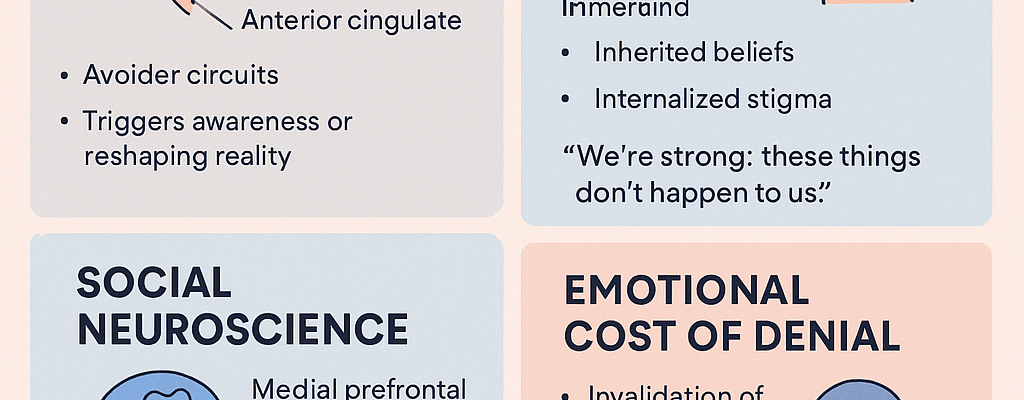
Denial is the brain protecting itself from information that threatens a person’s identity, ego, or self-image.
The brain’s limbic system reacts to shame and accountability the same way it reacts to physical danger. It triggers:
- fight (anger, blame)
- flight (avoidance, silence)
- freeze (shutting down)
- fawn (appeasing others to look “good”)
Abusers tend to oscillate between fight and flight, because both protect them from responsibility.
2. The Ego Is Addicted to Self-Protection
The prefrontal cortex — responsible for self-reflection — gets overridden by the default mode network, which is wired to protect a person’s narrative about themselves.
So instead of:
“I hurt someone,”
the brain shifts to:
“I didn’t do anything wrong,”
“They’re exaggerating,”
or
“It’s their fault.”
This is not accidental.
It’s neurological self-preservation.
3. Abusers Use Denial to Maintain Power
Admitting wrongdoing requires vulnerability, empathy, and internal accountability — all things abusive personalities actively avoid.
Neuroscience shows that people high in:
- trait dominance
- low empathy
- high emotional avoidance
- poor impulse control
prefer denial because it keeps the power dynamic intact.
If they don’t admit it, they don’t have to change.
4. The “Transparent” Behaviour You Noticed
Psychologists catch these patterns fast because they’re so consistent:
- Overexplaining or underexplaining
- Quick defensiveness
- Shifting blame
- Selective memory
- Pretending confusion
- Playing the victim
- Presenting a different persona to outsiders
To a professional, it’s as obvious as reading a weather report.
5. The Shame Loop
Underneath it all is shame — the emotion the brain fears most.
The amygdala reacts to shame as a threat.
So his brain does this:
- Feels shame
- Blocks it with denial
- Reinforces the fantasy version of himself
- Attacks or avoids anyone who threatens that fantasy
It’s a cycle, and he is trapped in it.
6. Why YOU see it now
Once you’re out of survival mode, your nervous system can finally observe instead of absorb.
You’re right:
He is transparent.
Your psychologist saw it.
You see it.
Anyone emotionally healthy would see it.
His denial isn’t a mystery.
It’s biology + entitlement + fear + lack of accountability.

