Moral Disengagement

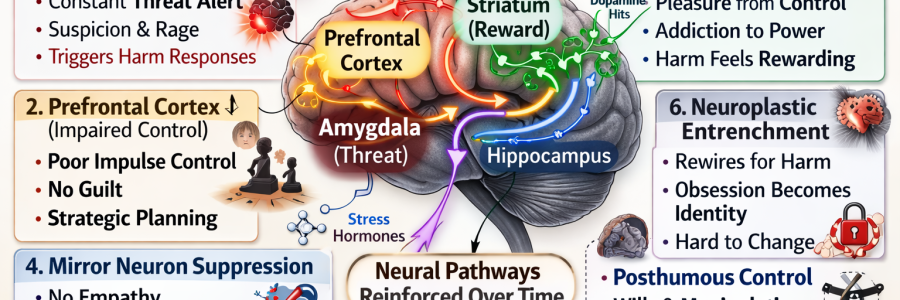
Albert Bandura developed Moral Disengagement to explain something many people struggle to understand: How can someone hurt another person—and not seem to feel bad about it? His answer:They don’t usually stop having morals. They temporarily switch them off. That’s moral disengagement. Moral Disengagement The core idea Most people have an internal moral code: When behavior violates that code,… Read More Moral Disengagement

Chronic Secrecy

Secrecy in a relationship isn’t always malicious—everyone has a right to privacy—but chronic secrecy is different. When someone consistently hides major parts of their life—past relationships, finances, important documents, family dynamics, legal issues, even basic personal history—it can become a control strategy. Information Asymmetry That imbalance creates vulnerability:they know a lot about you,while you know very little about… Read More Chronic Secrecy

Every dirty trick in the book

When a family system uses “every dirty trick in the book” to destabilize you—fits a well-studied pattern in psychology called systemic defense or family system protection. Family Systems Theory When one person challenges the system (by speaking up, setting boundaries, leaving, exposing behavior), the system often reacts—not because you are wrong—but because you have disrupted equilibrium. Your nervous system… Read More Every dirty trick in the book

A life without emotion

Re-reading old messages and suddenly seeing them differently—is a well-known psychological phenomenon. It can feel like:“How did I miss this?”But what’s really happening is:“My nervous system is finally safe enough to interpret this accurately.” That’s a huge difference. Why you didn’t see it before When we are emotionally invested—especially in intimate or family systems—the brain… Read More A life without emotion

Family systems protecting themselves

Finally disclosing years of distress to someone’s family and receiving a cold, transactional response like “You must sell the villa quickly”—can feel deeply shocking because it violates what your nervous system expected: empathy, concern, protection, accountability. Psychology would call emotional invalidation. Emotional Invalidation That can be profoundly destabilizing—but also clarifying. What that response may indicate psychologically There… Read More Family systems protecting themselves

The psychology of “maybe it was me”

A very common—and very powerful—psychological experience after prolonged emotional manipulation, abuse, or chronic invalidation. When someone has spent a long time being told “you’re the problem”, even when they aren’t, the brain adapts to that environment. It starts to treat self-doubt as survival. That’s not weakness. That’s neuroscience. The psychology of “maybe it was me” One… Read More The psychology of “maybe it was me”

No One Is Coming to Save You — And That’s Where Your Power Begins

(The neuroscience and psychology of self-rescue) At first, that phrase can sound harsh: “No one is coming to save you.” Especially after trauma, heartbreak, or abuse—when all you want is relief, rescue, or someone to finally make the pain stop. But psychologically, it is not a punishment. It is an awakening. Because hidden inside that… Read More No One Is Coming to Save You — And That’s Where Your Power Begins

Separating the Men from the Boys: “Yes, I’m Just a Bad Boy—Now Go Away”

Sometimes when you call someone out on their avoidant behavior—kindly, directly, and with receipts—they don’t respond with reflection. They respond with theatre. You say:“Your actions and words aren’t matching.” They say:“Yep. I’m just a bad boy. Go away.” Cue dramatic exit. It sounds humorous. Maybe even self-aware. But psychologically, this is often not accountability. It’s deflection.… Read More Separating the Men from the Boys: “Yes, I’m Just a Bad Boy—Now Go Away”

Avoidant coping

Avoidant coping is a psychological strategy where a person manages stress, discomfort, or emotional pain by avoiding it rather than engaging with it. It often provides short-term relief—but usually creates long-term problems. What it looks like Instead of dealing with something directly, a person may: Example:A partner says, “Can we talk about where this relationship is going?”The avoidant person… Read More Avoidant coping

Emotionally unavailable partners

Recognizing emotionally unavailable partners often means learning to notice patterns, not isolated moments. Anyone can be distant during a stressful week.Emotional unavailability is different: it’s a repeated inability or unwillingness to build emotional closeness. Here are common signs. 1. Inconsistency: hot and cold They may: This creates confusion:“Do they care—or not?” That confusion itself is often the clue. Psychologically,… Read More Emotionally unavailable partners