When Image and Reality Don’t Match
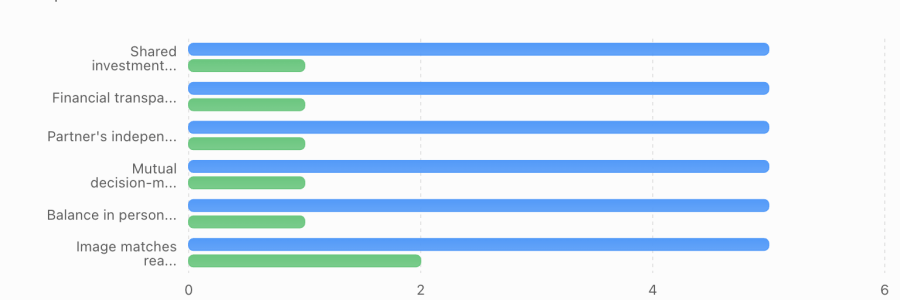
Healthy partnership vs unhealthy partnership Comparison of common relationship patterns. No single characteristic proves abuse or financial control; it is the overall pattern that matters. Healthy partnership When Image and Reality Don’t Match A healthy relationship is rarely measured by income alone. It is measured by how resources, respect, and responsibilities are shared. Someone may describe… Read More When Image and Reality Don’t Match

When Words and Behaviour Don’t Match: The Psychology of Family Narratives

One of the most revealing moments in any relationship is when you hear two very different accounts of the same family. One person describes a “perfect” childhood and an idyllic family life. Another sibling quietly confides that home was marked by frequent arguments, emotional distance, financial control, poor communication, or a lack of teamwork. Which… Read More When Words and Behaviour Don’t Match: The Psychology of Family Narratives

The quality of relationships matters much more than the family structure itself.

There isn’t a simple rule that a two-parent family or a single-parent family is inherently “healthier.” Decades of developmental psychology consistently show that the quality of relationships matters much more than the family structure itself. Children generally do best in environments that are safe, stable, nurturing, and predictable. Superficially “Perfect” Family with Chronic Conflict Single Parent… Read More The quality of relationships matters much more than the family structure itself.

Children Learn From What We Do, Not What We Say

Children are far more perceptive than many adults give them credit for. They notice inconsistencies. They observe how people treat one another, how conflict is handled, whether apologies are genuine, and whether actions match words. Neuroscience and developmental psychology have shown that children learn through observation. Psychologist Albert Bandura demonstrated that children imitate behaviours they… Read More Children Learn From What We Do, Not What We Say

Breaking the Cycle: What Children Really Learn

Intergenerational trauma is not simply about what happens to one generation—it is about the patterns of behaviour, relationships, and emotional responses that are passed from one generation to the next. Neuroscience tells us that a child’s brain is shaped by repeated experiences. Through a process known as experience-dependent neuroplasticity, the developing brain builds neural pathways based… Read More Breaking the Cycle: What Children Really Learn

“Get Over It” Is Not Healing—Healthy Families Break the Cycle

Children and grandchildren learn far more from what they observe than from what they are told. Neuroscience and psychology consistently show that young people develop their understanding of relationships by watching the adults around them. When families remain trapped in anger, resentment, hostility, and unresolved conflict for years or even decades, the next generation absorbs… Read More “Get Over It” Is Not Healing—Healthy Families Break the Cycle

When Children Are Drawn Into Abuse and Coercive Control

One of the most damaging aspects of domestic abuse is when children or grandchildren become involved in adult conflicts. Whether intentionally or unintentionally, placing children in the middle of abusive dynamics can have lasting psychological consequences. Triangulation occurs when a third person—often a child—is drawn into a conflict between adults. This can involve carrying messages, taking… Read More When Children Are Drawn Into Abuse and Coercive Control

Five Moves. One Pattern. The Neuroscience and Psychology of Carrying Everything Alone.

As I prepare for my fifth and final move, I’m struck by something I hadn’t fully appreciated before. I’ve spent decades moving homes. But more than that… I’ve spent decades moving almost entirely on my own. The first move was into his house. The second was into the home I bought myself. While I packed… Read More Five Moves. One Pattern. The Neuroscience and Psychology of Carrying Everything Alone.

Three Boxes of Self-Help Books: Thirty Years Spent Trying to Fix a Marriage That Was Never Mine to Fix

As I prepare for my final move, I have been sorting through decades of paperwork. Among the boxes were three large cartons filled with self-help books. Books on relationships. Communication. Trauma. Psychology. Neuroscience. Emotional intelligence. Attachment theory. Mindfulness. Marriage. Forgiveness. Conflict resolution. Thousands upon thousands of pages. Three decades of searching for answers. Three decades… Read More Three Boxes of Self-Help Books: Thirty Years Spent Trying to Fix a Marriage That Was Never Mine to Fix