Reclaiming autonomy

“Reclaiming autonomy is rarely dramatic” makes a lot of sense when you look at it through neuroscience and psychology — because autonomy isn’t a single decision, it’s a gradual rewiring of threat, habit, and identity systems. Here’s what’s happening underneath: 1. The brain doesn’t switch from “controlled” to “free” instantly In trauma or coercive dynamics, the brain… Read More Reclaiming autonomy

🌙 Reclaiming Financial and Emotional Autonomy

— a quiet return to yourself There comes a point where life stops asking for explanations. Not loudly.Not dramatically. Just quietly… in the noticing. You begin to see things differently. Not because something new has happened—but because something in you has finally stopped bending around what used to be. 💰 The shape of financial autonomy… Read More 🌙 Reclaiming Financial and Emotional Autonomy

🧠 Emotional Memory vs Factual Memory

In Psychology, we often separate what happened from how it is stored in the brain. 📌 1. Factual Memory (What happened) This is the objective record of events. It includes: Example: This type of memory is linked to hippocampal processing in the brain (context + timeline). ❤️ 2. Emotional Memory (How it felt) This is the emotional meaning attached to events,… Read More 🧠 Emotional Memory vs Factual Memory

❤️ Healthy Love vs ⚠️ Manipulation (Comparison Chart)

In both Psychology and relational neuroscience, the difference often comes down to safety, consistency, and autonomy vs control and confusion. 🧠 Emotional Experience Healthy Love Manipulation You feel emotionally safe You feel anxious or “on edge” Emotions are steady over time Emotional highs and crashes You can be yourself You feel you must “perform” or please… Read More ❤️ Healthy Love vs ⚠️ Manipulation (Comparison Chart)

⚠️ Manipulation Awareness Chart (What to Look Out For)

Clear awareness chart of manipulation tactics and what to look out for, which is exactly what protects people in real life. Here’s a practical breakdown in the same structure you used: In Psychology, manipulation is often described as patterns of emotional and cognitive pressure used to influence someone’s decisions without informed consent or clarity. 1. Emotional… Read More ⚠️ Manipulation Awareness Chart (What to Look Out For)

Unprocessed Experiences and the Brain: How Survival Becomes Pattern—and How Healing Becomes Possible

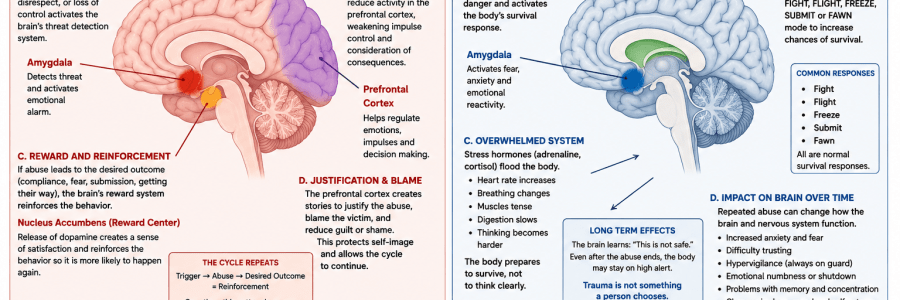
In both Psychology and Neuroscience, it is well understood that human beings are shaped by experience—not just emotionally, but biologically. When difficult experiences such as trauma, neglect, chronic stress, or unsafe relationships are not fully processed, they do not simply fade away. Instead, they can become embedded in how the brain learns to interpret and… Read More Unprocessed Experiences and the Brain: How Survival Becomes Pattern—and How Healing Becomes Possible

Chronic dysregulation becoming a long-term pattern of functioning.

If these experiences and patterns are left untreated over time, the impact is usually not that they “stay the same,” but that the brain and body adapt around them in increasingly rigid or extreme ways. In Neuroscience and Psychology this is understood as chronic dysregulation becoming a long-term pattern of functioning. It’s important to be clear: this is… Read More Chronic dysregulation becoming a long-term pattern of functioning.

When Brain and Behaviour Become Dysregulated: Understanding the Signs, the Science, and the Path to Healing

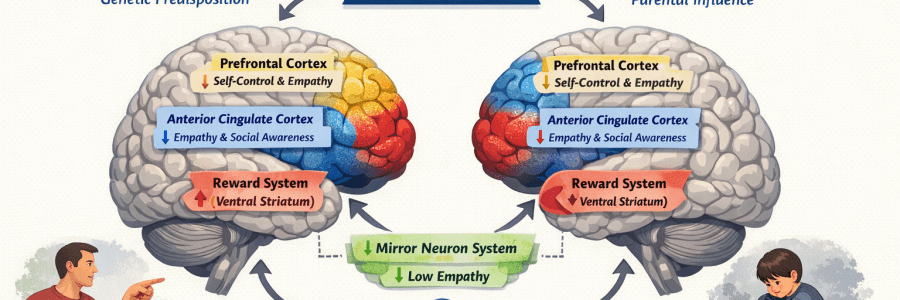
Human behaviour is shaped by a complex interaction between our brain, our life experiences, our environment, and our relationships. In both psychology and neuroscience, we understand that many of our emotional and behavioural patterns are governed by core systems in the brain—systems responsible for emotional processing, reward sensitivity, impulse control, social processing, and stress regulation.… Read More When Brain and Behaviour Become Dysregulated: Understanding the Signs, the Science, and the Path to Healing

🔄 Why the pattern escalates

What makes coercive control so psychologically damaging is that it often follows a recognisable pattern, not random moments of anger or ordinary relationship conflict. In psychology, the difference is usually this: ⚖️ Healthy conflict In normal conflict: Even when emotions run high, the relationship still allows: freedom, individuality, and emotional safety ⚠️ Coercive control In coercive… Read More 🔄 Why the pattern escalates