When People Sabotage Their Own Relationships: A Neuroscience and Psychology Perspective

One of the most painful things people experience is watching themselves — or someone they love — damage a relationship they deeply wanted. They may say: This is often called self-sabotage, but psychologically it is rarely about consciously wanting to destroy something. It is usually about protection. 🧠 The brain prefers familiar over healthy Your nervous system… Read More When People Sabotage Their Own Relationships: A Neuroscience and Psychology Perspective

Understanding Why It Took So Long: What 18 Months of Therapy Can Reveal

Many people come to therapy asking a simple question: “Why did I stay so long?”“Why did I not see it sooner?”“Why did I doubt myself?” These questions often carry shame, confusion, or frustration. But over time, therapy rarely delivers a dramatic single answer. Instead, it reveals something quieter — and more accurate. Understanding begins to… Read More Understanding Why It Took So Long: What 18 Months of Therapy Can Reveal

😳 “You Weren’t Expecting That, Were You?”

The Photo That Changed the Entire Conversation There are moments in life that permanently alter group dynamics. This was one of them. It started innocently enough: “Can we see a photo of him?” A simple request. Harmless. Curiosity wrapped in politeness. And for a brief second, I considered refusing on ethical grounds, emotional safety grounds,… Read More 😳 “You Weren’t Expecting That, Were You?”

🧠 Why “empty words” feel so powerful (and so damaging)

Something many people only fully understand after repeated relational harm — and it makes sense that it leaves a very strong emotional imprint. From a psychological and neuroscience perspective, the gap between verbal reassurance and behavioural reality. The brain is built to seek safety through connection. When someone says the right things, it activates expectations of safety and… Read More 🧠 Why “empty words” feel so powerful (and so damaging)

🧠 When words don’t match behaviour

A very well-recognised pattern in psychology and trauma-informed relational work: “performative safety” vs “embodied integrity.” Some people are highly skilled at: But the nervous system does not learn safety from language alone. It learns from repeated behavioural evidence over time. 🧠 Neuroscience perspective The brain doesn’t store “words = safety.” It stores patterns of experience, especially through… Read More 🧠 When words don’t match behaviour

Trust After Trauma: Learning to Recognise Safe People Again

Introduction After experiencing emotional abuse, coercive control, or relational trauma, many people find that trust feels confusing, fragile, or even unsafe. It is common to ask: These questions are not signs of weakness — they are signs of a nervous system that has adapted to survive uncertainty. Healing is not about becoming blindly trusting again.… Read More Trust After Trauma: Learning to Recognise Safe People Again

FAQ: Is this normal anger or is it unhealthy or abusive?

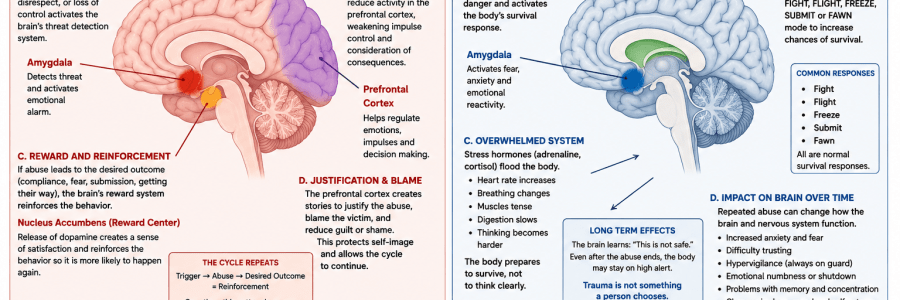
Anger itself is a normal human emotion. It is part of the brain’s natural threat-detection system and often appears when something feels unfair, unsafe, or overwhelming. However, not all expressions of anger are the same. From a neuroscience perspective, anger is regulated through the interaction between emotional and thinking systems in the brain: AmygdalaPrefrontal Cortex… Read More FAQ: Is this normal anger or is it unhealthy or abusive?