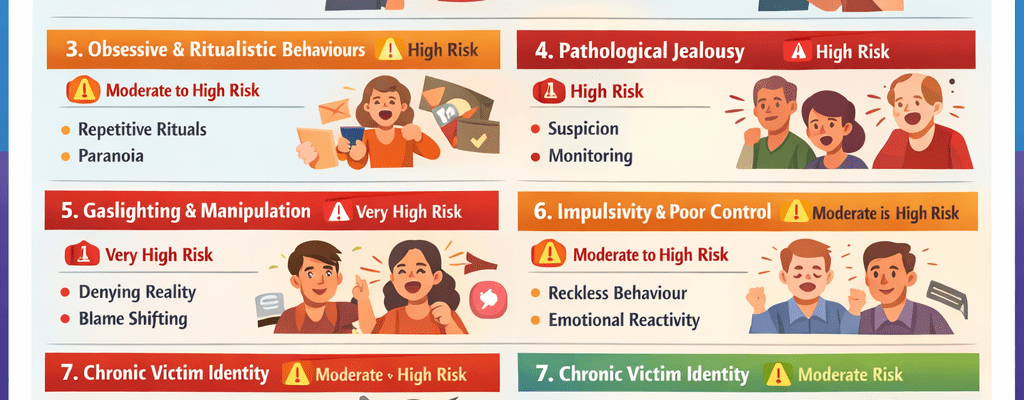
| Pattern | Typical Behaviour | Common Warning Signs |
|---|---|---|
| The Charmer | Uses charisma, compliments and generosity to build rapid trust. | Love bombing, excessive attention, moving the relationship very quickly, everyone says they’re “such a nice person.” |
| The Controller | Gradually takes control over decisions, finances, time or relationships. | Monitoring your phone, criticising friends, making rules, expecting permission, isolating you from support. |
| The Manipulator | Twists reality to create confusion and self-doubt. | Gaslighting, denying obvious facts, changing stories, making you apologise for their behaviour. |
| The Financial Exploiter | Uses others for money, housing or resources. | Constant borrowing, expecting others to pay, avoiding responsibility, leaving debts or practical problems for others. |
| The Professional Victim | Always has a crisis that requires rescuing. | Every problem is someone else’s fault, repeated emergencies, guilt used as leverage, no personal accountability. |
| The Image Manager | Protects a perfect public reputation while behaving differently in private. | Charming in public, dismissive or cruel in private, highly concerned with appearances, uses reputation as a shield. |
| The Boundary Tester | Starts with small violations to see what will be tolerated. | Ignoring “no,” unwanted touching, reading messages, showing up uninvited, pushing limits repeatedly. |
| The Intermittent Reinforcer | Alternates affection and withdrawal to create uncertainty. | Hot and cold behaviour, disappearing and returning, mixed messages, promises followed by silence. |
| The Isolator | Gradually reduces your independence and support network. | Criticising family and friends, creating conflict, encouraging dependence, making you feel guilty for seeing others. |
| The Smear Campaigner | Protects themselves by damaging someone else’s credibility. | Telling different stories to different people, portraying themselves as the victim, recruiting others to take sides. |
What Neuroscience Tells Us
Predatory and manipulative behaviour often exploits normal human brain processes:
- Dopamine keeps people hoping that “things will go back to how they were.”
- Oxytocin increases trust and attachment, making it harder to leave.
- Cortisol (the stress hormone) keeps the nervous system in a state of hypervigilance and confusion.
- Intermittent reinforcement—unpredictable rewards mixed with rejection—creates particularly strong emotional attachments.
Red Flags to Watch For
✔ Their words and actions rarely match.
✔ They move very quickly or constantly create urgency.
✔ They expect special treatment but avoid responsibility.
✔ They isolate you from people who challenge their behaviour.
✔ They appear wonderful in public but leave you feeling anxious, guilty or diminished in private.
✔ They repeatedly ignore boundaries and then tell you that you’re “too sensitive.”
✔ Multiple people describe similar experiences over time.
The Most Important Question
Rather than asking:
“Is this person a predator?”
Ask:
“How do I consistently feel after spending time with them?”
Do you feel:
- Safe or anxious?
- Respected or controlled?
- Heard or confused?
- Free to be yourself or constantly walking on eggshells?
Healthy relationships regulate the nervous system and create safety. Harmful relationships create chronic uncertainty, fear and self-doubt.
Trust consistent patterns of behaviour more than isolated promises, apologies or public appearances.

