People look at the wedding photograph and ask the same question.
“Why the rush?”
Why the quick engagement?
Why the quick wedding?
Why leave behind a secure home, a career, friends and family to move to another country?
Looking back now, the answers seem painfully obvious.
At the time, they were invisible.
That is the nature of psychological manipulation.
Hindsight Is Not the Same as Foresight
One of the cruellest aspects of coercive control is that survivors often blame themselves for not seeing what everyone else notices years later.
Psychologists call this hindsight bias—the tendency to believe events were obvious after they have already happened.
When people hear the whole story, they say,
“Of course.”
“The signs were there.”
“How could you not know?”
But they are seeing the completed puzzle.
The survivor only ever saw one piece at a time.
Abuse Is Rarely Introduced All at Once
Very few people would knowingly enter a relationship that promised emotional abuse, financial control and isolation.
Instead, control is introduced gradually.
A suggestion becomes an expectation.
An expectation becomes a rule.
A rule becomes normal.
Neuroscience tells us that the brain adapts remarkably quickly to repeated experiences. What initially feels uncomfortable slowly becomes familiar.
The extraordinary becomes ordinary.
The unacceptable becomes tolerated.
Isolation Changes Everything
Isolation is one of the most effective tools of coercive control.
Away from family.
Away from lifelong friends.
Away from colleagues.
Away from familiar routines.
Away from independent financial security.
The person who once had choices suddenly has far fewer.
This is not simply a change of geography.
It is a change in psychological power.
Without daily contact with people who know you, reality becomes easier to distort.
The controlling partner becomes the main source of information, approval and criticism.
The outside world slowly disappears.
Financial Dependence Is Psychological Dependence
Giving up a home.
Giving up a career.
Moving countries.
Combining finances.
Working to support a shared lifestyle.
These decisions often begin as acts of trust.
In healthy relationships they strengthen partnership.
In controlling relationships they increase dependency.
The psychology is straightforward: the fewer practical options someone has, the more difficult it becomes to leave.
Financial abuse is not only about taking money.
It is about reducing autonomy.
Every lost resource increases the perception that escape is impossible.
The Brain Learns to Survive
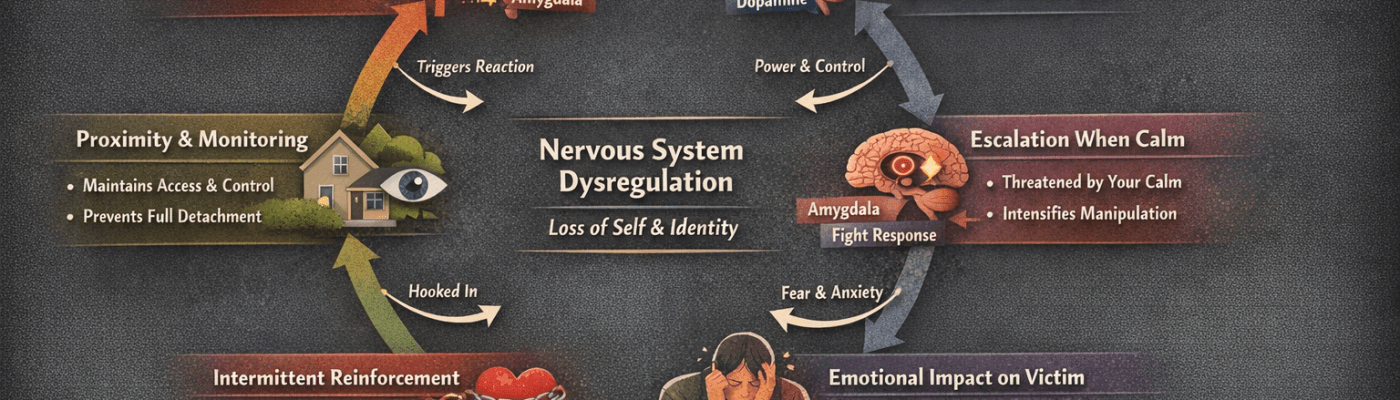
Over months and years, the nervous system becomes organised around avoiding conflict.
You stop arguing.
You stop asking questions.
You stop buying what you want.
You stop seeing people who might challenge the situation.
You stop trusting your own instincts.
Compliance becomes less a personality trait than a survival strategy.
To an outsider it may look like passivity.
To the brain, it is adaptation.
The Question That Is Hardest to Answer
Sometimes a thought appears that is impossible to ignore:
“If emotional control and financial control escalated over decades, where might it have ended?”
No one can know the answer to that question.
What matters psychologically is recognising that coercive control often follows a pattern of increasing restriction and increasing dominance if it is never challenged.
Many survivors only appreciate the seriousness of what they experienced once they are physically and emotionally safe enough to reflect on it.
Freedom Changes Perspective
Now people notice different things.
They notice someone who laughs.
Who speaks up.
Who buys what she wants.
Who drives her own car.
Who spends time with whoever she chooses.
Who no longer apologises for existing.
They say,
“You look so much more relaxed.”
What they are really seeing is a nervous system that no longer has to organise every decision around another person’s reaction.
The Greatest Illusion
People often imagine that survivors stay because they cannot see the truth.
The reality is far more complicated.
They stay because the truth arrives one small compromise at a time.
One criticism.
One lie.
One financial decision.
One sacrifice.
One move.
One apology.
One promise.
One more chance.
Until one day they wake up and realise that the life they built belongs almost entirely to someone else.
And then comes the most important realisation of all.
Leaving was never about choosing between comfort and discomfort.
It was choosing between continuing to survive and finally beginning to live.
Looking back, the pattern may seem obvious.
Living through it, one day at a time, it rarely is.
That is not a failure of intelligence or character.
It is a testament to the extraordinary ways the human brain adapts, hopes, and endures—even in circumstances it should never have had to endure at all.

