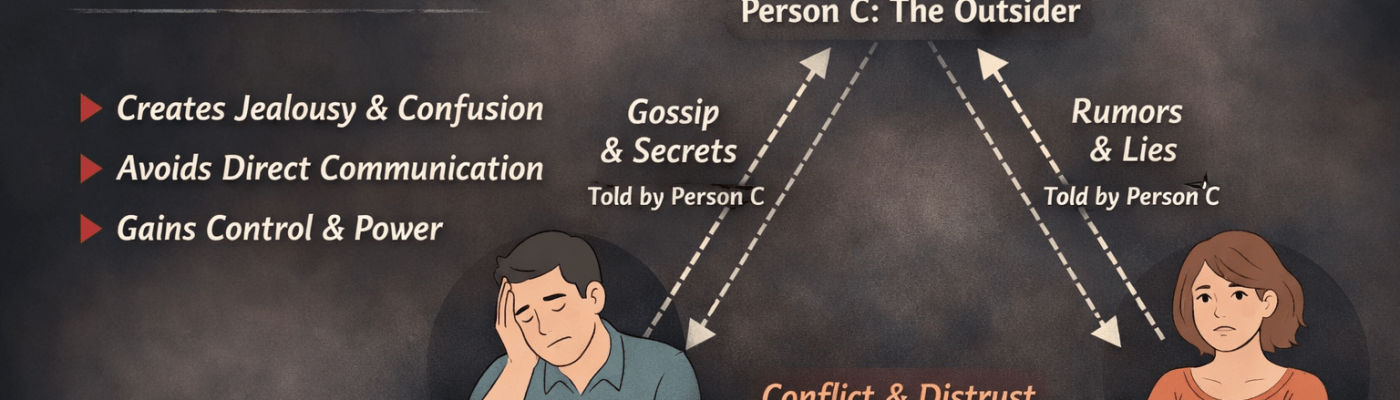
Why Some People Pull Others Into Conflict
Triangulation is a psychological manipulation pattern where a third person is deliberately pulled into a situation to create confusion, control, jealousy, power imbalance, or emotional instability between two people.
Instead of direct communication, a triangle is created:
Person A → Person B → Person C
Instead of:
Person A ↔ Person B
This pattern is emotionally destabilizing and psychologically harmful.
Why People Use Triangulation (Psychology)
Triangulation is driven by emotional insecurity and survival-based coping, not emotional maturity.
Common psychological drivers include:
1. Need for Control
By introducing a third party, the person:
- Controls information
- Manipulates perception
- Creates emotional chaos
- Gains power
Control restores psychological safety for insecure individuals.
2. Fear of Intimacy
Direct emotional closeness feels unsafe.
Triangulation creates:
Distance + distraction + emotional buffering
This avoids vulnerability.
3. Ego Protection & Self-Image
Rather than face:
- Accountability
- Shame
- Conflict
The person:
Shifts focus → Creates drama → Blames externally
This protects fragile ego structures.
4. Jealousy & Insecurity
Triangulation provokes:
- Competition
- Self-doubt
- Emotional imbalance
Which feeds:
Power + reassurance + validation
5. Attachment Wounds
Common in:
- Disorganized attachment
- Fearful-avoidant attachment
- Emotionally immature personalities
They learned early that direct communication was unsafe, so manipulation became survival.
The Neuroscience of Triangulation
When emotional threat is perceived, the amygdala (fear center) activates.
This:
- Reduces rational thinking
- Lowers empathy
- Increases impulsive control behaviors
The brain shifts from:
Connection mode → Survival mode
Triangulation is a fear-based coping strategy.
The brain seeks:
Emotional dominance → Reduced anxiety → Restored control
Not truth. Not resolution.
Common Triangulation Tactics
- Bringing a third person into private conflicts
- Comparing partners (“They understand me better than you”)
- Creating jealousy
- Passing messages through others
- Spreading stories
- Playing victim to outsiders
- Forming emotional alliances
- Withholding information
Goal:
Confusion → Doubt → Emotional imbalance → Control
The Psychological Impact on the Target
Triangulation causes:
- Confusion
- Self-doubt
- Anxiety
- Emotional instability
- Loss of trust
- Hypervigilance
- Trauma activation
This is emotional destabilization, not healthy conflict.
Triangulation vs Healthy Communication
Healthy communication:
- Direct
- Honest
- Transparent
- Boundaried
Triangulation:
- Indirect
- Manipulative
- Distorting
- Power-based
Who Commonly Uses Triangulation?
Seen frequently in individuals with:
- Narcissistic traits
- Borderline traits
- Insecure or disorganized attachment
- High emotional immaturity
- Control-based personalities
- Unresolved trauma
- Enmeshment patterns
⚠️ Not everyone who triangulates has a personality disorder — but it always indicates emotional dysregulation and insecurity.
The Core Truth
Healthy people resolve conflict directly.
Unhealed people create triangles.
How to Protect Yourself from Triangulation
- Insist on direct communication
- Verify information
- Do not engage in gossip
- Set clear boundaries
- Refuse to carry messages
- Stay grounded in facts
- Trust your nervous system
A Gentle Reality
People who triangulate are not trying to destroy others —
they are trying to regulate their own emotional chaos.
But their coping method creates harm.
Final Reflection
Triangulation is a sign of:
Emotional immaturity
Insecurity
Fear
Control-based attachment
Not love.
Not care.
Not emotional health.
 Linda C J Turner | Trauma Therapist & Emotional Healing Specialist