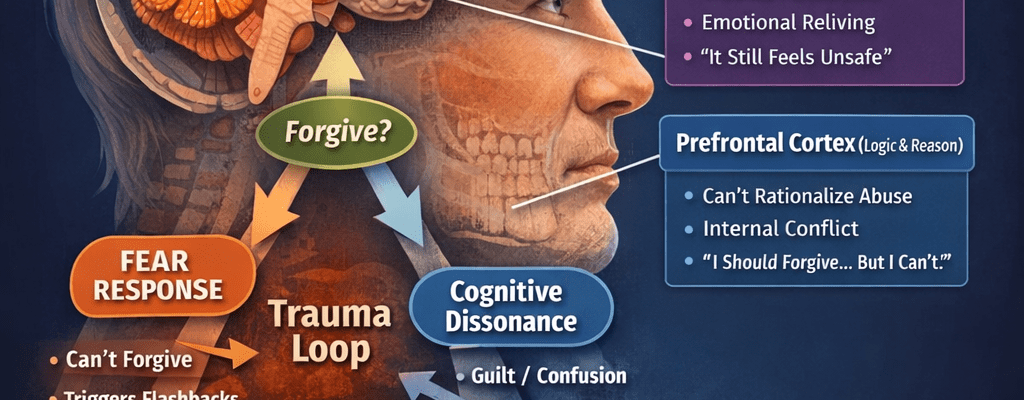
Forgiveness after abuse is not the same as forgiving a minor wrongdoing, and neuroscience and psychology explain why it’s often extremely difficult—sometimes impossible—without safety, repair, or accountability. Let’s break it down carefully.
🧠 Neuroscience & Psychology Behind Forgiving an Abuser
1️⃣ Trauma Hijacks the Brain
- Amygdala (fear center): Abuse sensitizes the amygdala. When the abuser is remembered, your brain reacts as if danger is present, triggering fight/flight/freeze responses.
- Hippocampus (memory & context): Trauma distorts memory. You relive abuse rather than recalling it as a past event, so emotional pain feels ongoing.
- Prefrontal cortex (rational thought): In abusive contexts, it becomes hard to rationalize or reframe the situation. Logical “I should forgive” thoughts conflict with a system wired for survival.
Result: Even if you want to forgive, your body and brain defend themselves automatically.
2️⃣ Abuse Breaks Trust at the Neural Level
- Abusers attack attachment systems, creating deep insecurity and mistrust.
- Oxytocin (bonding hormone) gets hijacked by trauma bonding, creating confusion and fear rather than safety.
- Dopamine/adrenaline cycles reinforce anxiety and hypervigilance when the abuser is remembered.
Result: Your brain is biologically wired to avoid forgiving, because forgiveness without safety signals danger.
3️⃣ Psychology of Accountability & Responsibility
Forgiveness usually requires:
- Recognition of harm by the abuser
- Genuine remorse and repair
- Safety that the behavior won’t repeat
Abusers rarely meet these conditions. Without this:
- Forgiveness becomes toxic, forcing the victim to relive trauma internally
- It’s not liberating; it’s suppressive
- Can reinforce guilt or self-blame
Psychological insight: Forgiving without accountability is emotionally coerced—you’re giving something your nervous system has not agreed to.
4️⃣ Moral & Emotional Boundaries
- Forgiveness does not mean reconciliation
- Your brain and psyche need boundaries to survive
- Trying to forgive an abuser while trauma persists can re-trigger PTSD, anxiety, depression, and hypervigilance
Key point: Forgiveness is meant for healing when the danger has passed, not while you’re still at risk.
5️⃣ Trauma Bonding & Cognitive Dissonance
- Victims may feel pressure to forgive: “I should forgive to be kind/spiritual.”
- But trauma bonding creates internal conflict: “I love/hate this person.”
- Cognitive dissonance increases stress hormones (cortisol) and reinforces the impossibility of genuine forgiveness while the abuse imprint remains.
⚡ Bottom Line
Forgiving an abuser while abuse is ongoing or unaccounted for is neurologically and psychologically impossible.
- Your brain is wired for safety, survival, and trust restoration, not forced forgiveness.
- Trying to forgive too soon can be self-destructive, not healing.
✅ Healthy Alternatives
- Forgive yourself for being hurt
- Set boundaries and protect yourself
- Focus on healing rather than the abuser
- Therapy: EMDR, somatic therapy, trauma-informed CBT
- Validation of your experience rather than forcing forgiveness
Neuroscience truth: Healing does not require forgiving the abuser—it requires safety, repair, and reclaiming your nervous system. Forgiveness can only come much later, if ever, when your brain no longer signals threat.
 Linda C J Turner | Trauma Therapist & Emotional Healing Specialist