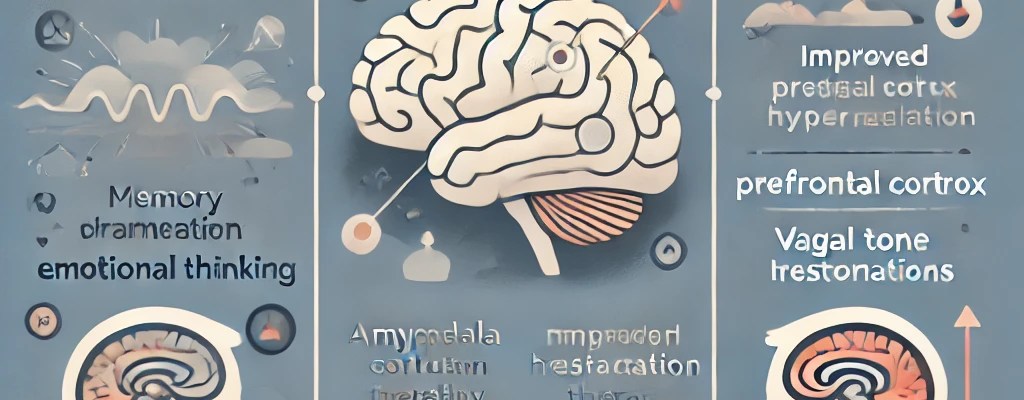
A Legal and Safeguarding Briefing**
For Courts, Social Services, Safeguarding Officers, and Legal Representatives
Summary:
Long-term exposure to coercive control, emotional deprivation, and relational intimidation produces well-documented neurological effects. These are not subjective experiences. They are measurable injuries that impact cognition, memory consistency, and threat appraisal — all of which are directly relevant to legal credibility, risk assessment, and safeguarding decisions.
This briefing outlines the major neurological consequences of chronic domestic abuse and their implications for evidence interpretation, survivor behaviour, and judicial decision-making.
1. Neurological Injury: The Impact of Chronic Abuse
Brain imaging research (Bremner et al.; McEwen; Teicher; van der Kolk) demonstrates that prolonged relational trauma can cause:
• Hippocampal Atrophy
- Reduced volume visible on MRI
- Disrupted episodic memory
- Impaired temporal sequencing
- Fragmented recall
• Prefrontal Cortex Suppression
- Difficulty with complex planning
- Impaired long-term decision-making
- Increased confusion under stress
• Amygdala Hyperactivation
- Heightened fear responses
- Hypervigilance
- Over-sensitivity to threat
Legal relevance:
These symptoms can affect the way survivors recall and report events. They are not indicators of dishonesty or instability — they are signatures of neurological trauma.
2. Coercive Control Behaviours That Produce Neurological Harm
The following behaviours are clinically recognized as risk factors for neurobiological injury:
- Prolonged silent treatment
- Repeated stonewalling
- Isolation within the home
- Unpredictable relational withdrawal
- Refusal to answer direct questions
- Intermittent reinforcement (cycles of punishment and reward)
- Intimidation through ambiguity (“You’ll never know, you’re guessing”)
These behaviours activate a sustained stress response comparable to chronic threat exposure.
Legal relevance:
Such tactics are not “communication problems.”
They constitute psychological violence and are linked directly to measurable harm.
3. Memory Inconsistency: A Predictable Trauma Symptom
Survivors of coercive control often show:
- inconsistent sequencing of events
- imperfect recall
- difficulty giving linear timelines
- fragmented memories
- cognitive fog
- situational confusion
In legal settings, these symptoms are sometimes misinterpreted as:
- fabrication
- exaggeration
- evasiveness
- lack of credibility
This is clinically incorrect.
These symptoms reflect injury to the hippocampus and prefrontal cortex, not dishonesty.
Every major trauma body (ISTSS, NICE, APA) warns courts against equating memory fragmentation with unreliability.
4. The Role of MRI Evidence
In some cases, survivors have objective neurological findings such as:
- reduced hippocampal volume
- signs of chronic stress on neuroimaging
- clinical symptoms aligning with long-term trauma exposure
Legal relevance:
MRI findings can substantiate the presence and duration of psychological abuse.
They support, but do not replace, behavioural and contextual evidence such as:
- documented coercive patterns
- witness statements
- isolation behaviours
- communication patterns
- financial control
- medical or psychological records
MRI scans provide objective corroboration, strengthening a survivor’s overall evidence profile.
5. Behavioural Presentations Commonly Misinterpreted in Court
Survivors may present with:
- flat affect
- emotional numbing
- delayed emotional responses
- confusion when questioned
- difficulty staying linear
- minimising or downplaying harm
None of these behaviours indicate:
- lying
- exaggeration
- instability
- unreliability
They indicate:
- chronic allostatic load
- neurological suppression of memory integration
- trauma-based survival adaptations
Legal systems must account for this to avoid incorrect credibility assessments.
6. Safeguarding and Risk Assessment Implications
Chronic coercive control is a strong predictor of:
- escalation to physical violence
- long-term psychological injury
- impaired functioning
- economic dependency
- increased vulnerability during separation
- post-separation coercion or harassment
Survivors with neurological trauma may require:
- additional time to process questions
- regulated conditions for interviews
- trauma-informed interviewing techniques
- protection from adversarial interrogation styles
- support with documentation and timelines
A failure to adopt trauma-informed methods may result in inaccurate assessments and unsafe outcomes.
7. Recommendations for Courts and Safeguarding Bodies
A. Treat fragmented memory as evidence of trauma, not deception.
This aligns with current clinical and forensic research.
B. Recognise coercive control patterns as cumulative harm.
Their severity increases over time.
C. Use trauma-informed interview protocols.
Linear recall should not be required from trauma-impacted witnesses.
D. Consider neurological evidence when available.
MRI findings can substantiate reports of long-term abuse.
E. Avoid misinterpreting emotional numbing or flat affect.
These are classic trauma responses.
F. Assess ongoing risk post-separation.
Coercive control often intensifies when the victim leaves.
Conclusion
Chronic emotional abuse and coercive control constitute a documented neurological injury, not merely a relational conflict. Understanding the neurobiology is essential for accurate:
- evidence interpretation
- credibility assessment
- safeguarding decisions
- risk evaluation
- judicial outcomes
Trauma-informed legal practice is not optional.
It is fundamental to ensuring safe, fair, and accurate assessments of cases involving domestic abuse.
 Linda C J Turner | Trauma Therapist & Emotional Healing Specialist