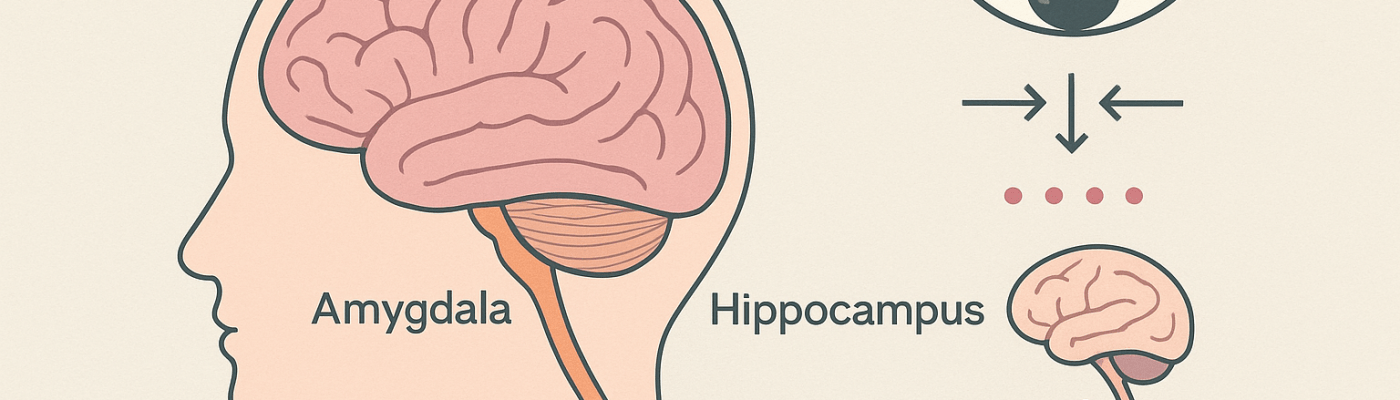
Let’s unpack how EMDR (Eye Movement Desensitization and Reprocessing) works through the lens of neuroscience and healing psychology.
🧠 1. The Core Idea
EMDR helps the brain reprocess traumatic memories that have been “stuck” in the nervous system — meaning they weren’t properly integrated at the time of the trauma because the brain went into survival mode (fight, flight, freeze, or fawn).
When a memory is stuck, it’s stored not as a normal narrative memory but as raw sensory fragments — sights, sounds, smells, emotions, and body sensations — that can later trigger flashbacks, anxiety, or physical tension.
⚡ 2. What Happens in the Brain During Trauma
During trauma:
- The amygdala (the brain’s alarm center) fires intensely, tagging the experience as dangerous.
- The hippocampus, which organizes memories in time and space, shuts down, so the memory isn’t filed away properly.
- The prefrontal cortex (responsible for logic and self-soothing) goes offline, leaving the person in pure emotional survival.
The result:
The traumatic memory is stored as if it’s still happening right now, rather than “something that happened in the past.”
👁️ 3. How EMDR Intervenes
EMDR uses bilateral stimulation (BLS) — typically eye movements, tapping, or alternating sounds — to engage both hemispheres of the brain while recalling the traumatic memory.
This rhythmic left-right stimulation mimics the natural processing that occurs during REM sleep, when the brain integrates emotional experiences.
Neuroscientifically, bilateral stimulation:
- Activates communication between the amygdala, hippocampus, and prefrontal cortex.
- Reduces the amygdala’s alarm response.
- Allows the hippocampus to re-file the memory as part of the past.
- Restores the prefrontal cortex’s control, bringing calm and perspective.
🧩 4. Memory Reprocessing
As the client focuses on a distressing image, thought, or body sensation while engaging in bilateral stimulation, the brain revisits and reprocesses the memory — but this time, in a safe and regulated state.
Gradually, the emotional intensity drops.
The memory loses its painful “charge” and becomes just another life event rather than a current threat.
Functional MRI studies show:
- Decreased amygdala activation (less fear).
- Increased prefrontal cortex activity (more regulation and meaning-making).
- Strengthened hippocampal integration (memory now contextualized as “past”).
🌱 5. Healing Mechanism — In Simpler Terms
You could say EMDR:
“Unfreezes” the stuck memory → “Replays” it safely → “Refiles” it correctly.
After successful EMDR:
- The body no longer reacts as if the trauma is happening now.
- The nervous system returns to balance.
- The client feels emotional distance, insight, and often forgiveness or peace.
🧬 6. Neuroscience Summary Table
| Brain Area | Before EMDR | After EMDR |
|---|---|---|
| Amygdala | Overactive, constant alarm | Calmer, perceives safety |
| Hippocampus | Fragmented, poor time/context | Integrated, memory filed correctly |
| Prefrontal Cortex | Offline, poor regulation | Re-engaged, logical and calm |
| Nervous System | Hypervigilant or numb | Regulated and balanced |
🌊 7. The Bigger Picture
EMDR works not by erasing memory, but by restoring adaptive information processing — the brain’s innate ability to heal itself when conditions of safety and dual attention are present.
It’s a neurobiological reset of trauma.


[…] that meet you exactly where you are.By blending powerful, evidence-based therapies such as EMDR (Eye Movement Desensitization and Reprocessing), CBT (Cognitive Behavioural Therapy), NLP (Neuro-Linguistic Programming), and […]
LikeLike