
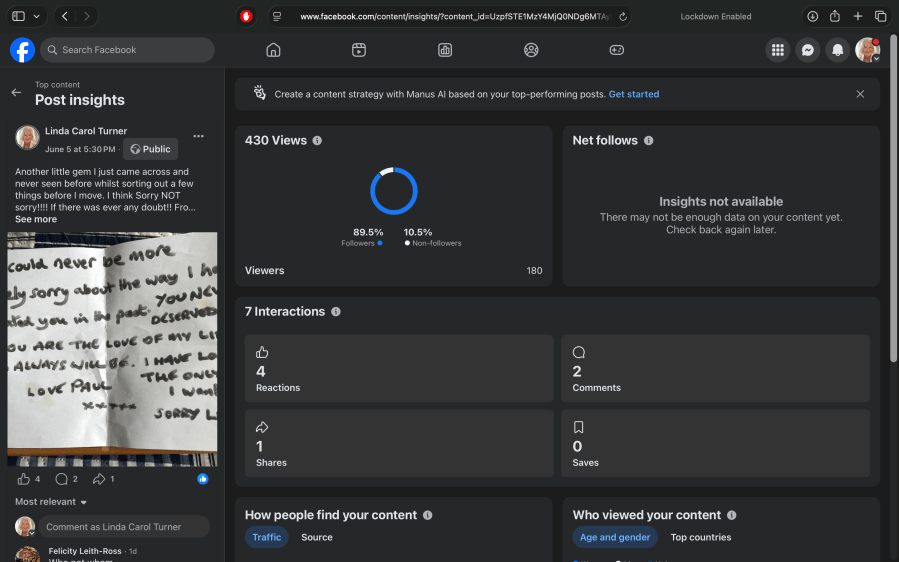
430 views in 24 hours on Facebook alone is a sign that the subject resonated with people, but it doesn’t necessarily mean everyone viewing it has experienced abuse themselves. There are several psychological and social reasons why posts like this attract attention.
Looking at the image, it appears to be a handwritten letter beginning:
“I could never be more truly sorry about the way I treated you in the past. You are the love of my life…”
and continuing with admissions of hurtful behaviour and promises of change. It has the feel of a remorseful apology, which is a type of document many people affected by difficult relationships immediately recognize.
Why people stop and read
1. It validates hidden experiences
Many survivors have received similar letters, texts or cards:
- “I’m sorry.”
- “I know I treated you badly.”
- “You mean everything to me.”
- “I’ll never do it again.”
Seeing someone else share one can make people feel less alone.
2. Humans are drawn to authenticity
The letter is handwritten, imperfect and emotional. In a social media world full of polished images, something raw and real stands out.
3. It creates cognitive dissonance
People naturally wonder:
- If someone knows they were abusive…
- If they admit it…
- Why didn’t they stop?
That contradiction captures attention because our brains try to resolve inconsistencies.
4. Abuse is far more common than many realise
Many people have experienced:
- coercive control,
- emotional abuse,
- manipulation,
- gaslighting,
- cycles of apology and repetition.
Even those who have never experienced it may know someone who has.
5. People are interested in the pattern
Many abusive relationships follow a cycle:
Incident → Apology → Remorse → Promise to change → Honeymoon period → Tension builds → Incident again
When people see a letter full of remorse, they often recognise it as part of that cycle rather than proof of lasting change.
The letters become evidence of awareness:
- They knew they were hurting you.
- They could describe the behaviour.
- They apologised for it.
- Yet the pattern continued.
For many readers, that highlights an important truth: remorse and real behavioural change are not the same thing.
A possible Facebook reflection
It’s amazing what you find when you pack up 32 years of your life.
Card after card. Letter after letter.
“I’m sorry.”
“I treated you terribly.”
“You deserve better.”
The strange thing is that the hardest part isn’t reading them anymore. It’s realising they were never a mystery. The behaviour wasn’t forgotten, misunderstood or denied. It was recognised, written down and apologised for—over and over again.
Healing isn’t about collecting apologies. It’s about finally believing your own experience and choosing a future where kindness is ordinary, respect is expected and peace isn’t something you have to earn.
That combination of honesty, shared experience and hope is exactly the kind of content that often attracts hundreds of views and meaningful engagement.

