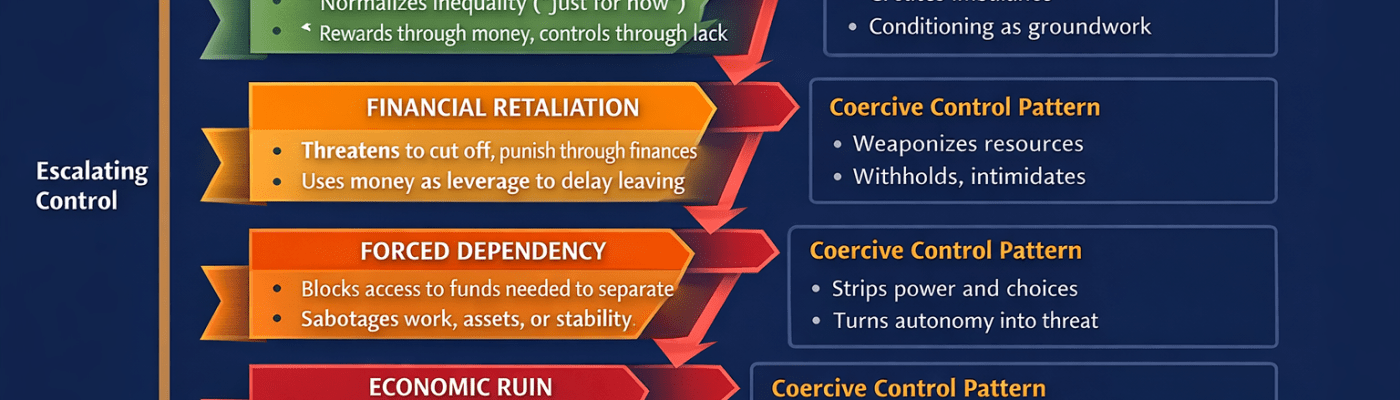
Here’s a clear, grounded definition of control, with concrete real-world examples, especially in the context of abuse, coercive control, and unhealthy power dynamics:
What is control?
Control is the systematic use of fear, pressure, threat, manipulation, or power to override another person’s autonomy, choices, safety, dignity, or freedom.
It is not disagreement.
It is domination.
Core forms of control
1. Threat-based control
“If you don’t stop, I will do something that harms you.”
Examples:
- Threatening legal action to intimidate
- Threatening to expose private information
- Threatening to take children, pets, money, or housing
- Threatening immigration, job loss, or reputation damage
- Threatening suicide or self-harm to manipulate behavior
This is coercion through fear.
2. Blackmail & extortion
“If you don’t comply, I’ll reveal / destroy / take something.”
Examples:
- Holding past mistakes, private messages, photos, or secrets hostage
- Using financial pressure
- Emotional blackmail: guilt, shame, obligation
This is psychological captivity.
3. Decision control
Making choices for you instead of with you.
Examples:
- Dictating where you live
- Deciding who you can see
- Controlling medical decisions
- Overriding therapy, legal, or personal boundaries
- Blocking access to money, transport, documents, or support
This removes personal agency.
4. Legal system abuse (post-separation control)
Using lawyers, courts, or legal threats to dominate, exhaust, or intimidate.
Examples:
- Filing excessive motions
- Threatening lawsuits to silence you
- Using restraining orders, custody battles, or immigration threats abusively
- Dragging out legal processes to drain finances & energy
This is called legal abuse or paper abuse.
5. Emotional domination
Using fear, guilt, shame, or obligation to shape your behavior.
Examples:
- “After everything I’ve done for you…”
- “You’re selfish if you don’t…”
- “You owe me”
- “You’ll destroy the family if you don’t comply”
This is coercive emotional pressure.
6. Surveillance & monitoring
Tracking, checking, monitoring, interrogating.
Examples:
- Reading messages
- Demanding passwords
- Constant checking of whereabouts
- Excessive questioning
- GPS tracking
- Monitoring social media
This destroys psychological safety.
7. Isolation control
Cutting you off from support.
Examples:
- Undermining friendships
- Creating conflict with family
- Discouraging therapy
- Smearing your reputation
- Making you afraid to speak
Isolation is one of the strongest tools of control.
8. Gaslighting (reality control)
Making you doubt your memory, perception, and sanity.
Examples:
- “That never happened”
- “You’re imagining things”
- “You’re too sensitive”
- “You’re unstable”
This is psychological destabilization.
Legal definition (coercive control)
In modern law (UK, Spain, EU frameworks):
Control = repeated patterns of behavior designed to dominate, restrict, intimidate, and remove autonomy.
It does not require physical violence.
Psychological control is abuse.
Simple test: Is it control?
Ask:
Am I being pressured through fear, threat, guilt, or force rather than free choice?
If yes → It is control.
The emotional impact of control
- Anxiety
- Hypervigilance
- Fear of consequences
- Decision paralysis
- Trauma bonding
- Loss of identity
- PTSD symptoms
Your nervous system recognizes control as danger.
Important truth
Healthy relationships do not require fear, pressure, threat, or domination to function.
Where control exists:
➡ Safety disappears
➡ Autonomy disappears
➡ Psychological harm begins
 Linda C J Turner | Trauma Therapist & Emotional Healing Specialist