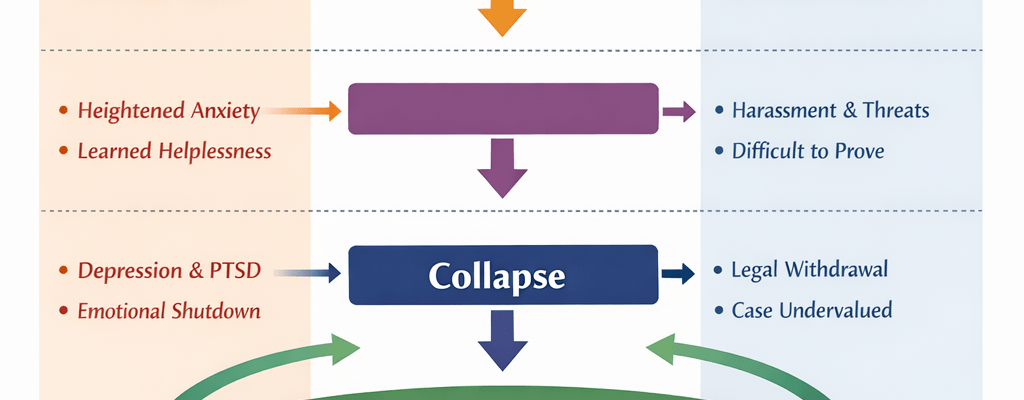
Step 1: Abuse
- Types: Emotional, psychological, financial, or physical harm.
- Neurological Effects:
- Chronic stress → sustained activation of amygdala and HPA axis → elevated cortisol.
- Hypervigilance: constant scanning for threats.
- Memory fragmentation: trauma memories stored in implicit memory.
- Dysregulated vagus nerve: affecting social engagement and calming capacity.
- Legal Effects: Initial reports may be ignored or minimized; protective measures may be requested.
Step 2: Family Denial
- Mechanisms:
- Minimization of abuse, refusal to acknowledge the survivor’s reality.
- Gaslighting: “It didn’t happen” or “You’re overreacting.”
- Neurological Effects:
- Confusion and cognitive dissonance → prefrontal cortex struggling to integrate reality with feedback.
- Intensifies trauma encoding → persistent fight-or-flight or dissociation.
- Emotional isolation → lower oxytocin, reduced sense of safety.
- Legal Effects:
- Hinders evidence gathering: witnesses are silent or biased.
- Can delay or obstruct protective orders or settlements.
Step 3: Escalation
- Mechanisms: Abuser or family uses denial to increase pressure, harassment, or threats.
- Neurological Effects:
- Heightened stress and cortisol → hippocampus shrinkage, impaired memory & decision-making.
- Learned helplessness may develop → decreased motivation to act legally or socially.
- Amplified fear responses → triggers amygdala-driven hyperarousal.
- Legal Effects:
- Escalation can be documented for legal purposes but may also be harder to prove if denial obscures facts.
- Psychological evidence may be critical: therapist notes, documented patterns.
Step 4: Collapse
- Mechanisms: Breakdown of coping strategies, overwhelm, or trauma-induced shutdown.
- Neurological Effects:
- Autonomic collapse: parasympathetic shutdown → exhaustion, depression, dissociation.
- Risk of PTSD or complex PTSD if repeated cycles continue.
- Trust networks damaged → social withdrawal, relational isolation.
- Legal Effects:
- Survivors may disengage from legal systems temporarily → missed deadlines, loss of momentum.
- Courts may underestimate severity if survivor’s presentation is fragmented or silent.
Interaction with Silence as a Protective Strategy
- Protective Function: Reduces immediate conflict, shields nervous system from further arousal.
- Neurological Effects: Lowers acute stress response temporarily, allows internal processing.
- Trade-offs:
- Silence may perpetuate family denial, giving abusers or enablers space to continue.
- Legal consequences: lack of testimony/documentation may weaken case.
- Adaptive framing: Silence is temporary safety, not submission — ideally paired with safe recording of events.
 Linda C J Turner | Trauma Therapist & Emotional Healing Specialist