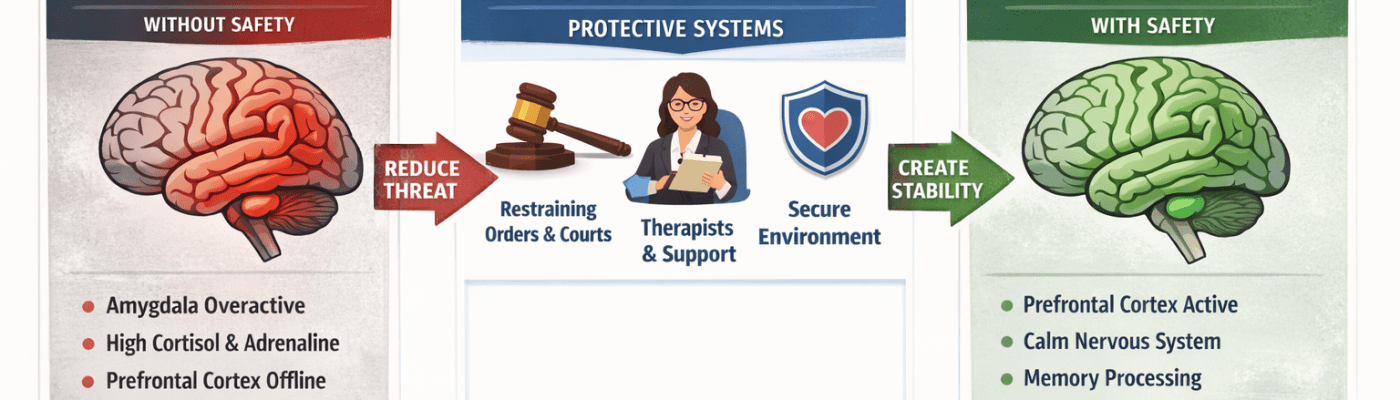
1. Enforcing One Boundary Rewires Safety Faster Than Insight
Key idea:
Action speaks louder than thought. The brain needs proof, not reasoning.
Mechanism:
- Prefrontal cortex enforces “I am in control here.”
- Amygdala receives reliable signals of safety: when a boundary is respected, threat circuits downregulate.
- Hippocampus updates memory: “Limits = effective, predictable, protective.”
Clinical/Legal translation:
- Documented boundary enforcement demonstrates intentional risk management.
- Courts/therapists can see behavioural consistency as evidence of safe self-regulation.
- Insight alone (recognizing danger internally) does not recalibrate the nervous system; observable action does.
Example:
- Saying “I will not discuss finances outside therapy” and withholding information until respected signals safety faster than thinking “I should set a boundary.”
2. Silence as the Final Neurological Boundary
Key idea:
Silence is not passive. It is active nervous-system regulation.
Mechanism:
- Removing verbal or emotional engagement stops feeding the abuser’s control loop.
- Prefrontal cortex says: “No further negotiation.”
- Amygdala receives repeated confirmation: lack of escalation = safe limit maintained.
- This is often the last and strongest signal the brain needs to recalibrate threat perception.
Clinical/Legal translation:
- Silence in response to repeated coercion demonstrates self-protection and dissociation from manipulative influence.
- Can be documented in therapy notes or court statements as non-escalatory defensive strategy, not compliance.
Example:
- After repeated harassment, remaining silent on calls or messages signals boundary enforcement without engagement, which is neurologically stabilizing.
3. How the Brain Knows It’s Safe to Feel Again
Key idea:
Safety is experienced first physiologically, then cognitively.
Mechanism:
- Vagus nerve activation → parasympathetic tone returns → calm.
- Amygdala activity reduces; stress hormones (cortisol, adrenaline) drop.
- Prefrontal cortex can re-engage with memory and emotion.
- Hippocampus reconsolidates fragmented memory into narrative memory.
- Emotional circuits re-open for joy, grief, and attachment.
Clinical/Legal translation:
- Documented evidence of consistent, safe environments allows therapists to justify reintroduction of affect regulation techniques.
- Courts may consider evidence of prolonged no-contact and stability as a marker that the individual can safely process trauma without immediate threat.
Example:
- After leaving an abusive household and having consistent independent living, a client experiences grief or joy without triggering panic — nervous system confirms safety has arrived.
Integrated Timeline: Neuro-Therapeutic Map
- Boundary enforcement: Initiates neurological proof of safety → starts threat recalibration.
- Repetition: Confirms pattern → strengthens prefrontal regulation over amygdala.
- Silence: Stops external manipulation → finalizes recalibration, preventing false signals of attachment.
- Autonomous safety: Nervous system now able to integrate previously overwhelming memories → feelings resurface naturally (grief, relief, joy).
Outcome:
- Nervous system no longer reacts to abuser’s manipulations.
- Emotional regulation is restored.
- Behavioral autonomy is reinforced.
- Self-trust is rebuilt.
Summary in Legal / Clinical Terms
Repeated, documented boundary enforcement, including strategic silence, provides observable evidence of self-protective behavior. Neurologically, this establishes safety pathways in the nervous system, reduces threat response, and allows emotional processing to occur. In clinical settings, this demonstrates trauma-informed coping; in legal settings, it supports claims of independent decision-making, credible threat recognition, and protective actions.
 Linda C J Turner | Trauma Therapist & Emotional Healing Specialist