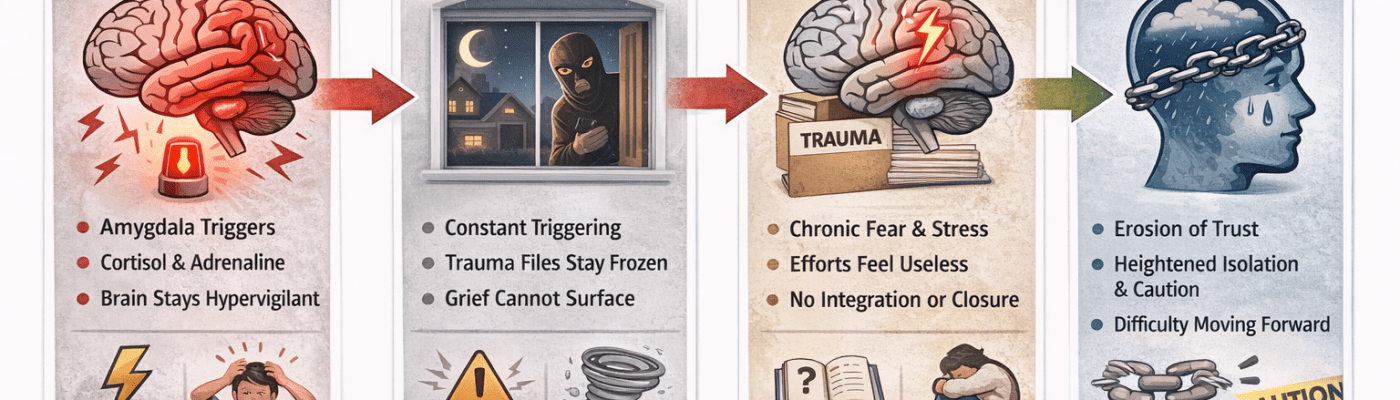
When family members join in the abuse — sending threatening emails, insults, or manipulative messages — it creates a compound trauma effect. This goes far beyond emotional pain: it directly affects the nervous system, memory processing, and psychological recovery. Here’s a neuroscience- and psychology-informed breakdown.
1️⃣ Safety Signals Are Undermined
Normal function: Family is usually the “safe base” for emotional regulation.
Impact of abuse from family:
- Amygdala perceives threat where it expected safety → hypervigilance spikes
- Brainstem activates fight/flight/freeze circuits → chronic stress
- Cortisol and adrenaline remain elevated, preventing parasympathetic downshift
Result: The nervous system cannot relax, which is necessary for trauma healing.
2️⃣ Trauma Memory Is Reactivated and Reinforced
- Threatening messages act as micro-traumas, repeatedly activating old trauma circuits
- Memory reconsolidation cannot occur because the nervous system interprets current abuse as ongoing danger
- Emotional responses (fear, anger, shame) become locked in, making integration of past trauma impossible
Neuroscience: Repeated activation of trauma circuits strengthens synaptic pathways that maintain hyperarousal and mistrust.
3️⃣ Core Trust and Relational Safety Are Eroded
- Family abuse attacks the relational system that supports co-regulation
- Oxytocin pathways (trust, bonding) are suppressed → forming safe attachments becomes harder
- Social withdrawal, hypervigilance, and caution toward others increase
Psychological effect: Feeling unsafe in the very people who should protect you blocks relational repair and support-based healing.
4️⃣ Identity and Self-Worth Are Threatened
- Insults and manipulation often target core identity and self-concept
- Prefrontal cortex (responsible for regulating emotion and rational thinking) is overwhelmed → emotional regulation is compromised
- Internalized messages may lead to shame, guilt, and self-blame, reinforcing trauma loops
Behaviorally: This can manifest as anxiety, depression, hyper-defensiveness, or emotional shutdown.
5️⃣ Healing Is Slowed or Stalled
- Grief and integration cannot proceed when the nervous system perceives ongoing threat
- Insight or therapy alone is insufficient → the body cannot “let go” or integrate trauma
- Chronic stress maintains fight/flight/freeze, keeping the trauma “live” rather than allowing closure
Summary: Each abusive communication re-traumatizes, essentially resetting the healing process.
6️⃣ Neuropsychological Summary
| System | Effect of Family Abuse |
|---|---|
| Amygdala | Hyperactive, threat detection escalates |
| Brainstem & Autonomic | Sympathetic dominance, chronic arousal |
| Prefrontal Cortex | Impaired regulation, rational integration blocked |
| Oxytocin/Trust Circuits | Suppressed, relational repair blocked |
| Memory Reconsolidation | Trauma remains unprocessed, frozen in nervous system |
7️⃣ Strategies to Protect Healing
Even with family abuse, you can protect your nervous system and recovery:
- External Safety: Legal protections, restraining orders, block email/phone contacts
- Psychological Safety: Safe therapy, trusted friends, co-regulation networks
- Nervous-System Regulation: Grounding, vagus-nerve exercises, somatic therapy, slow breathing
- Cognitive Boundaries: Recognize the abuse is about them, not your worth; maintain mental distance
- Reinforce Safety Anchors: Safe physical spaces, supportive relationships, routines
Recovery becomes possible when the nervous system experiences repeated signals of safety despite abuse from unsafe sources.
🔑 Key Insight
Family abuse is especially destabilizing because it attacks the very base of relational safety. Healing is stalled until external and internal safety are restored.
 Linda C J Turner | Trauma Therapist & Emotional Healing Specialist