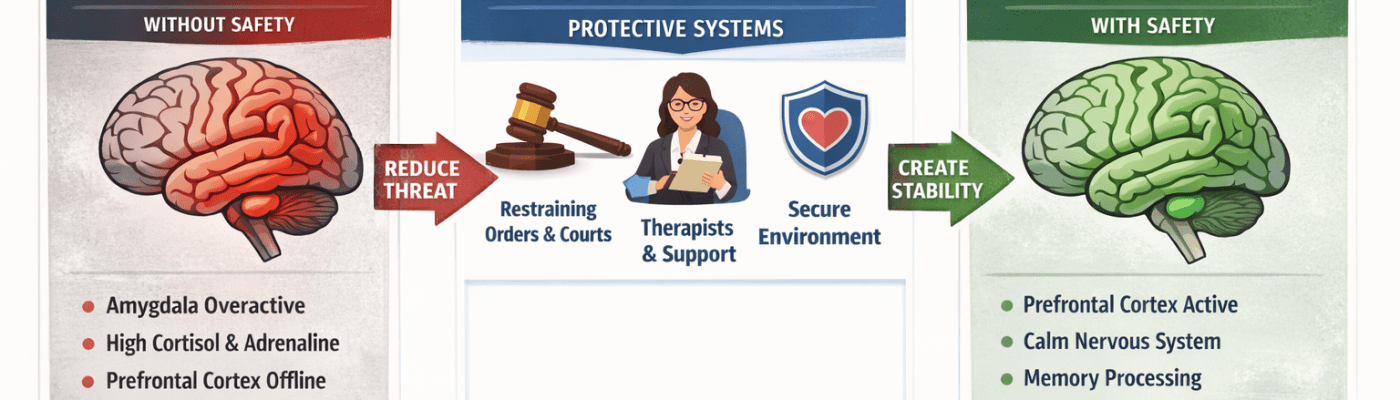
When someone continuously breaks a restraining order, it’s not just a legal violation — it’s a direct assault on the nervous system, and it profoundly affects trauma recovery. I’ll break it down using neuroscience and psychology, step by step.
1️⃣ SAFETY SIGNALS ARE DESTROYED
Neuroscience
- Trauma triggers hypervigilance: amygdala constantly scans for threat
- A restraining order is a clear safety cue: “I am protected; I am allowed to relax”
- When it’s repeatedly violated:
- Amygdala reactivates continuously
- Cortisol and adrenaline remain high
- Parasympathetic nervous system (rest-and-digest) cannot engage
Impact: The nervous system never settles, so healing pauses or reverses.
2️⃣ TRAUMA MEMORY REMAINS FROZEN
- Trauma processing requires safety for memory reconsolidation
- Repeated violations:
- Reactivate fear and hyperarousal
- Prevent integration of past trauma
- Keep trauma “live” rather than processed
Result: Emotional responses stay intense, and triggers become chronic.
3️⃣ HEALING STALLS
Psychological effects
- Anger cycles intensify → can become a holding pattern
- Grief cannot fully emerge → the system stays in protection mode
- Trust in self, others, and institutions erodes
- Insight is blocked → understanding alone cannot heal
Bottom line: Healing requires stability and predictability, which are undermined.
4️⃣ NERVOUS SYSTEM ADAPTATIONS
Repeated violation leads to:
- Hypervigilance: scanning for threats all the time
- Startle responses: overreactions to minor cues
- Dysregulated arousal: alternating between fight/flight and freeze
- Learned helplessness: feeling powerless to enforce boundaries
This can look like emotional shutdown, chronic anxiety, and avoidance behaviors.
5️⃣ PSYCHOLOGICAL CONSEQUENCES
- Erosion of trust in legal systems and support networks
- Increased self-blame or hyper-responsibility for “staying safe”
- Fear-based decision making, leading to isolation
- Difficulty moving forward or forming new relationships
Even small progress in therapy or self-regulation can feel fragile and unsafe.
6️⃣ WHY THIS BLOCKS MOVING FORWARD
- Recovery is not just about emotional insight — it’s embodied: the nervous system must experience safety repeatedly
- Continuous violations re-traumatize the system, keeping it in “survival mode”
- Effortful coping (journaling, therapy, self-care) is less effective under chronic threat
Neuroscience summary:
Safety allows integration → violation recreates threat → integration halts → healing stalls
7️⃣ STRATEGIES TO PROTECT THE Nervous System
Even if violations occur:
- Increase objective safety
- Call police immediately
- Update legal protections
- Document everything
- Reinforce perceived safety
- Supportive friends, therapists, or advocates
- Safe spaces and routines
- Self-protective boundaries
- Use nervous-system regulation tools
- Vagus nerve exercises (slow breathing, cold exposure, grounding)
- Movement, somatic therapy, mindfulness
- Stabilizing routines
- Maintain forward-looking focus
- Healing becomes slower but not impossible
- Small, incremental victories rebuild trust in your own agency
🔑 TAKEAWAY
Safety is the soil of healing. Continuous violations are like repeated floods — they wash away the foundations you’re trying to build.
Protecting your nervous system — legally, socially, and personally — is the only way to allow recovery to resume.
 Linda C J Turner | Trauma Therapist & Emotional Healing Specialist