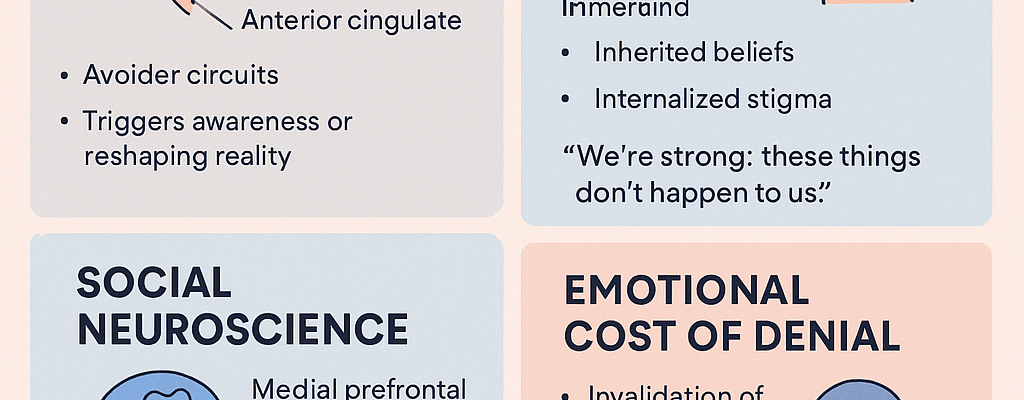
When a hidden truth or secret is revealed, the natural reaction is often shock, anger, or grief. But reframing the experience can transform it from trauma into empowerment, insight, and personal growth.
1. The Gift of Awareness
- Psychology: Awareness is the first step in regaining control. Carl Jung said, “Until you make the unconscious conscious, it will direct your life and you will call it fate.”
- Hidden truths, when revealed, remove illusions, allowing the brain to stop predicting danger incorrectly.
- Neuroscience:
- The prefrontal cortex engages to evaluate new information, integrating it with prior knowledge.
- The amygdala initially triggers fear or stress, but conscious awareness allows regulation of this response.
- Benefit: You can now make choices based on reality rather than assumptions, intuition, or misinformation. Awareness is literally a neural reset, enabling rational decision-making and recalibration of trust.
2. An Opportunity for Growth
- Emotional Growth:
- Processing the truth activates emotional learning circuits in the hippocampus and anterior cingulate cortex.
- It strengthens resilience as you practice tolerating uncertainty, grief, or anger without becoming overwhelmed.
- Self-Awareness:
- Awareness of deception highlights personal boundaries, needs, and values.
- It provides a mirror: you can see what you truly want in relationships, work, or life.
- Neuroscience:
- Exposure to controlled stress (truth discovery) engages the HPA axis, releasing cortisol briefly, which primes learning.
- Over time, the brain encodes new patterns of threat vs. safety, reinforcing adaptive behaviors.
- Benefit: Each confrontation with reality is like strength training for the nervous system: stress is endured, regulated, and learned from.
3. A Chance to Reclaim Your Life
- Psychology:
- Secrets or deception trap people in cognitive and emotional loops: doubt, rumination, and anxiety.
- When the truth surfaces, these loops are interrupted, allowing conscious narrative construction.
- Narrative Identity:
- According to narrative psychology, we construct our identity through the stories we tell ourselves.
- Revealed truth provides the raw material to rewrite your life story, choosing alignment with authentic desires rather than imposed illusions.
- Empowerment:
- You can set boundaries, release toxic influences, and prioritize relationships or activities that nurture your wellbeing.
- The sense of agency is restored; your nervous system registers safety and control where previously there was uncertainty.
4. Additional Deep Reframes
Truth as a Compass
- Every revelation points to what is healthy vs. unhealthy.
- Pain is not punishment — it’s a signal guiding decisions about relationships, work, or life direction.
Truth as Catalyst for Authenticity
- Facing deception or betrayal strips away facades.
- You are freed to live in accordance with your values, not others’ manipulation or social pressures.
Truth as a Reset Button
- Neural circuits previously conditioned to false assumptions can now rewire.
- Learning to trust your intuition again and identify safe, consistent patterns becomes possible.
5. Practical Steps for Reframing
- Pause and Breathe: Allow initial emotional activation (amygdala response) without reacting impulsively.
- Label Emotions: Name feelings (anger, grief, relief). This engages the prefrontal cortex, regulating intensity.
- Identify Lessons: Ask: “What boundaries, self-knowledge, or choices does this truth reveal?”
- Take Action Aligned With Values: Make decisions that restore your sense of agency and autonomy.
- Integrate Gradually: Reflection, journaling, or therapy solidifies new patterns and emotional resilience.
Summary
Reframing the revelation transforms hidden truths from a source of trauma into a tool for empowerment:
- Awareness: frees you from illusions, enabling rational and aligned decision-making
- Growth: strengthens emotional intelligence, resilience, and self-awareness
- Reclamation: restores narrative control, agency, and the ability to live authentically
Ultimately: The pain of truth is temporary; the empowerment it creates is lasting.
The nervous system learns to trust reality again, relationships improve, and life can be navigated with clarity, courage, and wisdom.
 Linda C J Turner | Trauma Therapist & Emotional Healing Specialist