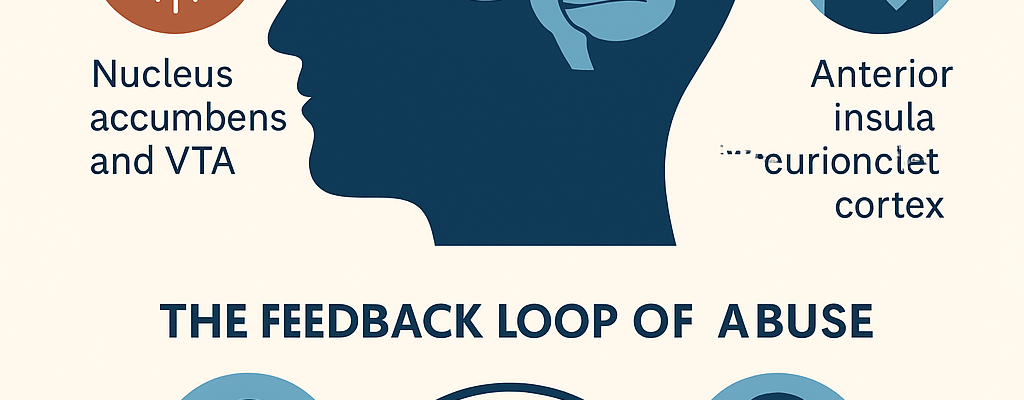
Here’s a neuroscience-informed explanation of behavioral choice pathways, specifically in the context of abusive or manipulative behavior. This framework emphasizes that abuse is a deliberate, neurologically reinforced choice rather than a symptom or accident.
1. Key Brain Circuits Involved
| Brain Region | Function in Behavioral Choice | Implication for Abuse |
|---|---|---|
| Prefrontal Cortex (PFC) | Executive function, planning, decision-making, inhibition | Enables abuser to strategically plan and conceal harmful actions; can suppress impulses to act “randomly” |
| Nucleus Accumbens (Ventral Striatum) | Reward processing, dopamine signaling | Activation when witnessing/control of others’ suffering reinforces abusive behavior through pleasure pathways |
| Anterior Insula / Anterior Cingulate Cortex | Emotional empathy, awareness of others’ feelings | Reduced activation allows abuser to ignore or dismiss victim’s distress without guilt |
| Amygdala | Threat detection, fear, and arousal | Can enhance excitement or thrill-seeking; hyperarousal may increase attention to victim’s reactions |
| Hippocampus | Memory and context | Encodes patterns of successful manipulation or reward, reinforcing learned abusive behaviors |
2. Behavioral Choice Pathway Overview
- Trigger / Situation
- A context presents an opportunity for dominance, control, or manipulation (e.g., disagreement, vulnerability, dependency).
- Cognitive Evaluation (PFC)
- The abuser evaluates potential actions, risks, and benefits.
- PFC allows strategic planning, weighing which abusive actions will maintain power or elicit reward.
- Reward Anticipation (Nucleus Accumbens)
- Brain anticipates dopamine release from victim’s compliance, fear, or distress.
- This reinforces the pleasure of controlling others, independent of external stressors.
- Empathy Suppression (Insula / ACC)
- Emotional concern for victim is reduced; guilt or moral reasoning is minimized.
- Allows deliberate cruelty without emotional inhibition.
- Action / Execution
- Abuser engages in coercion, manipulation, emotional abuse, or physical harm.
- Prefrontal planning ensures controlled, effective, and repeated behavior.
- Feedback & Reinforcement
- Positive reinforcement (victim compliance, perceived control, excitement) strengthens the neural circuitsassociated with abusive behavior.
- Over time, this creates a habitual pattern, making abuse more predictable and entrenched.
3. Implications
- Conscious Choice: Each step involves decision-making; abuse is not accidental.
- Neuroplasticity: Reward pathways are strengthened over time, reinforcing abusive habits.
- Accountability: Even if on or off medication, the abuser’s planning and reward circuits make behavior deliberate.
- Intervention Points: Therapy, legal constraints, or external consequences can disrupt reinforcement loops, but responsibility remains with the abuser.
4. Visual Concept
A simple behavioral choice pathway diagram could include:
Trigger / Situation
        │
        ▼
Cognitive Evaluation (PFC)
        │
        ▼
Reward Anticipation (Nucleus Accumbens)
        │
        ▼
Empathy Suppression (Insula / ACC)
        │
        ▼
Action / Execution (Abuse)
        │
        ▼
Feedback / Reinforcement (Dopamine, Learned Pattern)
        └───loops back to Cognitive Evaluation
This shows a closed-loop pathway where deliberate choices are reinforced by reward mechanisms, creating predictable abusive behavior.
 Linda C J Turner | Trauma Therapist & Emotional Healing Specialist