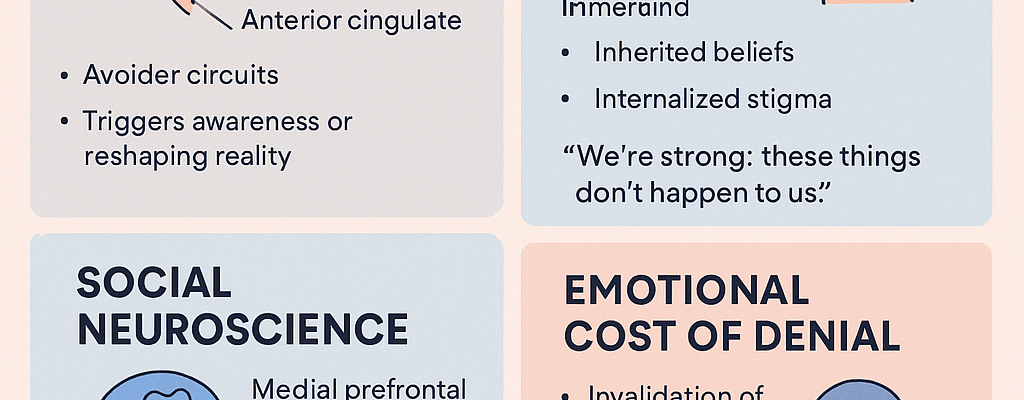
Neuroscience & Psychology Confirm This Is Real**
For decades people believed anxiety was “personality” or a child being “sensitive.”
But neuroscience and epigenetics show something deeper:
👉 Children can inherit anxiety and social difficulties — not just emotionally, but biologically.
👉 Trauma, fear, and stress experienced by parents and grandparents can change how a child’s brain develops.
This isn’t superstition.
It’s measurable science.
1. Epigenetic Inheritance: Trauma Leaves Biological Marks
Epigenetics studies how life experiences change gene expression.
When parents or grandparents go through:
- constant fear
- war or violence
- abuse
- emotional neglect
- chronic stress
- anxiety disorders
their stress response system can become dysregulated.
These changes can alter how genes turn “on” and “off.”
Those altered stress patterns can be passed to their children and grandchildren —
meaning the next generations inherit a nervous system already wired for anxiety.
Studies show trauma effects lasting 3 generations.
This is why a child may have anxiety even if their own life is safe.
2. The Developing Brain Absorbs the Mother’s Stress During Pregnancy
A mother’s emotional environment literally influences:
- fetal cortisol levels
- the developing amygdala (fear center)
- the vagus nerve (emotional regulation)
- the child’s stress sensitivity
If the mother was anxious, overwhelmed, or living in a stressful environment (even if she hid it), the child’s nervous system may be born more reactive.
This is not the mother’s fault — it is biology responding to survival signals.
3. The Stress System Becomes “Programmed” Across Generations
Chronic stress in parents or grandparents can lead to:
- an overactive amygdala
- an underdeveloped prefrontal cortex
- reduced oxytocin bonding
- hypersensitive fight/flight responses
A child in the next generation may then:
- worry excessively
- freeze in social situations
- avoid new environments
- struggle with confidence
- become hyperalert to tone or facial expressions
- expect rejection or danger even when none exists
This is the body following an inherited survival pattern.
4. Social Anxiety is Often a Family Pattern — Not a Choice
Children learn how to interact by watching the adults around them.
If a parent or grandparent:
- was afraid of conflict
- struggled socially
- avoided people
- was emotionally shut down
- was overly cautious
- lived in a household with tension or fear
the child may unconsciously absorb the same behavioural patterns.
This happens through:
- mirror neurons (copying behaviour)
- attachment conditioning
- emotional modeling
- nervous system synchronization
So social anxiety is not “shyness.”
It is learned + inherited neural programming.
5. Trauma Changes How the Brain Handles Relationships
Families with intergenerational stress or abuse often pass down:
- fear of judgment
- fear of rejection
- hypervigilance in social spaces
- poor emotional regulation
- difficulty trusting others
- trouble reading social cues
Children from these backgrounds may appear:
- withdrawn
- anxious
- “overly sensitive”
- avoidant
- easily overwhelmed
These are not flaws — they are survival adaptations passed through generations.
6. The Nervous System Remembers What the Mind Forgets
Even if a parent or grandparent never told their child about:
- past abuse
- traumatic relationships
- family violence
- emotional neglect
- humiliating childhoods
the nervous system remembers.
It passes down the patterns through biology and behaviour.
This is why a child may feel:
- anxious without knowing why
- overwhelmed in crowds
- nervous with authority figures
- uncomfortable with strangers
- fearful when someone raises their voice
The trigger is inherited, not chosen.
7. The Good News: These Patterns Are Reversible
The brain is plastic.
Epigenetic marks can soften.
Trauma responses can be rewired.
Children (and adults) can heal through:
- therapy
- nervous system regulation
- secure relationships
- positive social experiences
- mindfulness and breathwork
- stable, predictable environments
When one generation heals, the next one inherits that healing.
In One Sentence
Yes — children can inherit anxiety and social difficulties from parents and grandparents.
It is real, biological, and deeply rooted in neuroscience and psychology.
But the cycle can be changed.
 Linda C J Turner | Trauma Therapist & Emotional Healing Specialist