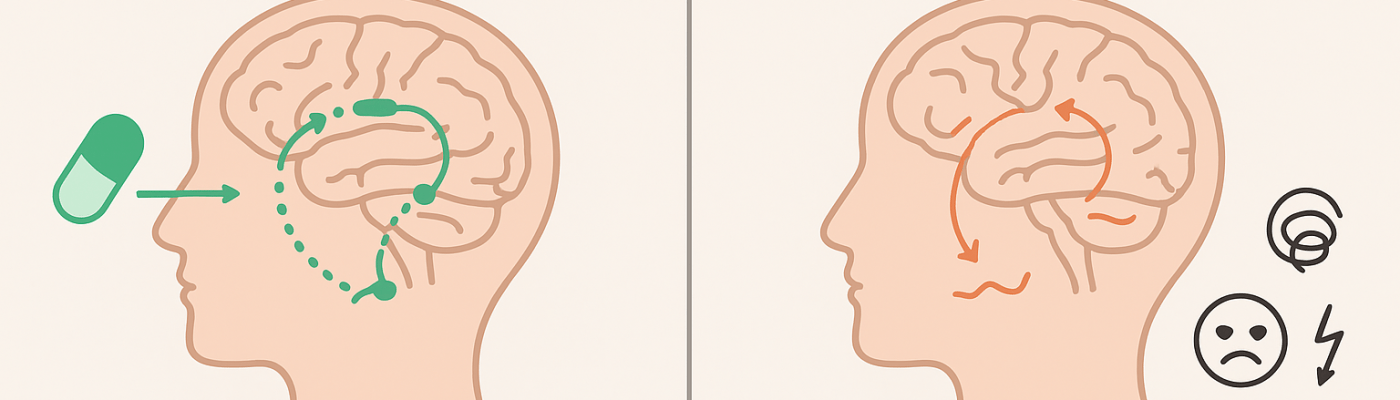
“Just because you try to erase the truth doesn’t mean it didn’t happen.”
Below is a psychological and neuroscientific explanation of what that erasure attempt does to the victim’s brain and emotional world — and why the truth always leaves traces in the body, memory, and nervous system.
🧠 The Neuroscience of Erased Truth
“Erasure” doesn’t delete the memory — it rewires the brain around the pain.
When someone denies, minimizes, or tries to rewrite what happened — especially after abuse — the victim experiences “reality invalidation.”
This isn’t just psychological; it creates measurable neurological stress.
1. The Brain’s Alarm System (Amygdala)
When truth is denied or twisted, the amygdala — the brain’s threat detector — fires as if danger is happening again.
Your body experiences the same adrenaline and cortisol surge as it did during the original event.
That’s why survivors often feel panic, shaking, or confusion when someone says, “It wasn’t that bad” or “You’re remembering wrong.”
The brain reads those words as attack, not conversation.
2. The Prefrontal Cortex (Reality Anchor)
The prefrontal cortex helps us make sense of events and form coherent stories.
When your truth is constantly contradicted, this region becomes overworked and shuts down under stress.
You begin to question your own perception — a state called cognitive dissonance — where your inner experience and outer messages don’t match.
Over time, this can lead to self-doubt, brain fog, and emotional paralysis.
3. The Hippocampus (Memory Integration)
Traumatic memories are stored differently than ordinary ones.
They are fragmented, sensory, and vivid — because the hippocampus, which organizes memory, is disrupted during trauma.
When someone denies your reality, the hippocampus can’t fully “file away” the event, keeping it in a half-processed loop.
This is why reminders or gaslighting can re-trigger flashbacks or nightmares: the brain is still trying to finish an interrupted story.
💔 The Psychology of Erasure: Gaslighting and Reality Collapse
1. Gaslighting
When abusers deny what they’ve done or rewrite events, it’s called gaslighting — a deliberate attempt to distort your sense of reality.
Research shows that chronic gaslighting causes disorientation, self-blame, anxiety, and even depersonalization(feeling detached from your own body).
The victim begins to internalize the abuser’s narrative, thinking: “Maybe it’s my fault. Maybe it wasn’t that bad.”
2. The Loss of Witnesses
When the people who knew — friends, family, professionals — are silenced or turned away, the survivor loses external validation.
Psychologically, this creates “testimonial isolation”: no one to confirm what happened, no one to hold the shared memory.
Without witnesses, the survivor’s mind bears the full weight of the truth alone — which can intensify symptoms of complex PTSD.
3. Fragmentation of Self
To survive the contradiction (“It happened” vs. “It didn’t happen”), the brain often splits emotional awareness from rational thought.
This coping mechanism — called dissociation — numbs pain in the short term but delays healing.
It’s like living in two timelines: the world’s version and your body’s version.
⚖️ Why the Truth Always Persists
Even if the world denies it, the body remembers.
- Somatic researchers (like Bessel van der Kolk, The Body Keeps the Score) show that trauma is stored in muscles, fascia, and the nervous system.
- Survivors often experience physical symptoms — insomnia, stomach issues, chronic pain — that correspond to unacknowledged experiences.
- When truth is finally validated, even privately, the body begins to release its defensive tension. The parasympathetic nervous system activates, allowing healing.
In neuroscience terms:
🧩 Suppression ≠ Erasure.
The memory remains encoded in the limbic system until it is acknowledged, processed, and integrated.
🌱 Healing: Reclaiming the Narrative
- Telling the truth — even to yourself — is neurological repair.
Every time you write, speak, or share your story, the prefrontal cortex re-links to the emotional brain, helping integrate the memory. - Validation rewires safety.
Being believed, even by one person, restores the social neural pathways that trauma and isolation damaged. - Body-based therapies (yoga, EMDR, somatic work) can help the brain safely reprocess what happened, so the event becomes a memory, not an ongoing alarm.
✳️ Closing Thought
You can’t erase the truth from a nervous system that lived it.
The body, brain, and psyche hold records far deeper than words or denials.
Attempts to rewrite history only prove how powerful the truth really is — because if it didn’t exist, no one would need to erase it.
 Linda C J Turner | Trauma Therapist & Emotional Healing Specialist