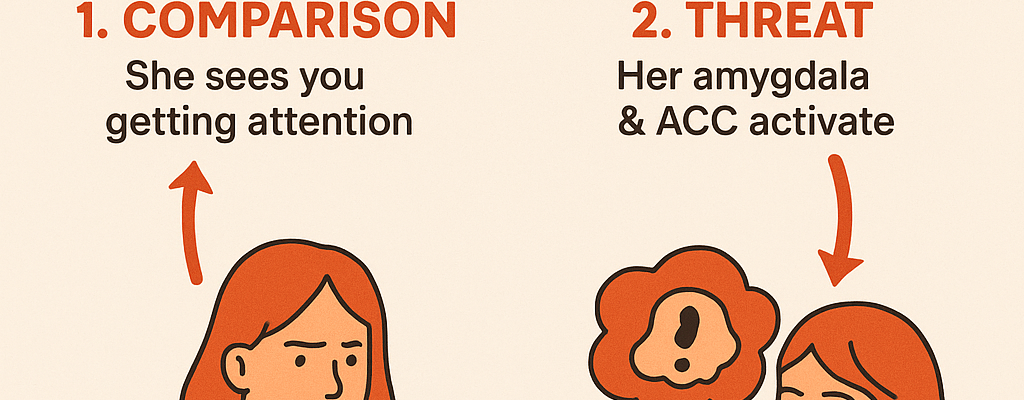
When someone sees you thriving or being noticed after leaving a relationship, their brain goes through a cycle similar to the classic envy loop, but with deeper emotional triggers tied to self-worth and belonging.
Step 1 — Comparison
They perceive your new attention as proof of your value.
“People want her now — maybe she’s more attractive, more confident.”
Their anterior cingulate cortex (comparison center) and reward system activate to measure “their” standing against yours.
Step 2 — Neural Discomfort (Threat)
The amygdala and insula trigger anxiety or shame.
“If she’s doing better, what does that say about me?”
This is a status threat response — the same circuitry used in social hierarchies or rivalry.
Step 3 — Rationalization / Defense
To calm that inner discomfort, the brain finds a story that protects their ego:
“She’s just desperate.”
“Everyone flirts with her because she’s trying too hard.”
This is cognitive dissonance reduction — reframing your success as something negative so they don’t feel inferior.
Step 4 — Insult or Undermining
The brain now externalizes the discomfort as hostility or mockery.
“Let’s cut her down a bit so I feel equal again.”
That’s the projection stage — transferring inner envy outward through sarcasm, gossip, or “jokes.”
💭 2. What’s Really Going On
- They’re not angry at you, they’re reacting to their own status anxiety.
- Your visibility reminds them of what they feel they’ve lost — youth, desirability, control, or power.
- Your newfound confidence or attention challenges their self-concept, activating ego threat.
This triggers the same dopamine drop and amygdala alarm as losing a competition — it’s social pain disguised as criticism.
🧩 3. Why the Insults Come
- Restoring equilibrium — by belittling you, they neurologically soothe the envy gap.
- Deflecting discomfort — humiliation of others quiets their own shame response.
- Reasserting dominance — social hierarchies in groups (especially ex-partner circles or jealous peers) depend on control through narrative.
So insults = a self-soothing mechanism for the insecure brain.
💬 4. Your Side of the Equation
When you’re glowing, exploring, and attracting new attention:
- Your dopamine and serotonin are rising again (novelty, validation, freedom).
- Your body language changes — more open posture, more eye contact, less guarded tone.
- People sense that energetic shift — which triggers admiration in some and jealousy in others.
It’s a neural feedback loop of liberation — but it can make others’ threat circuits flare.
🧘♀️ 5. How to Protect Your Peace
- Don’t internalize the insult. It’s projection, not truth.
- Avoid overexplaining or defending. That feeds their comparison loop.
- Stay grounded in your own dopamine–serotonin balance — keep focusing on meaning, not validation.
- Respond with empathy and boundary:“Sounds like that really bothers you — but I’m just living my life.”
This disarms the envy loop by removing the competition frame.
🧩 In short:
Their insult is the sound of their nervous system trying to equalize what your confidence exposed in them.
Envy disguises itself as judgment when admiration feels too threatening.
 Linda C J Turner | Trauma Therapist & Emotional Healing Specialist