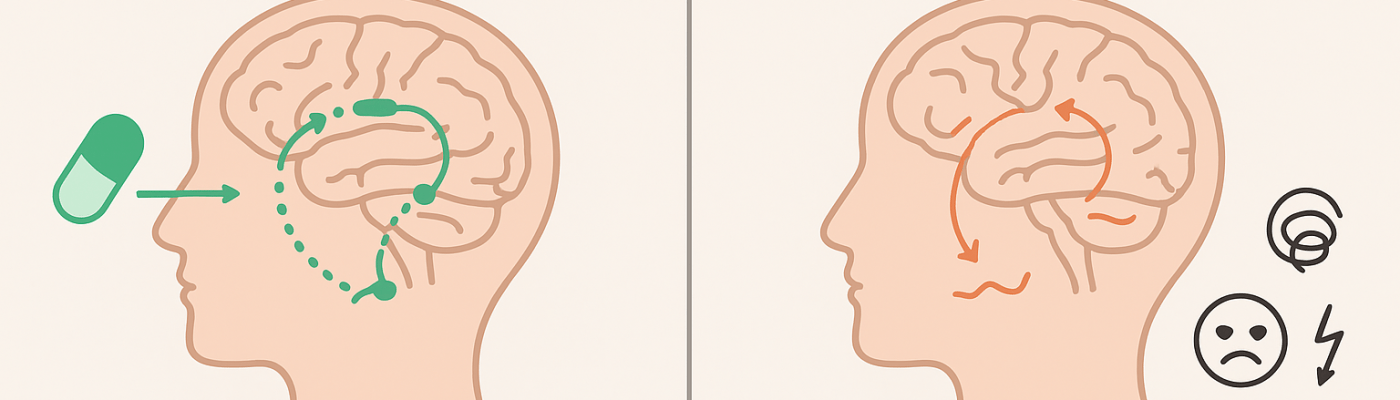
When someone repeatedly breaks a restraining order or keeps pursuing a victim despite the risk of arrest, they’re often driven by a combination of neurological dysfunction, emotional dysregulation, and learned behavior patterns — not simply “wanting punishment,” but an inability to regulate their impulses or tolerate loss of control.
Let’s unpack what’s happening in their brain, step by step, using neuroscience and psychology:
🧠 1. The Prefrontal Cortex: Impulse Control Breakdown
The prefrontal cortex (the brain’s executive control center) is responsible for judgment, impulse control, and understanding consequences.
In many abusers — especially those with traits of narcissism, antisocial personality disorder, or borderline traits — this region functions abnormally.
- They can intellectually understand that breaking the order leads to prison,
but their emotional brain overrides the rational one. - This is called “limbic hijacking” — when intense emotion (anger, obsession, shame) shuts down the logical circuitry.
- The result: they act on impulse, driven by emotion rather than foresight.
So, their brain’s “brakes” (prefrontal cortex) aren’t strong enough to stop the “engine” (amygdala and limbic system).
⚡ 2. The Amygdala: Obsession, Threat, and Control
In many chronic abusers, the amygdala — the brain’s threat detector — is hyperreactive.
When a victim leaves or enforces boundaries, the abuser’s brain interprets it not as normal separation, but as a loss of power or ego annihilation.
Neuroscientifically, this triggers:
- Rage and panic similar to survival fear.
- A surge of stress hormones (adrenaline, cortisol).
- Obsessive thinking and impulsive behaviors to “reassert control.”
In other words, their brain treats the loss of control like a physical danger — and they act out to regain psychological safety, even if it means self-destruction.
💣 3. The Reward System (Dopamine): Addiction to Control
Some abusers develop what’s called a “compulsion loop” — a form of behavioral addiction.
Every time they violate boundaries and get a reaction (fear, anger, or attention), their dopamine system releases a small “hit” of reward.
That neural reinforcement works just like gambling or substance addiction:
- Anticipation → dopamine rise.
- Action (breaking the order) → temporary relief or thrill.
- Consequences → shame or anxiety → craving for another hit of control.
This keeps the cycle going, even when it leads to punishment — because the act itself becomes neurologically rewarding.
🌀 4. Shame, Self-Destruction, and Punishment Loops
Paradoxically, some abusers unconsciously seek punishment.
Their brains are locked in a cycle of guilt, rage, and shame — especially if they have deep-rooted trauma or personality pathology.
When they feel powerless or exposed, the brain’s default mode network (which constructs self-image) floods them with shame.
But rather than tolerating that feeling, they project it outward — through aggression, control, or rule-breaking.
Some neuroscientists call this “self-sabotaging defense”:
When the inner pain is intolerable, the brain externalizes it — even if that means punishment — because punishment feels more manageable than shame.
So, breaking the order might feel like “at least I’m doing something,” even if it’s destructive.
🧩 5. Trauma and Emotional Immaturity
Many chronic abusers show patterns of early attachment trauma — emotional neglect, inconsistent caregiving, or abuse.
This disrupts the development of the prefrontal cortex and limbic regulation, leaving them with:
- Poor emotional tolerance (can’t handle rejection or loss)
- A craving for control to feel safe
- A distorted sense of self based on dominance, not connection
Neurologically, their brains never learned the pathways for empathy, accountability, or emotional regulation.
Instead, they default to control or collapse — dominance or despair.
⚖️ 6. The Illusion of Invincibility and the Risk–Reward Miscalculation
When the orbitofrontal cortex (the part that weighs reward vs. risk) is underactive — common in antisocial and narcissistic personalities — they literally underestimate risk and overestimate their ability to “get away with it.”
They might think:
- “They won’t really arrest me.”
- “I can talk my way out of it.”
- “They still care about me if I get a reaction.”
This distorted reasoning is not just arrogance — it’s impaired reward prediction circuitry, meaning their brain miscalculates the consequences.
🌱 7. In Summary: The Neuropsychology of Repeated Violation
When an abuser keeps breaking a restraining order:
- Their prefrontal cortex fails to regulate impulse.
- Their amygdala misreads boundaries as threats.
- Their dopamine system becomes addicted to control.
- Their self-concept is threatened, triggering shame and rage.
- Their risk–reward system malfunctions, making punishment seem irrelevant.
It’s a cycle of neurological chaos — driven by fear of powerlessness, not rational thought.
They don’t consciously want to be punished, but their brain’s wiring leads them to create punishment, because it’s the only way they still feel something or maintain the illusion of connection.
 Linda C J Turner | Trauma Therapist & Emotional Healing Specialist