The Psychology of Self-Deception: Why Living a Lie Leads to Emotional Suffering

Some people spend their lives constructing illusions — pretending, manipulating, performing — and then wonder why they feel hollow, anxious, or lost.Deception may protect the ego for a while, but it eventually corrodes the mind that sustains it.Living a lie isn’t just a moral problem; it’s a neuropsychological burden that keeps the brain and body in constant… Read More The Psychology of Self-Deception: Why Living a Lie Leads to Emotional Suffering

🧠 Neuroscience of Chronic Deception

When someone lives through deceit, manipulation, or chronic inauthenticity, it isn’t just a moral problem — it becomes a nervous system and identity disorder of sorts. Here’s what’s happening beneath the surface: 🧠 Neuroscience of Chronic Deception Lying and deceiving require constant cognitive control — the prefrontal cortex has to suppress truth, rewrite memory, and maintain the story.Over time, this: This… Read More 🧠 Neuroscience of Chronic Deception

🌿 How to Reset Your Nervous System After Mixed Signals

When someone’s words say “I care” but their actions say “I’m gone,” your body doesn’t just feel sad — it becomes confused at a biological level.The nervous system is wired to detect safety or threat, not maybe.Mixed signals keep it swinging between connection and rejection, flooding you with cortisol one moment and craving oxytocin the next.Healing means teaching your brain and body… Read More 🌿 How to Reset Your Nervous System After Mixed Signals

The Neuroscience of Mixed Signals: Why “Let’s Stay Friends” Hurts More Than Goodbye

When someone says “Let’s stay friends” and then disappears, it can feel like a quiet kind of heartbreak — confusing, painful, and strangely unfinished.You’re left wondering: Did they mean it? Did I do something wrong? Why does this feel worse than a clean break?Neuroscience and psychology give us powerful answers. 🧠 Your Brain Craves Predictability The human brain is… Read More The Neuroscience of Mixed Signals: Why “Let’s Stay Friends” Hurts More Than Goodbye

🧠 Neuroscience: What Happens in the Brain

When someone says “let’s stay friends” and then ignores you, your brain experiences a kind of prediction error — what you expect (continued connection) doesn’t match what happens (silence or rejection). This mismatch activates: Your brain had already mapped that person into its social reward circuitry — dopamine, oxytocin, and endorphins reinforced that bond. When they pull away suddenly, your brain… Read More 🧠 Neuroscience: What Happens in the Brain

🇪🇸 DIVORCE IN SPAIN INVOLVING DOMESTIC VIOLENCE

When a divorce in Spain involves domestic violence (“violencia de género”), the process is handled with special legal protections and urgency to safeguard the victim. Below is a clear overview of how it works — legally, practically, and emotionally. 🇪🇸 DIVORCE IN SPAIN INVOLVING DOMESTIC VIOLENCE 1. Immediate Protection Comes First If domestic violence has occurred, the family court (“Juzgado… Read More 🇪🇸 DIVORCE IN SPAIN INVOLVING DOMESTIC VIOLENCE

Drop the court case!

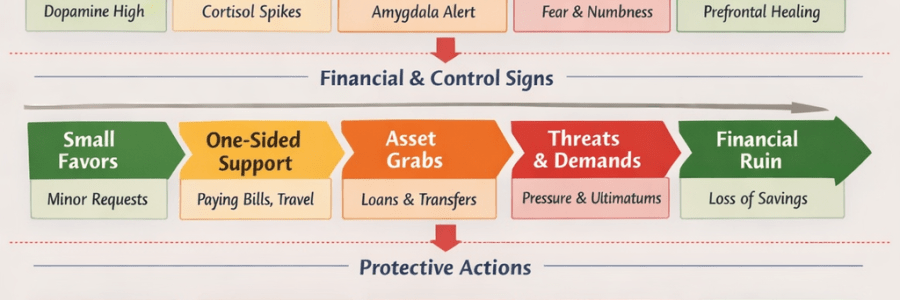
Demanding someone drop a court case and threatening they’ll “get nothing” in the divorce unless they do — can amount to coercive/controlling behaviour, threats, blackmail or undue pressure. It can be criminal and it will also affect family/civil proceedings (and the safety of the person pressured). Crown Prosecution Service+1 Below I’ve summarised what that means in practice,… Read More Drop the court case!

Putting someone under excessive pressure when they are suicidal — coercive control as a weapon

Summary When a person is suicidal, pressuring, threatening, shaming, or isolating them to get compliance is not only cruel — it is a form of coercive control that dramatically increases risk of self-harm and suicide. This behaviour exploits vulnerability, amplifies fear and hopelessness, and may be criminal in many jurisdictions. (See legal guidance and evidence… Read More Putting someone under excessive pressure when they are suicidal — coercive control as a weapon

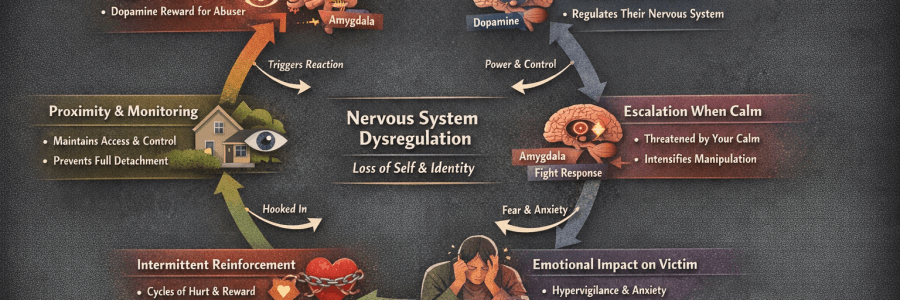
The Neuroscience of Coercive Control in Divorce: How Threats Hijack the Brain and How to Break Free

By Linda Carol When a relationship ends, it should bring space for calm. But for many survivors of coercive or emotionally abusive marriages, separation is not peace — it’s the beginning of a new battle for psychological freedom. Threats, intimidation, and manipulative contact often intensify just as the survivor tries to disconnect. Neuroscience helps us understand… Read More The Neuroscience of Coercive Control in Divorce: How Threats Hijack the Brain and How to Break Free

The Psychology of Digital Intimidation: Why Some Abusers Escalate During Divorce

By Linda Carol When a relationship ends, healthy people grieve, reflect, and eventually rebuild.Abusive people, however, often do something different: they intensify control.They move from affectionate texts to weaponized messages — from WhatsApp to email — using new channels to reassert power, rewrite the story, and destabilize the person trying to break free. This pattern is… Read More The Psychology of Digital Intimidation: Why Some Abusers Escalate During Divorce