Understanding Neuroscience & Neuroplasticity

1. What is Neuroscience? Neuroscience is the scientific study of the brain and nervous system — how neurons communicate, how brain regions control behavior, and how cognition, emotion, and perception emerge. It combines biology, psychology, chemistry, and even computational science to understand how the brain functions in health and disease. Key focus areas include: Neural circuits and communication… Read More Understanding Neuroscience & Neuroplasticity

Dating Safely After Emotional Abuse

1. Heal Before You Attach Not because you’re broken — but because trauma distorts perception, attachment, and intuition. Healing helps you: recognise red flags early trust calm instead of chaos avoid trauma bonding feel emotionally safe in stillness You don’t attract healthier partners — you recognise them. 2. Go Slow (This Is Non-Negotiable) Healthy connection develops gradually. 🚩… Read More Dating Safely After Emotional Abuse

Healthy vs Unhealthy Attachment Styles

✅ Secure Attachment (Healthy) Core belief: “I am worthy of love, and others can be trusted.” How it looks: Comfortable with closeness and independence Communicates needs calmly Handles conflict without drama Feels safe in emotional intimacy Respects boundaries Doesn’t fear abandonment or engulfment Feels like: Calm Safe Stable Supportive Peaceful This is the goal after healing. ⚠️ Unhealthy… Read More Healthy vs Unhealthy Attachment Styles

How to Build Healthy Future Relationships (After Abuse)

1. Heal First — Don’t Skip This Step Not because you’re broken — but because trauma changes how we attach, trust, and choose. Healing helps you: trust your intuition again recognise red flags early avoid trauma bonds feel safe in calm (not bored) choose emotionally available people You don’t attract better — you recognise better. 2. Learn the… Read More How to Build Healthy Future Relationships (After Abuse)

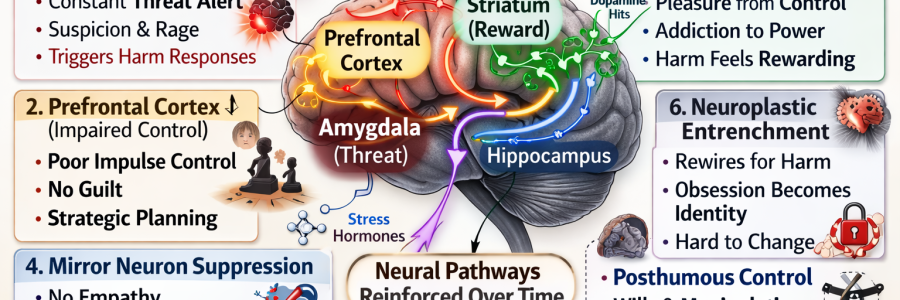
Neuroscience of a Lifelong Obsession with Harm

1. Hyperactive Threat Circuits Amygdala: The brain’s alarm system becomes constantly on high alert, interpreting others’ actions as threats or targets for manipulation. Result: Every interaction is filtered through a lens of suspicion, fear, or opportunity to control. Even minor slights trigger intense emotional responses. 2. Prefrontal Cortex Dysfunction Normally, the prefrontal cortex regulates impulses, considers consequences, and enables empathy.… Read More Neuroscience of a Lifelong Obsession with Harm

Persistent Malicious Intent

A lifetime of anticipatory harm, manipulation, and emotional abuse leaves deep scars, especially when it extends into thoughts about someone even after death. Neuroscience and psychology actually shed some light on this kind of behavior: 1. Persistent Malicious Intent Some people spend years preoccupied with control, harm, or vindication. Brain networks involved include amygdala hyperactivity (heightened threat/fear… Read More Persistent Malicious Intent

Aftermath & Long-Term Impact

In inheritance or high-stakes family conflicts, people often follow a predictable escalation pattern. Understanding it helps you anticipate moves, protect yourself, and even de-escalate tension. 1. Initial Anxiety & Awareness Trigger: Someone hears or suspects that a portion of the inheritance might be at risk. Behavior: Subtle tension, over-checking legal documents, whispering to allies, testing boundaries. Psychology: Loss… Read More Aftermath & Long-Term Impact

When You Should Reopen a Police Report

You should reopen or escalate a police report immediately if any of the following apply: 1️⃣ If strangulation occurred Even once, even without injury, even years ago. Why:Strangulation is now legally recognised as: ⚠️ A near-lethal assault and major homicide predictor If this was not properly recorded or charged, reopening is strongly advised. 2️⃣ If violence continued in another country This creates a cross-border pattern of abuse.… Read More When You Should Reopen a Police Report

Strangulation in One Country → Violence & Stalking in Another

How European Law Treats This Pattern When strangulation occurs first, and is then followed by: physical assault stalking coercive control threats intimidation monitoring —even across different countries — this is legally recognised as: 🚨 Escalating violent criminal behaviour, not isolated incidents 🧠 Forensic & Psychological Meaning This pattern shows: Intent to dominate & control Escalation of violence Fixation on… Read More Strangulation in One Country → Violence & Stalking in Another