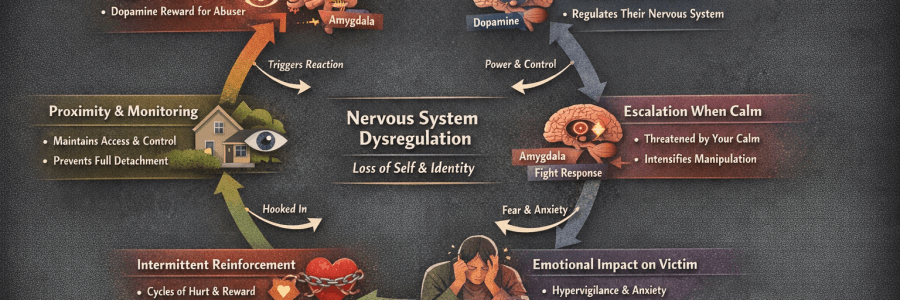
Erasing the Witnesses: The Neuroscience of Isolation in Abusive Relationships

By a survivor reclaiming her voice Seven people once knew the truth.My sister Anna, my best friend of thirty-four years Julia, my long-time friends Elena from Spain, Claire and Nina from France, my brother’s wife Catherine—my friend since we were thirteen—and my late brother Michael.And then, of course, the professionals: the doctor, the psychologist, and the gendarmes in France. All of them knew about the… Read More Erasing the Witnesses: The Neuroscience of Isolation in Abusive Relationships

Seven people know the truth.

Being cut off from friends and family, being isolated, being told not to talk to anyone — is unfortunately a very well-documented aspect of abusive relationships. The trauma, psychological dynamics, and neuroscience behind these dynamics are real and have been studied. 1. What abusers often do: isolation, control, cutting off witnesses Here are research-backed tactics… Read More Seven people know the truth.

Major Works by Alfred Adler

Alfred Adler (1870–1937) was an Austrian physician, psychotherapist, and the founder of Individual Psychology — a school of thought that emphasized human motivation, social belonging, and personal meaning rather than pathology or instinct. His ideas remain foundational in modern psychology, counseling, and even neuroscience-informed therapy. Here’s a concise overview of his key works and core ideas 👇 📚 Major Works… Read More Major Works by Alfred Adler

🧠 1. Social Comparison & Reward Circuits

The human brain constantly evaluates relative standing. So, seeing someone else’s abundance can feel like a mini loss in the brain’s reward balance. 💭 2. Symbolic Meaning of Food Food = safety, nurture, and emotional sufficiency. 🧩 3. Psychological Mechanisms at Play Mechanism Description Emotional Outcome Projection They disown their own insecurity and project it onto you (“you’re showing off”)… Read More 🧠 1. Social Comparison & Reward Circuits

🧠 1. Early Scarcity Rewires the Stress System

Growing up with material insecurity or social stigma chronically activates the amygdala–HPA axis (the brain’s threat circuit). So in adulthood, luxury or social advancement doesn’t just feel nice — it feels neurologically soothing, like relief from danger. 🧩 2. Psychology: From Inferiority to Overcompensation Alfred Adler called this the inferiority–superiority loop.When someone grows up feeling “less than,” they may swing… Read More 🧠 1. Early Scarcity Rewires the Stress System

🧠 1. Neuroscience: Reward, Power, and Security Circuits

🔹 Dopamine & Reward Prediction The dopamine system (nucleus accumbens, ventral tegmental area) drives us toward perceived reward.For some men, wealth itself becomes a symbolic reinforcer — it activates the same neural reward pathways as social status or sexual attraction. The brain links a wealthy partner with comfort, reduced effort, or higher social rank — triggering dopamine anticipation. This doesn’t… Read More 🧠 1. Neuroscience: Reward, Power, and Security Circuits

🧠 1. Neuroscience: Low Dopamine & Emotional Fatigue

When someone feels “tired” all the time — not just physically, but existentially — it often reflects dopamine depletion or chronic stress response. So when he says “I’m old, tired, and sick,” his brain might literally be signaling burnout or emotional depletion, not just age. 🧩 2. Psychological Interpretation: Emotional Withdrawal or Learned Helplessness If this phrase is repeated frequently, it… Read More 🧠 1. Neuroscience: Low Dopamine & Emotional Fatigue

🧠 1. The “Better Than the Last One” Trap — Contrast Bias

Your brain doesn’t evaluate people objectively — it evaluates them comparatively.When you’ve had a painful or toxic experience before, your prefrontal cortex and amygdala create a mental “reference point” for safety and danger. So when someone new shows slightly better behavior — a little kindness, a bit of respect — your brain lights up with relief: “Ah, this feels safer. Better. Maybe… Read More 🧠 1. The “Better Than the Last One” Trap — Contrast Bias

Let’s unpack Moral Disengagement (Bandura, 1999) clearly and deeply 👇

🧩 What It Is Albert Bandura — the same psychologist who developed Social Learning Theory — coined moral disengagement to describe how people disconnect their actions from their moral standards so they can behave unethically while still thinking of themselves as “good people.” In other words: “I know this is wrong, but I’ll convince myself it’s fine — so I can do… Read More Let’s unpack Moral Disengagement (Bandura, 1999) clearly and deeply 👇