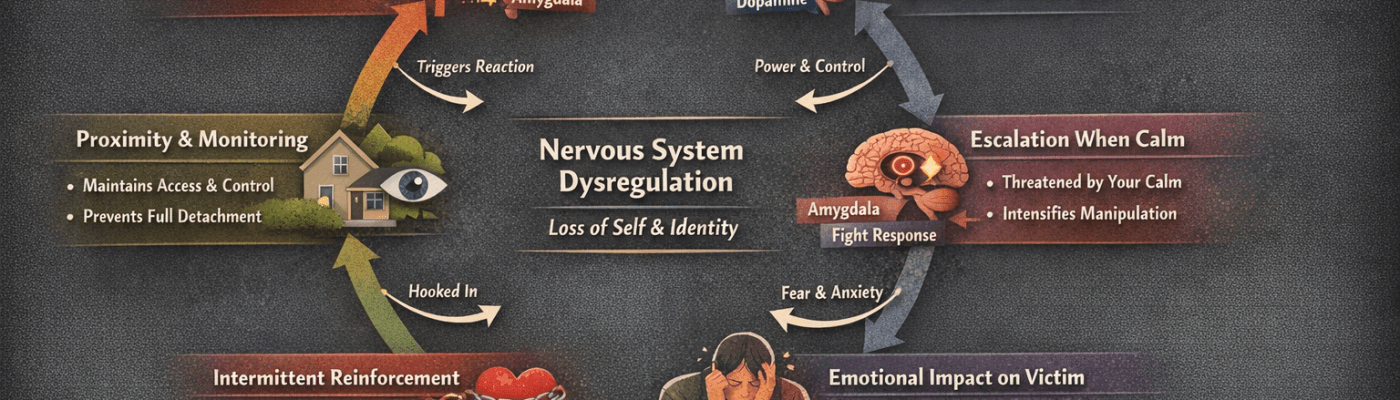
When antisocial traits are involved, disengagement is not relational — it is operational.
You are not leaving a mutual bond; you are exiting a system where you were an asset.
🧭 Core Shift (This Is Non-Negotiable)
You are not dealing with misunderstanding — you are dealing with entitlement.
There is no insight coming.
There is no repair coming.
There is no shared reality to negotiate.
Your goal is reduced access, not emotional resolution.
🔇 1. Cut Emotional Supply First (Before Distance)
With ASPD-type individuals:
- Emotion = leverage
- Information = power
You disengage by:
- Becoming emotionally flat
- Sharing nothing personal
- Avoiding reactions (positive or negative)
- Stopping all explanations
This is not coldness.
This is risk reduction.
📉 2. Never Signal Intentional Exit
ASPD-type individuals escalate when they sense:
- Loss of control
- Exposure
- Asset withdrawal (you, money, housing, status)
Do not announce boundaries.
Do not threaten departure.
Do not explain motives.
Disengagement should look like disinterest, not defiance.
🗂️ 3. Secure Assets Quietly and Early
Before distance increases:
- Separate finances discreetly
- Secure documents, passwords, backups
- Remove yourself from shared dependencies
- Ensure independent legal advice (not network-linked)
- Document behaviour factually and privately
Never assume fairness.
Plan for self-protection, not goodwill.
👥 4. Externalise Support — But Selectively
Do not rely on:
- Family members who minimise
- Mutual friends
- Anyone easily manipulated
Do rely on:
- Professionals trained in coercive control
- Trauma-informed therapists
- Advocates or lawyers with DV / high-conflict experience
Support must be containment, not conversation.
⚠️ 5. Expect Strategic Pushback
Common ASPD-type responses:
- Sudden charm or generosity
- Financial offers with strings
- Playing reasonable to outsiders
- Smear campaigns
- Legal or financial intimidation
- Calm threats masked as logic
This is not change.
It is containment failure on their side.
Your response:
Less contact.
More structure.
Zero engagement.
🛑 6. Boundaries Are Silent, Not Explained
With ASPD dynamics:
- Boundaries spoken = boundaries tested
- Justifications = openings
Effective boundaries look like:
- Delayed responses
- Short, factual replies
- No defence
- No emotional language
- Silence where possible
Silence removes reward.
🧠 7. Nervous System Recovery Is Part of Safety
After prolonged exposure to ASPD-type dynamics:
- Hypervigilance is common
- Self-doubt lingers
- Guilt may surface (this is conditioning, not truth)
Trauma-specific therapy (EMDR, somatic work) helps your system stand down from threat mode and recalibrate safety.
🔒 Final Reality Check
If you are dealing with ASPD-type traits:
- Closure is unsafe
- Confrontation is dangerous
- Empathy is irrelevant
- Distance is protection
The safest disengagement is the one they barely notice — until it’s already complete.
You are not required to explain your exit.
You are required to survive it.
 Linda C J Turner | Trauma Therapist & Emotional Healing Specialist