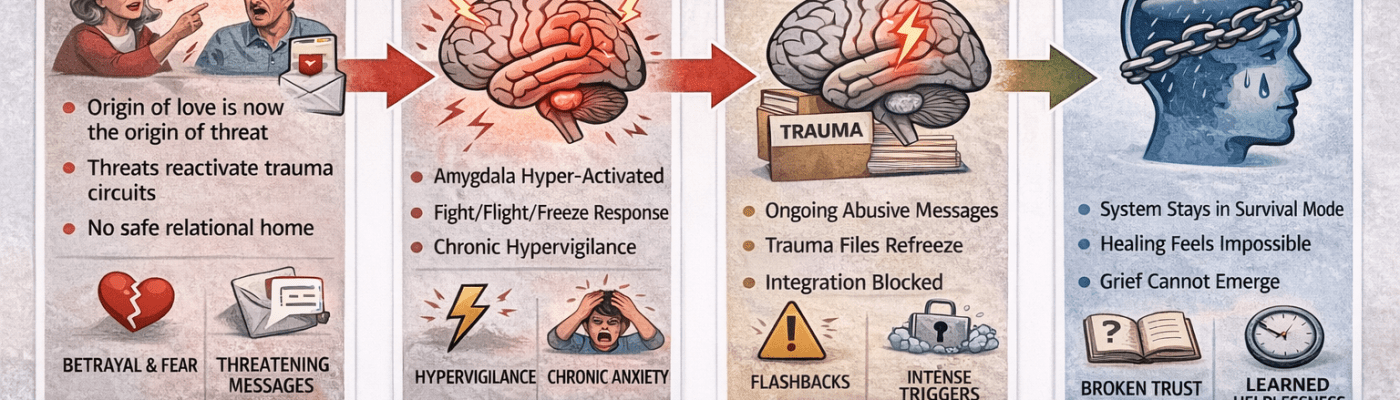
Why Police Protection is Paramount
- Escalation is Predictable and Biologically Driven
- As we’ve mapped, when an abuser loses control over their “reward loop” (via boundaries or silence), their nervous system can trigger intense, impulsive, and unpredictable behavior.
- Police protection ensures that this peak danger does not translate into physical or legal harm.
- Abuser Behaviour Can Become Erratic
- Impulse control decreases during the extinction burst.
- Attempts to regain control can include:
- threats
- property damage
- harassment
- attempts to manipulate or coerce through children, finances, or social systems
- Rapid intervention prevents harm before escalation intensifies.
- Immediate Risk Mitigation
- Law enforcement presence or enforceable protection creates a buffer between survivor and abuser.
- It allows the survivor’s nervous system to self-regulate safely.
⚖️ Why Courts Remain Vigilant
- Legal Oversight Supports Survivor Safety
- Courts monitor compliance with orders and ensure that boundaries are respected legally, not just socially.
- This reduces opportunities for the abuser to exploit gaps in surveillance or oversight.
- Prevention of Reward Re-establishment
- Any violation of restraining orders or court conditions reintroduces neurological reinforcement for the abuser’s cruelty.
- Court vigilance interrupts this cycle before escalation restarts.
- Documentation and Accountability
- Courts maintain official records of breaches, which can be critical if future actions escalate or criminal charges are warranted.
- This protects both the survivor and wider social systems.
🧠 Why Restraining Orders Remain in Place
- Boundaries Must Be Consistent
- Neurobiologically, abusers rely on predictable feedback.
- Removing access intermittently reverses extinction progress.
- Maintaining orders consistently prevents the abuser’s nervous system from regaining “reward” via engagement.
- Supports Survivor Nervous System Recovery
- Restricting contact reduces stress and cortisol spikes.
- Allows grief, clarity, and healing to proceed safely.
- Prevents “freeze” responses from being triggered repeatedly.
- Protects Children and Third Parties
- Orders are not only for the survivor but for anyone else at risk.
- Keeps the abuser’s impulses contained, reducing collateral harm.
🔑 Integrated Insight
- Police protection, court monitoring, and restraining orders are neurologically and legally protective, not punitive.
- They ensure that:
- the survivor remains safe during the highest-risk neurological phases
- the abuser cannot re-establish reinforcement loops
- escalation does not result in physical or emotional harm
In short: these protections are the structural “shock absorbers” that allow extinction bursts to fail safely.
 Linda C J Turner | Trauma Therapist & Emotional Healing Specialist